
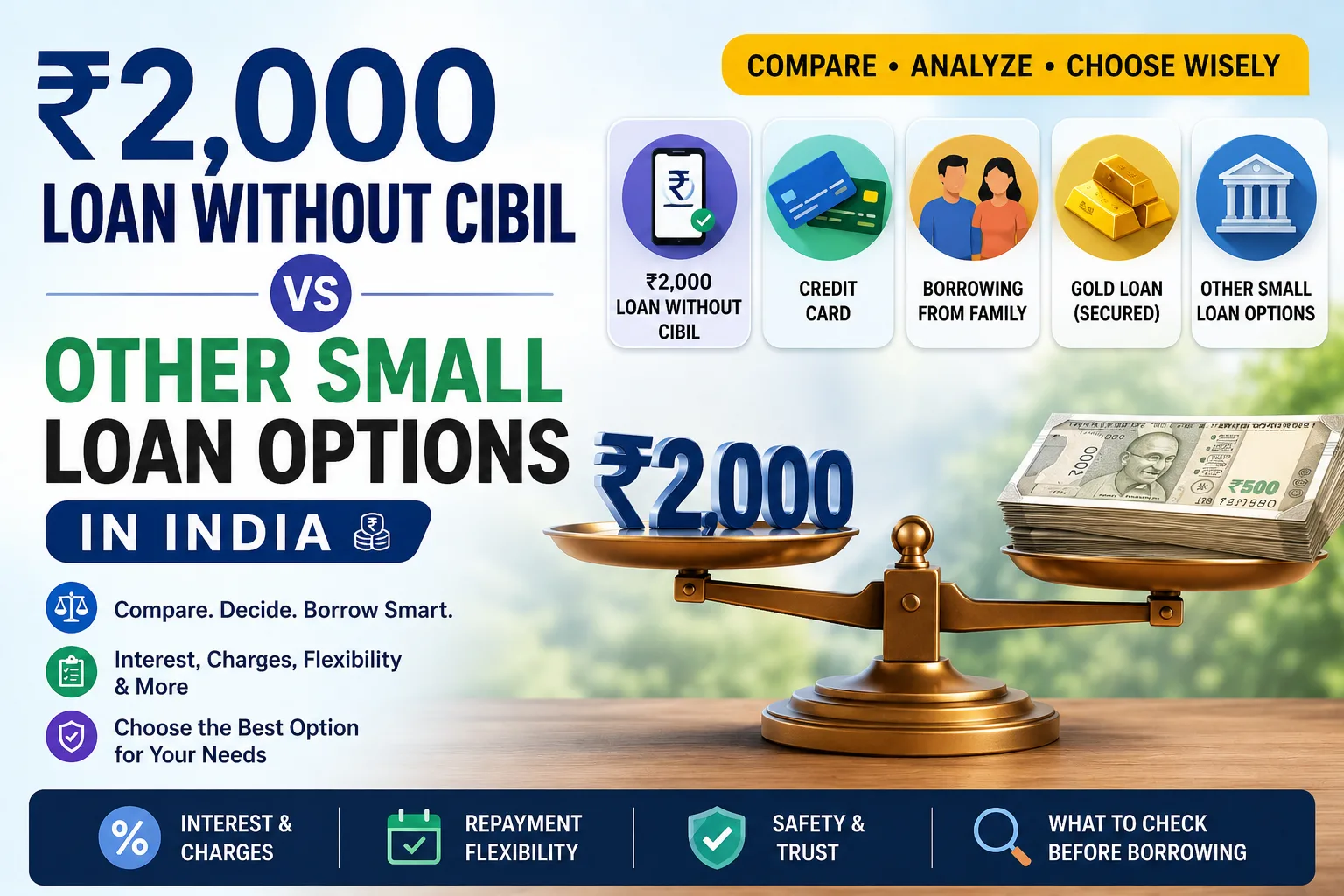
When a small financial gap appears, borrowing ₹2,000 may seem like a simple solution. However, a digital loan is not the only option available. Depending on your circumstances, you may consider an existing credit card, borrowing from family, or a secured option such as a gold loan.
For first-time borrowers, the comparison becomes even more important. A ₹2000 loan without CIBIL does not mean that a lender will ignore credit risk or approve every application. Even when there is no established credit history, lenders may consider income, repayment capacity, bank activity, existing obligations, KYC information, and their own eligibility criteria.
The right choice depends on why you need the money, how quickly you need it, how much the borrowing will cost, and whether you can comfortably repay it.
What Does a ₹2,000 Loan Without CIBIL Mean?
A person who has never used formal credit may have no established credit history with a credit bureau. This is generally described as being new to credit.
It is different from having a poor credit history.
Someone with no established history may simply have insufficient information about previous borrowing and repayment behavior. A person with a low credit score, on the other hand, may have an established credit history containing factors that negatively affect their score.
Therefore, ₹2000 loan without CIBIL should not be understood as a loan with no financial assessment.
A lender may consider:
- Income
- Employment or business activity
- Bank account activity
- Existing financial commitments
- Repayment capacity
- Identity and KYC information
- Internal lending criteria
Approval depends on the lender and the applicant's overall profile.
Option 1: Small Personal or Digital Loan
A small personal loan or digital lending product can be an option when you need a relatively small amount and meet the lender's eligibility requirements.
A ₹2000 loan online may provide a convenient application process, with identity verification and other steps completed digitally.
Potential benefits
- Convenient online application
- May require limited physical paperwork
- Structured repayment schedule
- Useful when an urgent expense cannot be postponed
- Some products may consider applicants with limited credit history
Potential drawbacks
- Interest charges
- Processing fees and applicable taxes
- Late-payment charges
- Approval is not guaranteed
- Total cost may be high relative to the amount borrowed
Before choosing a digital loan, calculate how much you will actually receive and how much you will repay in total.
Option 2: Credit Card
If you already have a credit card with sufficient available limit, it can sometimes be a practical alternative to taking a separate small loan.
For an eligible purchase, using an existing credit card may avoid the need to complete a new loan application. Depending on the card's terms and repayment behavior, purchases may have an interest-free period.
However, carrying a credit card balance can become expensive.
Potential benefits
- No separate loan application for an existing cardholder
- Convenient for eligible purchases
- May provide an interest-free period when the balance is paid according to applicable terms
- Flexible payment options within the card's conditions
Potential drawbacks
- Interest can become expensive when balances are carried
- Cash withdrawals may have separate charges and interest
- Minimum payments can extend repayment
- Requires an existing credit card and available limit
If you already have a card and can repay the amount promptly, it may be worth comparing with a new ₹2000 instant loan.
Option 3: Borrowing From Family or Friends
For a small and temporary requirement, borrowing from a trusted family member or friend can be another possibility.
This option may not involve formal interest or processing fees, and the repayment schedule can sometimes be mutually agreed upon.
However, there is a non-financial consideration: personal relationships.
Before borrowing, clearly agree on:
- Amount
- Repayment date
- Whether any interest applies
- Installment arrangement
- What happens if repayment is delayed
Clear communication can reduce the possibility of misunderstandings.
When it may make sense
Family borrowing may suit someone who has a trustworthy person willing to provide temporary assistance and who can repay the amount within the agreed timeframe.
It should still be treated as a real financial obligation.
Option 4: Gold Loan or Other Secured Borrowing
A gold loan is a secured form of credit in which eligible gold is pledged as collateral.
Someone who owns eligible gold and needs funds may consider this option, subject to the lender's requirements.
However, for a requirement of only ₹2,000, pledging valuable jewellery may not always be practical.
Potential benefits
- Secured borrowing
- Credit history may not be the only factor considered
- May be an option for people who own eligible collateral
Potential drawbacks
- Gold must be pledged
- Interest and applicable charges apply
- Repayment conditions must be followed
- Failure to meet obligations can put the pledged asset at risk
The value and importance of the collateral should be carefully considered before choosing this route for a small expense.
Comparing the Main ₹2,000 Loan Options
OptionCredit RequirementInterest/CostCollateralRepayment FlexibilityBest ConsiderationDigital/personal loanLender-specificInterest and fees may applyUsually unsecuredScheduled repaymentUrgent short-term needCredit cardExisting card generally requiredDepends on repaymentNoCard-specificExisting cardholderFamily/friendInformalMay have no interestNoUsually negotiableTemporary cash gapGold loanLender-specificInterest and feesGold requiredAgreement-basedBorrower with eligible collateralThis table is only a general comparison. Actual eligibility, pricing, fees, and repayment conditions vary by lender and product.
Compare Interest and Additional Charges
When comparing a small loan without CIBIL, do not focus only on the interest rate.
Consider the complete borrowing cost, including:
- Interest
- Processing fee
- Applicable taxes
- Late-payment charges
- Failed-payment charges
- Prepayment or foreclosure charges, where applicable
- Other disclosed costs
For regulated digital lending, borrowers should review the Key Facts Statement and the Annual Percentage Rate where applicable. These disclosures help provide a clearer picture of the cost of credit.
With a ₹2,000 loan, even a small fee can represent a significant percentage of the amount borrowed.
Look at the Amount You Actually Receive
Another important question is how much money reaches your bank account.
Suppose a hypothetical lender approves ₹2,000 but deducts a disclosed processing fee and applicable tax before disbursement. The amount you receive may therefore be less than ₹2,000.
The borrower should know:
Approved amount ≠ necessarily the amount received.
Before accepting the loan, check the disbursement amount and compare it with the total repayment obligation.
EMI vs Total Repayment
A lower installment does not automatically mean that a loan is cheaper.
Imagine two hypothetical offers:
Offer A
- Short repayment period
- Higher installment
- Lower total repayment
Offer B
- Longer repayment period
- Lower installment
- Higher total repayment
Offer B may initially appear easier because the installment is smaller. However, Offer A could have a lower overall cost.
When comparing a ₹2000 emergency loan, always ask:
How much will I repay in total?
This is usually more useful than looking at the installment alone.
Which Option May Suit Different Short-Term Needs?
Different circumstances can call for different solutions.
For an urgent essential expense
A small digital or personal loan may be considered if you meet the lender's requirements and have a reliable repayment plan.
For an existing credit card user
A credit card may be convenient for eligible purchases if you can repay according to the card's terms.
For a temporary cash shortage
Borrowing from a trusted family member may be an alternative when there is a clear understanding about repayment.
For someone with eligible gold
A gold loan can provide secured borrowing, but pledging valuable jewellery for ₹2,000 should be carefully evaluated.
For a non-essential purchase
The best option may be to delay the purchase instead of taking new debt.
Questions to Ask Before Borrowing ₹2,000
Before accepting any ₹2000 instant loan, ask yourself and the lender a few important questions.
1. Do I really need to borrow?
If the expense can wait, borrowing may not be necessary.
2. How much will I actually receive?
Check whether fees or taxes are deducted before disbursement.
3. How much will I repay?
Calculate the complete repayment amount, not just the EMI.
4. What is the interest rate and APR?
Understand the cost of credit rather than relying on promotional claims.
5. What additional charges apply?
Look for processing fees, taxes, late charges, and other disclosed costs.
6. Who is the actual lender?
If you are using a digital lending application, identify the entity actually providing the credit.
7. What happens if I miss a payment?
Understand late-payment consequences before accepting the loan.
8. What information will I have to share?
Review the KYC requirements and privacy information before submitting sensitive documents.
9. Can I repay the loan comfortably?
A loan should fit within your available repayment capacity.
10. Is there a cheaper alternative?
Compare savings, family borrowing, an existing credit card, or other appropriate options before taking new debt.
Beware of "Guaranteed" ₹2,000 Loans
People searching for a ₹2000 loan online may encounter advertisements promising guaranteed approval, no verification, or immediate cash regardless of financial circumstances.
These claims should be treated cautiously.
"No CIBIL" does not mean "no assessment." A legitimate lender can still evaluate repayment risk.
Also be careful about applications that:
- Demand unexplained advance payments
- Ask for sensitive information through unofficial channels
- Are distributed through suspicious links
- Hide the identity of the actual lender
- Provide unclear interest or repayment information
- Pressure you to accept the loan immediately
Speed should not replace verification.
When Should You Avoid a Small Loan?
A small loan may not make financial sense if:
- You already have several outstanding debts.
- You cannot comfortably afford repayment.
- You are borrowing for unnecessary spending.
- You need another loan to repay an existing one.
- The total cost is unclear.
- The lender's identity cannot be verified.
- You are being pressured to make an immediate decision.
Repeatedly taking small loans can create a cycle of borrowing that is much harder to manage than the original ₹2,000 requirement.
Responsible Borrowing Can Support Better Credit Habits
If a formal loan is reported to a credit bureau, making payments on time may contribute to building a credit history.
For a new-to-credit borrower, this can be useful over time.
However, borrowing solely to establish a credit score is generally unnecessary. A person should take credit only when there is a genuine requirement and the repayment is affordable.
If you do borrow, develop simple habits:
- Pay every installment on time.
- Keep track of due dates.
- Avoid unnecessary borrowing.
- Do not use new debt to repeatedly repay old debt.
- Review your credit information periodically.
- Keep your total obligations manageable.
A strong credit profile develops through consistent financial behavior.
Final Thoughts
A ₹2000 loan without CIBIL is only one option for handling a small financial gap in India. Depending on your circumstances, an existing credit card, borrowing from family, or a secured gold loan may also be worth considering.
The best choice is not necessarily the fastest option. Instead, look at the complete cost, repayment flexibility, eligibility requirements, risks, and your own ability to repay.
Before choosing a ₹2000 loan online, compare the interest rate, processing fees, applicable charges, amount actually disbursed, and total repayment amount. Verify the lender and read the loan agreement carefully.
If you are borrowing because of a genuine emergency, make sure the repayment will not interfere with essential expenses. If the expense is non-essential or you do not have a clear repayment plan, postponing the expense may be the more responsible choice.
Ultimately, a ₹2,000 requirement should not turn into a much larger financial problem. Compare your options, ask the right questions, and borrow only when the cost and repayment obligations are clear.