For years, international students have viewed a U.S. degree as more than a classroom experience. The attraction also came from what happened after graduation: Optional Practical Training, or OPT, gave eligible F-1 students a chance to gain professional experience in the United States.
A reported $100,000 OPT fee could change that calculation dramatically.
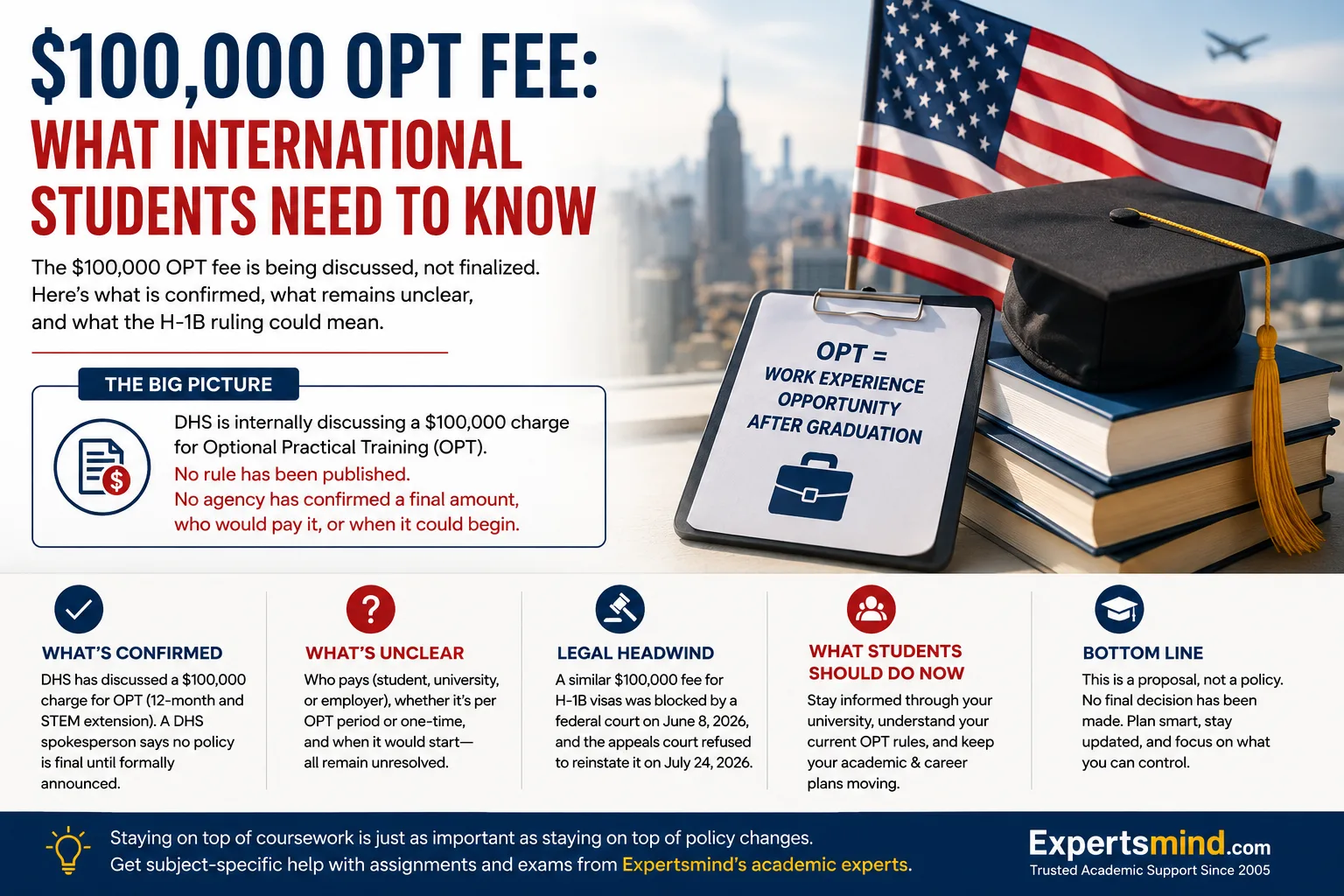
The important word is "reported." The research paper states that the Department of Homeland Security (DHS) has been discussing a possible six-figure charge, but no final policy has been published. The amount, payer and implementation date remain unresolved.
That means students should not treat $100,000 as a current OPT requirement. They should, however, understand why the proposal matters and what it could mean for future study decisions.
Why OPT Is Part of the U.S. Degree Calculation
OPT is often treated as a post-graduation benefit, but for international students it can be part of the financial logic behind studying in America.
Standard OPT can allow eligible F-1 graduates to work for up to 12 months after completing their studies. Eligible STEM graduates may qualify for an additional 24 months, creating a potential three-year period of U.S. work authorization.
That period can provide more than a first job. It can give graduates time to build experience, earn a salary and potentially pursue longer-term employment opportunities.
Consider a student who spends several years paying international tuition, accommodation and living expenses. The degree may cost a substantial amount before graduation day arrives. The opportunity to work afterward helps make that investment easier to justify.
Now add a hypothetical $100,000 charge.
The question is no longer simply whether a student can afford university tuition. It becomes whether the entire education-to-employment path still makes financial sense.
That is why the proposal has attracted attention despite not being official policy.
Students researching U.S. degrees can also review different academic pathways and subject options through Expertsminds.com's U.S. study-subject resources while considering how their chosen field fits into their longer-term plans.
The Biggest Questions Have Not Been Answered
The reported $100,000 figure sounds precise, but the policy details behind it are anything but settled.
One of the biggest unanswered questions is who would actually pay. The research paper identifies three possible groups: students, universities or employers. Each possibility would produce a very different outcome.
If students had to pay the full amount themselves, the financial barrier could be enormous. If employers were responsible, hiring decisions could become more complicated for international graduates. If universities had to absorb the cost, institutions could face pressure to change their international programs or pricing.
The timing is another open question. The paper notes that DHS is reportedly preparing a broader OPT overhaul, possibly for fall 2026, but that timeline is not confirmed.
There is also uncertainty about how the fee would be structured. Would it apply once to an OPT period? Would an additional payment be required for a STEM extension? Would the charge apply to students already studying in the United States?
There are no official answers yet.
This is why headlines about a $100,000 OPT requirement can be misleading. A reported internal discussion is not the same thing as a published regulation.
For students already dealing with demanding coursework, keeping academic work organized is equally important while immigration news develops. Resources such as homework help services can provide subject-focused academic support when assignments and deadlines begin competing for attention.
The H-1B Case Adds Another Layer
The proposal also needs to be viewed alongside the recent legal fight over a similar $100,000 H-1B fee.
According to the research paper, a presidential proclamation introduced a $100,000 charge for certain new H-1B petitions in September 2025. Twenty states challenged the policy, arguing that the executive branch did not have clear authority to impose a fee of that size.
A federal judge in Massachusetts vacated the policy on June 8, 2026. The government appealed and sought to pause that ruling.
On July 24, the First Circuit declined to do so. The appeals court did not settle the underlying legal dispute, but the decision meant the $100,000 H-1B fee remained blocked nationwide while the wider case continued.
That does not mean an OPT fee would automatically be struck down. The two situations are not identical.
Still, the H-1B case gives students an important piece of context. A six-figure immigration charge can face significant legal scrutiny when questions arise about executive authority and Congress's role in setting fees.
If DHS eventually publishes an OPT proposal, its legal foundation will matter just as much as its price.
What Students Should Do Before Making a Decision
The smartest response to the current uncertainty is not to panic or ignore the story. It is to plan around confirmed information.
Students considering the United States should continue comparing tuition, living costs, scholarships, course quality, career opportunities and post-study options. They should also recognize that immigration policy can change during the years between enrollment and graduation.
Students already enrolled should pay particular attention to their university's international student office and designated school official. These sources are more useful for individual status questions than social media posts or headlines.
Most importantly, students should separate existing OPT requirements from the reported fee proposal. The research paper notes that other OPT-related changes have already taken place and should not be confused with an unpublished $100,000 charge.
Academic planning should continue as well. A student who spends every semester worrying about what might happen two years later risks losing focus on the things that are certain today: classes, assignments, exams, projects and graduation requirements.
A Bigger Question for U.S. Higher Education
The debate over the proposed OPT fee reaches beyond one number.
International students compare countries based on the full journey, not simply the university name. They consider admission, tuition, visa rules, work opportunities and what happens after graduation.
If U.S. post-study work becomes significantly more expensive or unpredictable, countries such as Canada, the United Kingdom and Australia may become more attractive to students seeking a clearer path from education to employment.
That does not mean the United States will suddenly lose its appeal. American universities still offer major academic and professional opportunities. But uncertainty can influence decisions, particularly when students and families are committing large amounts of money years before they know what the rules will look like at graduation.
The proposed $100,000 OPT fee therefore deserves attention, but not panic.
For now, it remains a reported proposal rather than a confirmed requirement. The most sensible approach is to keep studying, monitor official announcements and evaluate the total cost of a U.S. education with realistic assumptions.
The key lesson is simple: do not build a study-abroad decision around a rumor, but do not ignore a policy signal that could change the numbers either.