
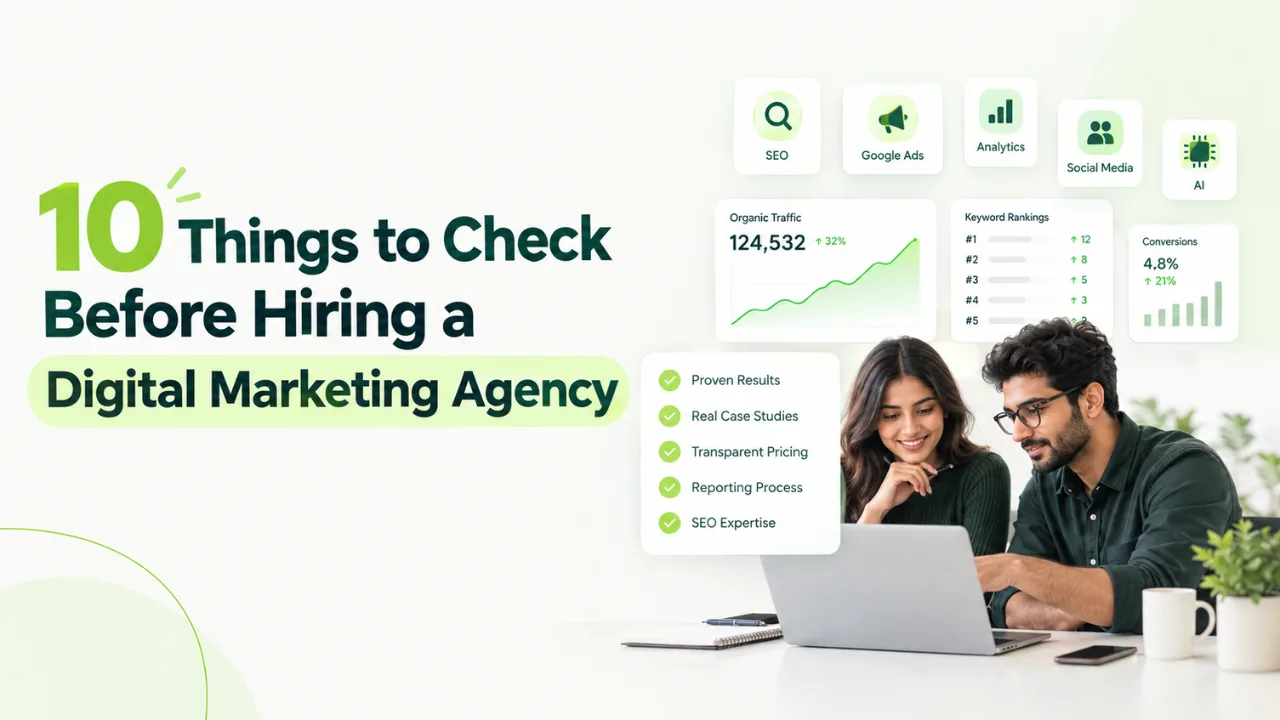
Think about hiring a builder to redo your kitchen. You would not pick the first name you find. You would ask for past jobs. You would ask for a written quote. You would want to know who shows up on site each day.
Hiring a marketing agency works the same way. The stakes are just as high. Yet many owners skip these steps because marketing feels hard to judge.
It is not as hard as it seems. You only need ten checks. For each one, this guide gives you three things: why it matters, a question to ask, and a sign that tells you to walk away.
Which Marketing Service Does What?
Agencies sell many services under one name. This table helps you tell them apart before you talk to anyone.
ServiceBest when youHow fast it movesWhat to trackSearch Engine Optimization Serviceswant steady organic traffic over timeSlow to build; early signs within monthsOrganic visits, leads from searchContent Marketing Servicesneed pages that answer buyer questionsBuilds over monthsPage visits, leads from contentPerformance Marketing Serviceswant leads fast and can keep paying for themData in days or weeksCost per lead, return on ad spendConversion Rate Optimization Serviceshave traffic but few salesDepends on how many visitors you getConversion rate, revenue per visitSocial Media Marketing Serviceswant to build brand reachBuilds over monthsReach, engagement, clicks to your siteAI Search Optimization Serviceswant your brand named in AI answersEarly field; no firm controls resultsBrand mentions, citations in AI toolsKeep this table in mind as you read. It will help with checks one and four.
1. Has the Agency Worked With Businesses Like Yours?
Why it matters. Marketing for an online store is not the same as marketing for a law firm or a local clinic. The buyer, the sales cycle, and the rules all differ.
Ask this: "Which clients like mine have you worked with?"
A good agency names real examples. It also explains what it learned from them. It may also admit when your field is new to the team and tell you how it would learn.
Walk away if the agency claims it can do everything for everyone. No team is an expert at every industry. A clear focus is a good sign.
Size matters too. A very large agency may treat a small account as a side job. A very small one may not have enough hands for a big plan. Ask how many clients each person on the team handles.
2. Can You Confirm Their Results Yourself?
Why it matters. Case studies are easy to write and hard to check. You want proof that a real person could confirm.
Ask this: "Can I speak with a client, and can you show me the numbers behind this case study?"
A strong case study states the starting point, the work done, the result, and the time it took. It uses real figures, such as leads, sales, or organic visits.
Then talk to the client. Ask what went well. Ask what went wrong. Ask how the agency handled a bad month.
Walk away if every result looks perfect. If each client doubled traffic in a few weeks, something is missing. Results change with market, budget, and starting point. Honest agencies share slower wins too.
3. Who Will Actually Work on Your Account?
Why it matters. The person selling the plan is often not the person doing the work. That is common. It becomes a problem only when you do not know who will handle your account.
Ask this: "Who will work on my account, and can I meet them?"
You want names and roles. Who writes the content? Who builds the ads? Who fixes the site? Who is your main contact?
Also ask if any work goes to freelancers or partner firms. Using outside help is fine. Many good agencies do it. The issue is hiding it.
Walk away if you cannot get a straight answer about who does what. Clear answers here show how the agency treats its clients in general.
Ask who checks the work before it goes live. For topics tied to health, money, or safety, a trained reviewer is even more important.
4. Do They Study Your Business Before Quoting a Price?
Why it matters. A fixed package given after a short call cannot fit your business. A good agency studies you first.
Ask this: "What will you do in the first 30 days, and what will I get at the end of it?"
A strong answer covers a review of your site, your data, your rivals, and your customers. It leads to a ranked list of fixes and a written plan.
This is also where you use the table above. Match your biggest gap to the right service. If you have little traffic, start with search and content. If you have traffic but few sales, look at conversion work. If you need leads fast, paid ads can help while search builds. A good agency will say which service to start with. It will not push all of them at once.
Walk away if the agency sends a quote with no review of your site. Ask to see a sample audit. It should point to real issues on a real site, not read like a template.
5. Are They Honest About How Long Results Take?
Why it matters. Marketing has limits. An agency that hides them is setting you up for a letdown.
Ask this: "What could slow results down for my business?"
Google states that no one can guarantee a first-place ranking. So any agency that promises a top spot, or a fixed traffic number by a set date, is promising something it cannot control.
An honest agency talks in ranges. It might say, "Early signs from search often show in a few months. Clear gains often take three to six months or more." For paid ads, it might say that costs change by season and competition.
Walk away if you hear a guarantee. Also be careful with a very short timeline for search work. Fast claims often come from shortcuts that can hurt you later.
6. Will They Set Up Tracking Before the Work Starts?
Why it matters. Without tracking, no one can tell what works. You also lose the chance to compare "before" and "after."
Ask this: "How will you track leads, calls, and sales from day one?"
A good answer includes Google Analytics, Google Search Console, and conversion tracking on your forms, calls, and checkout. For paid work, it includes ad account tracking and a plan to link ad clicks to leads.
Ask what the agency will count as a "lead." A form fill? A phone call? A sale? Agree on this early. Different definitions lead to confusion later.
Walk away if the agency will not set up tracking or says it is not needed. Without data, the agency can claim any result it likes.
7. Are Their Reports Easy to Read and Useful?
Why it matters. Reports show how an agency thinks. A long report can still tell you nothing.
Ask this: "Can I see a sample report?"
A good report shows:
- Leads, calls, or sales, and where each came from.
- Traffic by channel and by key page.
- Cost per lead or sale for paid work.
- What the team did this month and what comes next.
- Problems, with a plan to fix each one.
Watch out for vanity numbers. Likes, views, and impressions can feel good, but they do not pay bills. For each number, ask how it ties to money.
Walk away if the report is full of charts but never mentions leads or sales. Also ask how often you will meet. A monthly call with a real person beats a report that lands in your inbox.
8. Will You Own Your Accounts and Content?
Why it matters. If you leave an agency, you want to keep your work. Many owners learn this too late.
Ask this: "Will I own every account, file, and piece of content you create for me?"
You should own your website, domain, Google Analytics, Search Console, and ad accounts. The agency should have access, not ownership. You should also own the content written for you, unless the contract clearly says otherwise.
Ask how ad spend is paid. In many setups, the ad platform bills you directly for spend, and the agency charges a separate fee. Ask if the fee is flat or a share of spend. A share of spend can push an agency to raise your budget, so know which model you are signing.
Walk away if the agency runs ads only inside its own account and refuses to move them to yours. That can erase your history if you leave.
9. Do They Know How to Help You Show Up in AI Search?
Why it matters. Search has changed. Google now shows AI Overviews and an AI Mode in many results. Tools like ChatGPT and Perplexity also answer questions and name sources. Some people get an answer without clicking a link.
Ask this: "How do you help my brand show up in AI answers?"
Google has said that its usual SEO best practices still apply to its AI features, and that you need no special markup to appear there. So a good reply should sound calm and practical. It might include:
- Checking how your brand shows up in AI tools today.
- Writing clear pages that answer real questions and back claims with proof.
- Keeping your business name, address, and details the same across the web.
- Earning mentions on trusted sites.
- Tracking changes over time.
An agency that offers AI Search Optimization Services should explain how it measures this work.
Walk away if you hear a promise of a spot in AI answers or a "secret method." No firm controls those tools.
10. What Does the Contract Say About Leaving and Costs?
Why it matters. The contract is where promises become rules. Read it before you sign, not after.
Ask this: "What happens if I want to leave?"
Look closely at these items:
- Scope. Ask for a list of tasks by month.
- Length. Some firms ask for a year. Others work month to month.
- Exit terms. Can you leave? Will you keep your content, data, and accounts?
- Extra costs. Ask about tools, writing, design, and ad spend.
- Results language. Be wary of clauses that promise outcomes no one controls.
Price varies a lot. It depends on your country, your industry, your goals, and the services you need. Treat price as one signal, not the main one. Very low prices often mean copied work or shortcuts. High prices with no clear plan should raise questions too.
Walk away if the agency pushes a long lock-in with no exit terms. Ask for a short first phase, such as three months. Good agencies often welcome this.
How to Run a 20-Minute Call With an Agency
You do not need to be an expert to run a good call. Use this simple order:
- Minutes 1 to 3. Share your goal and your current numbers.
- Minutes 4 to 8. Ask about similar clients and proof (checks 1 and 2).
- Minutes 9 to 12. Ask who does the work and how they plan (checks 3 and 4).
- Minutes 13 to 16. Ask about tracking, reports, and AI search (checks 6, 7, and 9).
- Minutes 17 to 20. Ask about ownership and the contract (checks 8 and 10).
Take notes. After each call, give the agency a score from one to five on clarity, proof, and honesty. Talk to three agencies and compare the scores. Then wait a day before you decide.
Warning Signs: When to Slow Down
If you see two or more of these, slow down:
- A promise of guaranteed rank, traffic, or sales.
- A "secret" method the agency will not explain.
- Link buying. Google's spam policies say buying links to pass rank is against the rules, and it can harm your site.
- A plan with no audit or review.
- Pressure to sign fast.
- Accounts held by the agency.
- Reports with no link to leads or sales.
- A generic unsolicited email pitch.
What Should You See in the First 3 Months?
A fair view of the timeline helps you judge progress.
Month one is setup. The agency studies your business, sets up tracking, and shares a plan.
Month two is action. The team fixes site issues, launches content, or starts ad tests. Early data starts to come in.
Month three is review. You see first signals. Paid campaigns may show clear cost per lead. Search work may show better indexing and more impressions.
Clear gains from search often take longer than three months. That is normal. What matters is steady work, clear reports, and a team that can explain what comes next.
Learn More About SEO Revive's Services
If you want to see how a team can approach this, visit SEO Revive. It is an SEO agency that works on search visibility and organic growth for businesses. Use these ten checks on every firm you review, including this one. Ask about proof, tracking, ownership, and AI search. A good partner will welcome the questions.
Want to see these services in detail? Explore SEO Revive's services like search engine optimization services, AI search optimization services, content marketing services, conversion rate optimization services, performance marketing services, and social media marketing services.
Common Questions About Hiring an Agency
What is the difference between a digital marketing company and an SEO company?An SEO company focuses on organic search. A digital marketing company covers more channels, such as paid ads, social media, email, and content. Some firms do both.
Should I choose a full-service firm or a specialist?It depends on your needs. A full-service firm offering digital marketing services can join several channels into one plan. A specialist, such as an seo optimization agency, can go deeper on search. Start with the one that fixes your biggest gap.
How much does a digital marketing agency cost?There is no single price. Cost depends on your goals, your market, and the services you need. Ask what result each plan aims for and how it will be measured, instead of hunting for the lowest quote.
How long before I see results?Paid campaigns can show data within weeks. Search work often shows early signs within a few months. Clear gains often take three to six months or more.
Can I do digital marketing myself?Yes, for the basics. You can write useful pages, set up a business profile, and post on social media. For technical work, paid ads, or tough markets, a skilled team often saves time.
What if my agency is not working out?Review your goal and your reports first. Raise your concerns in writing and ask for a plan. If nothing improves, check the contract for exit terms and make sure you hold your own accounts.
The Bottom Line: Choose the Agency That Answers Clearly
Hiring an agency does not have to feel like a gamble. Ten checks, a short call script, and a careful read of the contract can tell you most of what you need to know.
Ask for proof. Ask for names. Ask what could go wrong. Then pay attention to how the agency answers. The best partners give clear replies, admit limits, and welcome your questions. That is often the clearest sign you have found the right one.