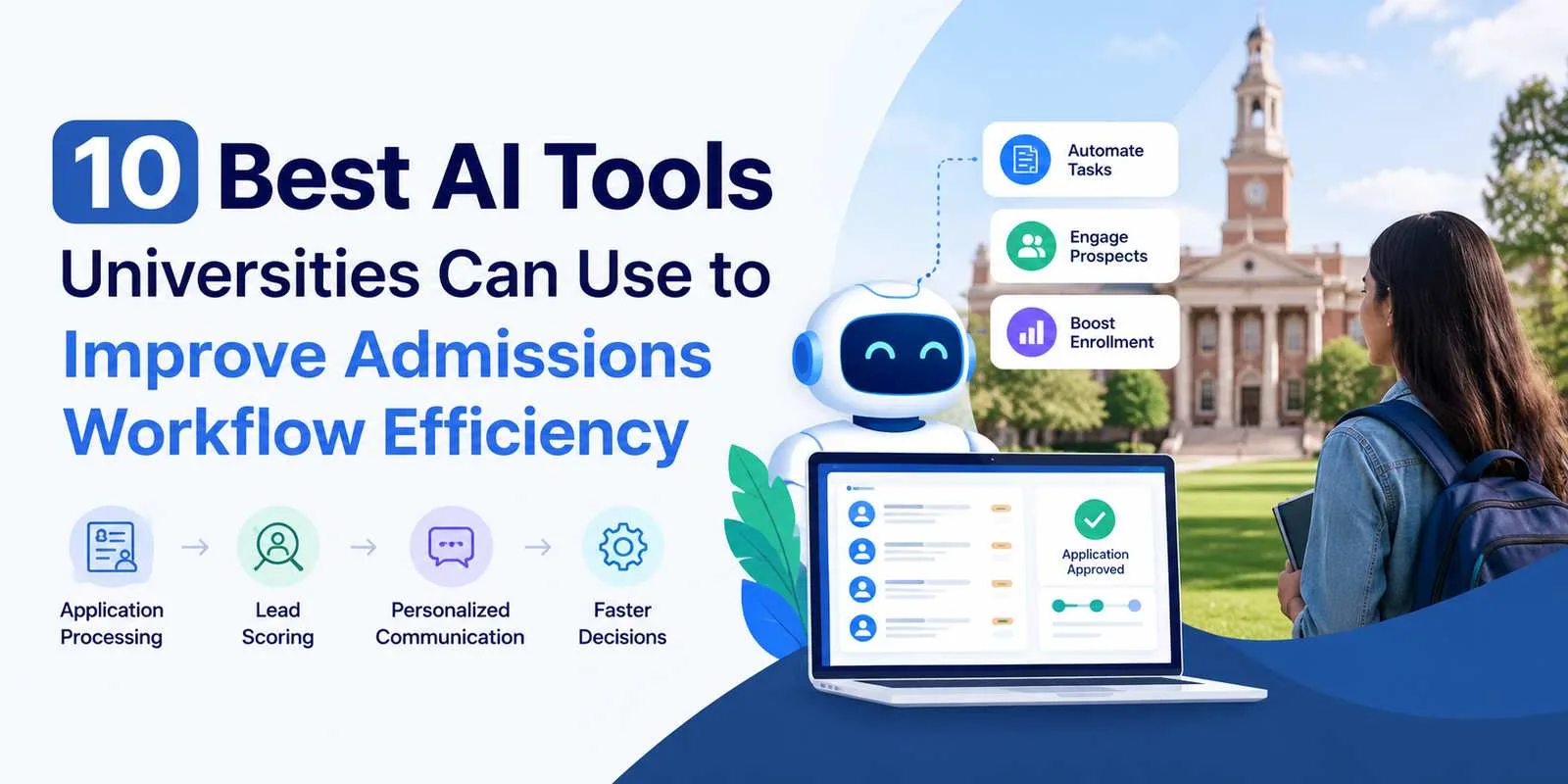
University admissions teams manage hundreds or thousands of student inquiries, application documents, follow-up activities, and enrollment decisions every admission cycle. Handling these tasks manually can create communication delays, increase administrative workloads, and make it difficult to provide prospective students with timely support.
Artificial intelligence (AI) is helping universities streamline these processes through automated communication, intelligent data management, application assistance, and predictive analytics. The right AI tools can help admissions teams spend less time on repetitive tasks and more time engaging with prospective students.
In this article, we explore 10 AI tools universities can use to improve admissions workflow efficiency and create a more organized, student-focused enrollment process.
Why Do Universities Need AI Tools for Admissions?
Traditional admissions workflows often involve disconnected spreadsheets, manual data entry, repetitive email responses, and time-consuming application tracking. As student inquiries grow across websites, email, phone calls, and social media, managing these interactions becomes increasingly complex.
AI-powered admissions tools can help universities:
- Automate responses to frequently asked questions.
- Organize prospective student information in a centralized system.
- Personalize communication based on student interests and behavior.
- Automate application reminders and follow-up activities.
- Identify bottlenecks in the admissions funnel.
- Improve visibility into recruitment and enrollment performance.
However, AI should support admissions professionals rather than replace human judgment in important decisions involving student eligibility, application evaluation, or admission outcomes.
10 Best AI Tools for University Admissions Workflow Efficiency
1. Talisma
Talisma provides customer relationship management (CRM) solutions for higher education institutions, helping universities manage prospective student relationships, communications, and admissions-related workflows.
With a centralized CRM approach, institutions can organize student inquiries, maintain interaction histories, and coordinate follow-ups across the admissions journey. Depending on the implementation and available integrations, workflow automation can also help reduce repetitive administrative activities.
Best for: Universities looking to improve student engagement, inquiry management, and admissions coordination.
Key benefits:
- Centralized student and prospect information.
- Structured inquiry tracking and follow-up.
- More coordinated student communication.
- Better visibility into recruitment and engagement activities.
For universities seeking to connect student recruitment with more organized communication and relationship management, Talisma's higher education solutions are worth evaluating.
2. Slate by Technolutions
Slate is a higher education platform designed to support admissions, recruitment, application management, and enrollment-related workflows.
Its capabilities include application processing, applicant communication, review workflows, event management, and reporting. Institutions can configure workflows around their specific admissions requirements and use available AI capabilities where appropriate.
Best for: Colleges and universities that need a configurable, higher education-focused admissions platform.
3. Salesforce Education Cloud
Salesforce Education Cloud supports student recruitment, relationship management, admissions processes, and student lifecycle engagement.
Its CRM capabilities help institutions bring together student information and coordinate interactions across departments. Available AI capabilities and automation can assist with selected recruitment and communication tasks, depending on the products and configuration adopted.
Best for: Universities seeking an extensible CRM ecosystem for complex recruitment and student engagement requirements.
4. Element451
Element451 combines higher education CRM functionality with AI-assisted engagement and admissions workflows.
Its platform offers capabilities for managing prospective students, coordinating communications, supporting applications, and automating selected recruitment activities. Universities can evaluate its AI agents and automation features for reducing repetitive tasks across the enrollment journey.
Best for: Institutions prioritizing AI-assisted admissions, recruitment marketing, and student engagement.
5. Ellucian CRM Recruit
Ellucian CRM Recruit supports student recruitment and admissions activities, including prospect management, communication, and enrollment-related processes.
For institutions already using Ellucian systems, it may offer a relevant option for coordinating recruitment workflows and connecting admissions activities with the broader student information environment. Specific integration and automation capabilities should be verified during evaluation.
Best for: Universities already invested in the Ellucian ecosystem.
6. HubSpot
HubSpot provides CRM, marketing automation, and AI-assisted content and communication capabilities that universities can adapt to prospective student engagement.
Admissions marketing teams can use it to organize inquiries, segment audiences, automate email sequences, and track engagement with recruitment campaigns. Institutions should confirm whether the selected edition and configuration support their admissions-specific requirements.
Best for: Universities seeking marketing-led lead management and prospective student nurturing.
7. Zoho CRM
Zoho CRM offers contact management, workflow automation, analytics, and AI-assisted features through its product ecosystem.
Universities can adapt these capabilities to organize prospective student records, assign inquiries to admissions counselors, schedule follow-ups, and monitor recruitment pipelines. The suitability of individual AI features depends on the selected product edition and configuration.
Best for: Institutions looking for a customizable CRM with flexible automation options.
8. Microsoft Dynamics 365
Microsoft Dynamics 365 offers CRM and workflow automation capabilities that institutions can configure for recruitment and student relationship management.
Its broader business application ecosystem can help universities connect communication, data management, and reporting processes. AI functionality depends on the specific Dynamics products, licensing, and integrations implemented.
Best for: Universities that need flexible enterprise workflows and already use Microsoft business applications.
9. Mainstay
Mainstay focuses on conversational engagement and student communication, helping educational institutions interact with prospective and enrolled students through automated messaging.
Its approach can support timely responses, proactive reminders, and outreach designed to help students complete important enrollment steps. Universities should assess how the platform integrates with their existing CRM and student information systems.
Best for: Institutions aiming to improve student communication, application completion, and enrollment follow-up.
10. Salesforce Agentforce for Education
Salesforce Agentforce capabilities can support configured AI-agent workflows within the Salesforce ecosystem. Depending on the product configuration, these agents can assist with prospective student questions and selected recruitment activities.
Universities should evaluate the available education-specific functionality, permissions, integrations, and human oversight requirements before deploying agents in admissions processes.
Best for: Institutions exploring AI agents to support recruitment and student service workflows within Salesforce.
How to Choose the Right AI Admissions Tool
Selecting an AI tool requires more than comparing feature lists. Universities should evaluate how well each platform fits their existing processes and institutional objectives.
Consider the following factors:
- Workflow automation: Can the platform reduce repetitive tasks such as inquiry assignment, reminders, and follow-ups?
- Communication capabilities: Does it support the channels prospective students actually use?
- CRM integration: Can student interactions and lead information be managed consistently?
- Reporting and analytics: Can admissions leaders identify engagement trends and bottlenecks?
- Data privacy and security: Does the solution meet institutional policies and applicable data protection requirements?
- Human oversight: Can staff review AI-generated responses and retain control over consequential admissions decisions?
- Implementation and cost: Are integration requirements, training needs, licensing, and ongoing maintenance manageable?
The most suitable platform will depend on the institution's size, admissions complexity, existing technology stack, and available resources.
Final Thoughts
AI tools are becoming an important part of modern university admissions, helping institutions manage inquiries, streamline communication, organize recruitment workflows, and improve operational visibility.
Platforms such as Slate, Salesforce Education Cloud, Element451, and Talisma address different aspects of student relationship management and admissions operations. Universities should compare their actual capabilities and integration requirements rather than assume every platform provides the same functionality.
For institutions seeking to strengthen student engagement and bring greater structure to admissions communication, Talisma's higher education CRM solutions can be part of the evaluation process. By combining suitable technology with well-defined workflows and human oversight, universities can create a more efficient admissions experience for both staff and prospective students.