Introduction
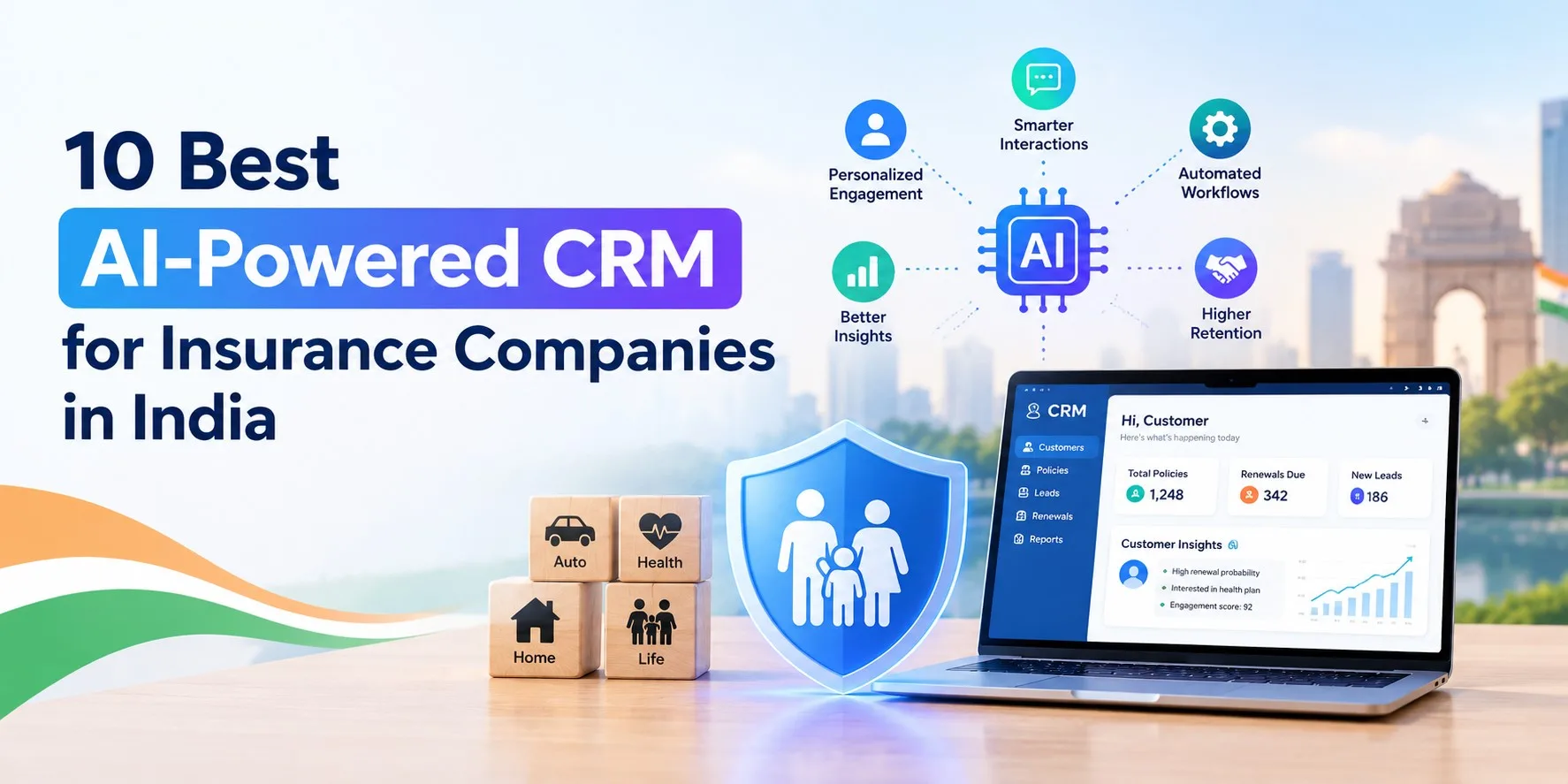
India’s insurance industry is undergoing a major digital transformation. With growing customer expectations, increasing competition, and multiple communication channels, insurance companies need smarter ways to manage customer relationships, streamline operations, and deliver personalized services.
Traditional customer relationship management (CRM) systems help insurers maintain customer records and track sales activities. However, AI-powered CRM software for insurance companies goes further by supporting intelligent customer interactions, automating repetitive tasks, and generating insights that help teams make informed decisions.
From managing insurance leads and policy enquiries to supporting renewals, claims-related communication, and customer service, AI-powered CRM platforms can help insurers improve efficiency throughout the customer lifecycle.
Here are 10 AI-powered CRM platforms worth considering for insurance companies in India.
1. Talisma
Talisma is an AI-powered customer engagement and CRM platform that helps financial services organizations connect customer interactions, business workflows, and service operations. Its dedicated BFSI solution is designed to support insurance and other financial services businesses.
The platform focuses on combining AI agents, customer engagement, workflow automation, and analytics to help organizations manage complex customer journeys.
Key capabilities:
- AI-powered customer service and engagement
- Customer onboarding and workflow automation
- Claims-processing workflow support
- Intelligent sales insights and next-best-action recommendations
- Reporting, analytics, and service performance monitoring
Best for: Insurance companies and financial institutions seeking an enterprise-focused AI CRM solution for customer engagement and operational automation.
Learn more about Talisma’s AI-powered CRM for BFSI.
2. Salesforce Financial Services Cloud
Salesforce Financial Services Cloud offers CRM capabilities designed for financial services organizations, including insurance providers. It helps teams bring customer information, sales activities, service interactions, and relationship management into a connected environment.
Its AI capabilities can support customer insights, workflow automation, and service operations, depending on the selected products and configuration.
Key capabilities:
- Customer and policyholder relationship management
- Sales and service workflow automation
- AI-assisted insights and recommendations
- Customer interaction tracking
- Integration with enterprise applications
Best for: Large insurance enterprises that require extensive customization and a broad enterprise technology ecosystem.
3. Microsoft Dynamics 365
Microsoft Dynamics 365 provides sales, customer service, and business application capabilities that insurance companies can configure around their processes. Its AI capabilities and Microsoft ecosystem integrations can help teams improve productivity and coordinate customer interactions.
Key capabilities:
- Customer data and interaction management
- AI-assisted sales and service activities
- Workflow automation
- Reporting and business intelligence
- Integration with Microsoft applications
Best for: Insurance organizations already using Microsoft products and seeking connected business applications.
4. Zoho CRM
Zoho CRM is a flexible customer relationship management platform suitable for insurance agencies, brokers, and growing businesses. Its Zia AI capabilities can assist with sales insights, lead management, and selected automation tasks, depending on the plan.
Key capabilities:
- Lead and contact management
- Sales pipeline tracking
- AI-assisted predictions and insights
- Workflow automation
- Email and customer communication management
Best for: Small and medium-sized insurance agencies looking for a customizable CRM with a broad set of sales features.
5. Freshsales
Freshsales, part of the Freshworks product portfolio, combines sales CRM functionality with AI-assisted capabilities. Insurance teams can use it to organize prospects, manage sales pipelines, and improve follow-up activities.
Key capabilities:
- Lead scoring and contact management
- AI-assisted sales insights
- Sales activity tracking
- Workflow automation
- Communication and pipeline management
Best for: Insurance agencies that prioritize lead conversion, prospect follow-ups, and sales team productivity.
6. LeadSquared
LeadSquared focuses on lead management, sales execution, and automation. Its capabilities can be useful for insurance businesses managing large volumes of enquiries across digital campaigns, sales teams, and distribution channels.
Key capabilities:
- Lead capture and distribution
- Lead scoring and nurturing
- Sales workflow automation
- Field sales management
- Performance reporting
Best for: Insurance companies and distribution networks that need structured lead management and sales execution.
7. HubSpot CRM
HubSpot CRM brings together contact management, sales pipelines, marketing tools, and customer service capabilities. Its AI features can assist with content creation, customer research, and selected sales and service activities.
Key capabilities:
- Contact and lead management
- Sales pipeline tracking
- Marketing automation
- AI-assisted content and productivity tools
- Customer interaction reporting
Best for: Insurance agencies that want to connect digital marketing, lead generation, and customer relationship management.
8. Creatio
Creatio offers CRM and business process automation capabilities through a configurable platform. Insurance organizations can use it to design workflows that align with their sales, customer service, and operational requirements.
Key capabilities:
- Customer and sales management
- Configurable business processes
- Workflow automation
- AI-assisted capabilities
- Analytics and reporting
Best for: Insurance businesses seeking configurable workflows and process automation across multiple departments.
9. Pega
Pega provides enterprise software for customer engagement, decisioning, and business process automation. Its capabilities can support complex customer journeys and operational processes within large insurance organizations.
Key capabilities:
- Customer engagement and decision management
- Process automation
- Case management
- AI-assisted decisioning
- Enterprise workflow orchestration
Best for: Large insurers with complex service operations, business rules, and process automation requirements.
10. Oracle Customer Experience (CX)
Oracle CX provides customer experience applications that help organizations manage sales, marketing, and customer engagement. Its AI capabilities can support insights and productivity across customer-facing business processes.
Key capabilities:
- Customer and sales data management
- Sales and marketing automation
- AI-assisted business insights
- Customer engagement tools
- Enterprise application integration
Best for: Large insurance organizations seeking customer experience applications that fit within an established Oracle technology environment.
Comparison of the 10 Best AI CRM Platforms
CRM platformPrimary strengthSuitable forTalismaAI-driven engagement and BFSI workflow automationInsurance and financial services enterprisesSalesforce Financial Services CloudFinancial services CRM ecosystemLarge insurersMicrosoft Dynamics 365Connected business applicationsMicrosoft-oriented organizationsZoho CRMFlexible sales CRMSmall and medium-sized agenciesFreshsalesLead management and sales productivityGrowing insurance teamsLeadSquaredLead distribution and sales executionHigh-volume sales operationsHubSpot CRMMarketing and sales alignmentDigital-first insurance agenciesCreatioConfigurable workflowsProcess-focused insurersPegaComplex enterprise processesLarge insurance operationsOracle CXEnterprise customer experience managementLarge organizations using Oracle applicationsThis comparison is based on general platform positioning, not an independently tested ranking. Features, integrations, and AI availability vary by product edition and implementation.
How to Choose the Right AI CRM for Your Insurance Business
Selecting the right CRM requires more than comparing feature lists. Insurance companies should evaluate how well a platform supports their customer journeys and existing technology infrastructure.
Consider these factors before making a decision:
1. AI and Automation Capabilities
Look for practical AI applications such as customer query handling, lead prioritization, workflow automation, and agent assistance. Confirm which functions are available natively and which require additional configuration.
2. Customer Engagement Across Channels
Customers may interact with insurers through phone calls, email, websites, messaging applications, and contact centres. A CRM should help teams maintain consistent information across supported channels.
3. Integration With Existing Systems
Evaluate how the CRM connects with policy administration systems, claims platforms, document management tools, and other enterprise applications.
4. Data Security and Compliance
Insurance businesses handle sensitive customer information. Assess access controls, audit trails, data governance, vendor security documentation, and applicable Indian regulatory requirements.
5. Scalability and Total Cost
Consider licensing, implementation, customization, integrations, training, and ongoing maintenance—not just the initial subscription price.
Conclusion
AI-powered CRM software is becoming an important part of insurance digital transformation. By connecting customer information, automating routine tasks, and supporting more personalized interactions, these platforms can help insurance businesses improve service delivery and operational efficiency.
The right choice depends on the organization's size, workflows, technology environment, and automation priorities. While platforms such as Salesforce,