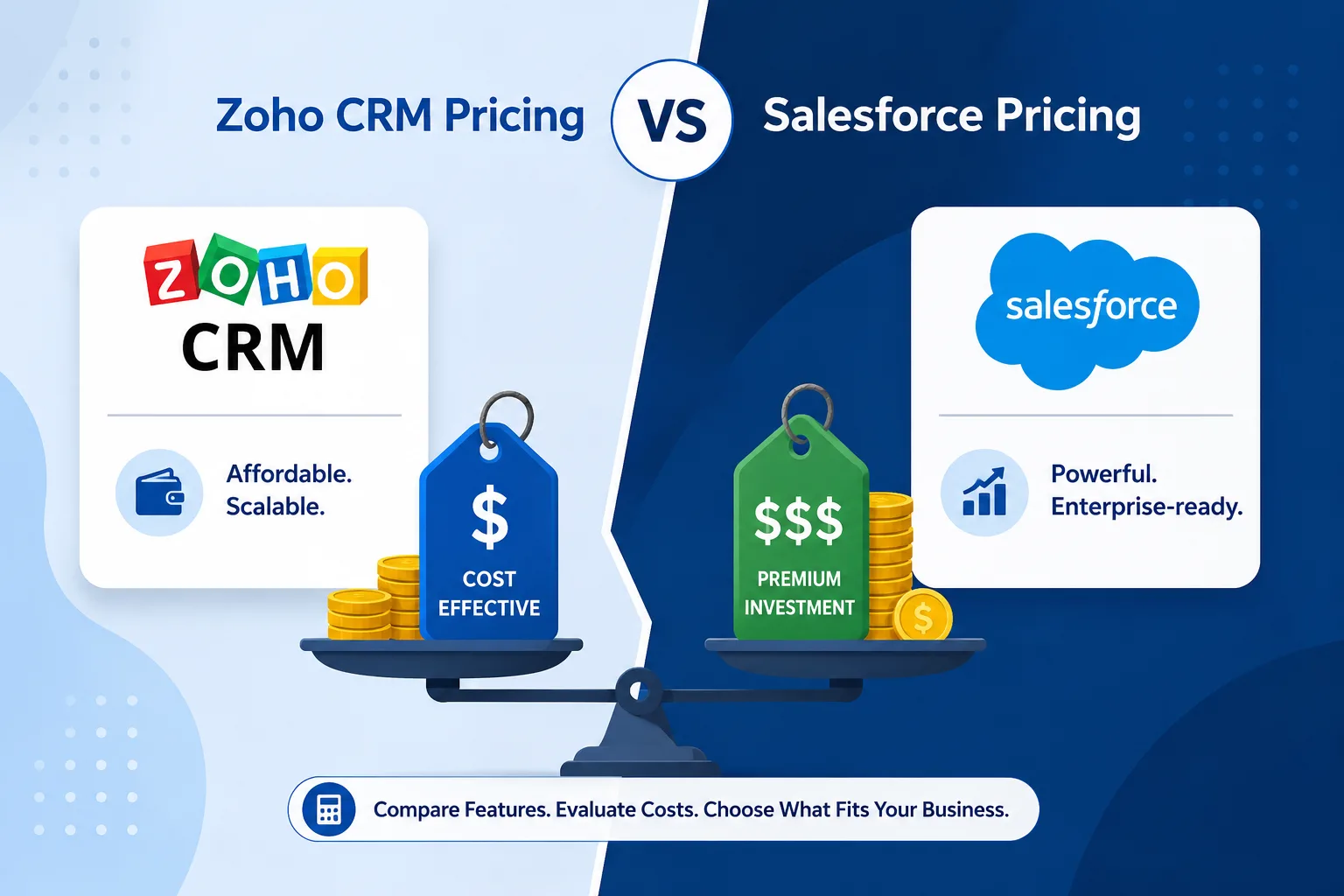
Zoho CRM Pricing vs Salesforce Pricing: Which Is More Cost Effective?
Selecting a Customer Relationship Management (CRM) platform involves more than comparing features and functionality. Pricing often becomes one of the most important factors during the decision-making process, especially for organizations looking to balance operational efficiency with long-term growth. Two of the most recognized CRM platforms in the market are Zoho CRM and Salesforce. While both solutions offer robust capabilities for managing customer relationships, sales processes, automation, and reporting, their pricing structures differ significantly.
Understanding the true cost of a CRM goes beyond the monthly subscription fee. Businesses must consider implementation, customization, training, maintenance, scalability, and consulting requirements before determining which platform offers better value. This article explores the pricing approaches of Zoho CRM and Salesforce and examines which solution may be more cost-effective depending on business requirements.
Understanding CRM Pricing Beyond Subscription Costs
Many organizations compare CRM platforms by looking at the listed price per user per month. Although this is an important starting point, it does not provide a complete picture of total ownership costs.
CRM expenses can include:
- User licensing fees
- Implementation costs
- Customization and configuration
- Third-party integrations
- Employee training
- Ongoing administration
- Technical support
- Future upgrades and scalability
A platform with a lower monthly subscription fee may require extensive customization costs, while a more expensive platform may reduce operational expenses through advanced automation capabilities. Therefore, cost-effectiveness should always be evaluated in terms of both immediate and long-term business value.
Zoho CRM Pricing Structure
Zoho CRM is often recognized for offering multiple pricing tiers that cater to businesses of various sizes. Its plans generally provide a gradual progression of features, allowing organizations to upgrade as their requirements evolve.
One of the major advantages of Zoho CRM's pricing model is accessibility. Businesses can begin with entry-level plans and expand functionality over time without facing dramatic increases in software costs.
Common characteristics of Zoho CRM pricing include:
- Lower entry barriers for small and medium-sized businesses
- Flexible user-based pricing
- Access to automation features at relatively affordable tiers
- Integration with the broader Zoho ecosystem
- Predictable subscription costs
This pricing approach often appeals to organizations that want advanced CRM capabilities without committing to enterprise-level budgets. Since many essential features become available at lower pricing tiers, businesses can often achieve operational improvements without significant upfront investments.
However, organizations with highly specialized workflows may still incur additional expenses related to customization, integrations, or consulting services.
Salesforce Pricing Structure
Salesforce follows a different pricing philosophy. The platform is designed to accommodate businesses ranging from small organizations to large enterprises with complex operational requirements.
Salesforce pricing tiers generally increase based on feature availability, automation capabilities, analytics tools, and customization options. As businesses move toward higher editions, the subscription costs can rise considerably.
Key characteristics of Salesforce pricing include:
- Extensive enterprise-level functionality
- Advanced customization capabilities
- Sophisticated automation features
- Large integration marketplace
- Scalability for complex business environments
While Salesforce provides significant flexibility, organizations often discover that the overall investment extends beyond licensing fees. Additional modules, advanced features, and integrations may contribute to higher total costs over time.
For businesses with highly complex requirements, these additional investments may be justified. However, for organizations with straightforward CRM needs, the pricing structure can sometimes exceed operational requirements.
Also Read : Zoho CRM vs Salesforce: Which CRM Is Right for Your Business?
Comparing Initial Investment
When comparing upfront costs, Zoho CRM generally presents a lower financial commitment.
Organizations can often deploy Zoho CRM with fewer budget concerns because:
- Subscription plans tend to be more affordable.
- Basic customization requirements are easier to manage.
- Essential CRM functionality is available earlier in the pricing hierarchy.
- User expansion typically involves predictable costs.
Salesforce, on the other hand, may require larger initial investments due to:
- Higher licensing fees.
- Additional implementation planning.
- More extensive configuration requirements.
- Potential reliance on specialized expertise.
For businesses seeking a faster and more budget-conscious CRM deployment, Zoho CRM often appears to be the more economical option during the initial stages.
Cost of Customization and Configuration
Customization plays a major role in CRM effectiveness. Every organization has unique sales processes, customer journeys, approval structures, and reporting requirements.
Zoho CRM offers customization tools that allow businesses to tailor workflows, modules, dashboards, and automation without requiring extensive technical expertise. This can reduce implementation costs and simplify ongoing administration.
Salesforce is widely known for its deep customization capabilities. While this flexibility is valuable, it can also introduce additional costs. More sophisticated customizations often require dedicated administrators, developers, or external consultants to ensure optimal configuration.
As customization complexity increases, the cost difference between the two platforms may become more noticeable.
The Role of CRM Consulting in Overall Costs
CRM pricing discussions frequently overlook consulting expenses, even though consulting can significantly impact the total cost of ownership.
Organizations adopting Zoho CRM may seek Zoho CRM consulting services to:
- Define CRM strategies
- Configure workflows
- Implement automation
- Integrate third-party applications
- Improve user adoption
Similarly, Salesforce consulting services are often utilized for:
- Enterprise-wide CRM planning
- Advanced customization
- Data migration
- System architecture design
- Process optimization
Neither consulting approach should be viewed as an unnecessary expense. Instead, consulting helps organizations avoid costly implementation mistakes and improve long-term CRM performance.
The difference lies in project complexity. Salesforce implementations often involve broader customization requirements, which may increase consulting hours and associated costs. Zoho CRM projects, while still benefiting from expert guidance, may require fewer resources depending on organizational needs.
As a result, consulting expenses can become a significant factor when evaluating overall CRM affordability.
Scalability and Long-Term Value
Cost-effectiveness should also account for future growth.
A CRM that appears affordable initially may become expensive if it cannot support expanding business requirements. Conversely, a more expensive platform may generate value if it eliminates the need for future system replacements.
Zoho CRM offers scalability through additional features, integrations, and ecosystem applications. Organizations can gradually expand functionality while maintaining reasonable budget control.
Salesforce provides extensive scalability for businesses with highly complex operational structures. The platform supports advanced automation, large datasets, extensive integrations, and sophisticated reporting capabilities.
The decision ultimately depends on anticipated business growth and process complexity.
For companies expecting moderate growth and manageable operational requirements, Zoho CRM may deliver strong long-term value without significant budget increases.
Organizations anticipating highly complex workflows, multiple departments, and enterprise-scale operations may find Salesforce's broader capabilities worth the additional investment.
Training and User Adoption Costs
Successful CRM implementation depends heavily on user adoption.
Platforms that are easier to learn often reduce training costs and accelerate productivity. Zoho CRM is frequently viewed as more approachable for teams that require a straightforward onboarding experience.
Salesforce offers extensive functionality, but the learning curve can be steeper depending on implementation complexity. Additional training programs, documentation, and administrative support may be required to ensure effective usage.
When evaluating cost-effectiveness, businesses should consider the indirect costs associated with employee training, productivity adjustments, and ongoing support requirements.
Which CRM Is More Cost Effective?
There is no universal answer because cost-effectiveness depends on organizational goals, operational complexity, and growth plans.
Zoho CRM is often considered more cost-effective for:
- Small and medium-sized businesses
- Organizations with budget-conscious technology strategies
- Teams seeking essential CRM functionality without excessive complexity
- Companies looking for predictable pricing structures
Salesforce may be more cost-effective for:
- Large organizations with complex business processes
- Enterprises requiring extensive customization
- Businesses managing sophisticated automation requirements
- Organizations seeking highly scalable CRM environments
Conclusion
Comparing Zoho CRM pricing and Salesforce pricing requires a broader perspective than simply evaluating subscription fees. Total cost of ownership includes implementation, customization, training, maintenance, consulting, and future scalability.
Zoho CRM generally offers a lower barrier to entry and predictable costs, making it an attractive option for businesses seeking a balance between functionality and affordability. Salesforce delivers extensive capabilities and flexibility but may involve higher investments in licensing, customization, and consulting.
Rather than asking which CRM is cheaper, organizations should focus on which platform aligns most effectively with their operational requirements and long-term objectives. A CRM becomes truly cost-effective when it supports business growth, improves efficiency, and delivers measurable value throughout its lifecycle.