What Is Zero-Code ETL?
Every modern business depends on data. The instant someone places an order, opens an app, makes a payment, or browses a website, data is created, but it tends to scatter across different databases, applications, analytics tools, and cloud services. The real difficulty isn't generating data; it's moving it smoothly between systems without delays. ETL pipelines have long been the answer: extracting data from one system, transforming it into the right format, and loading it into another. Simple in theory, traditional ETL was hard to manage in practice. Developers had to write scripts, configure APIs, maintain workflows, watch for failures, and constantly update integrations whenever connected systems changed, since even a minor database change could break the entire pipeline. As businesses grew and real-time operations became more important, this manual workload grew unsustainable.
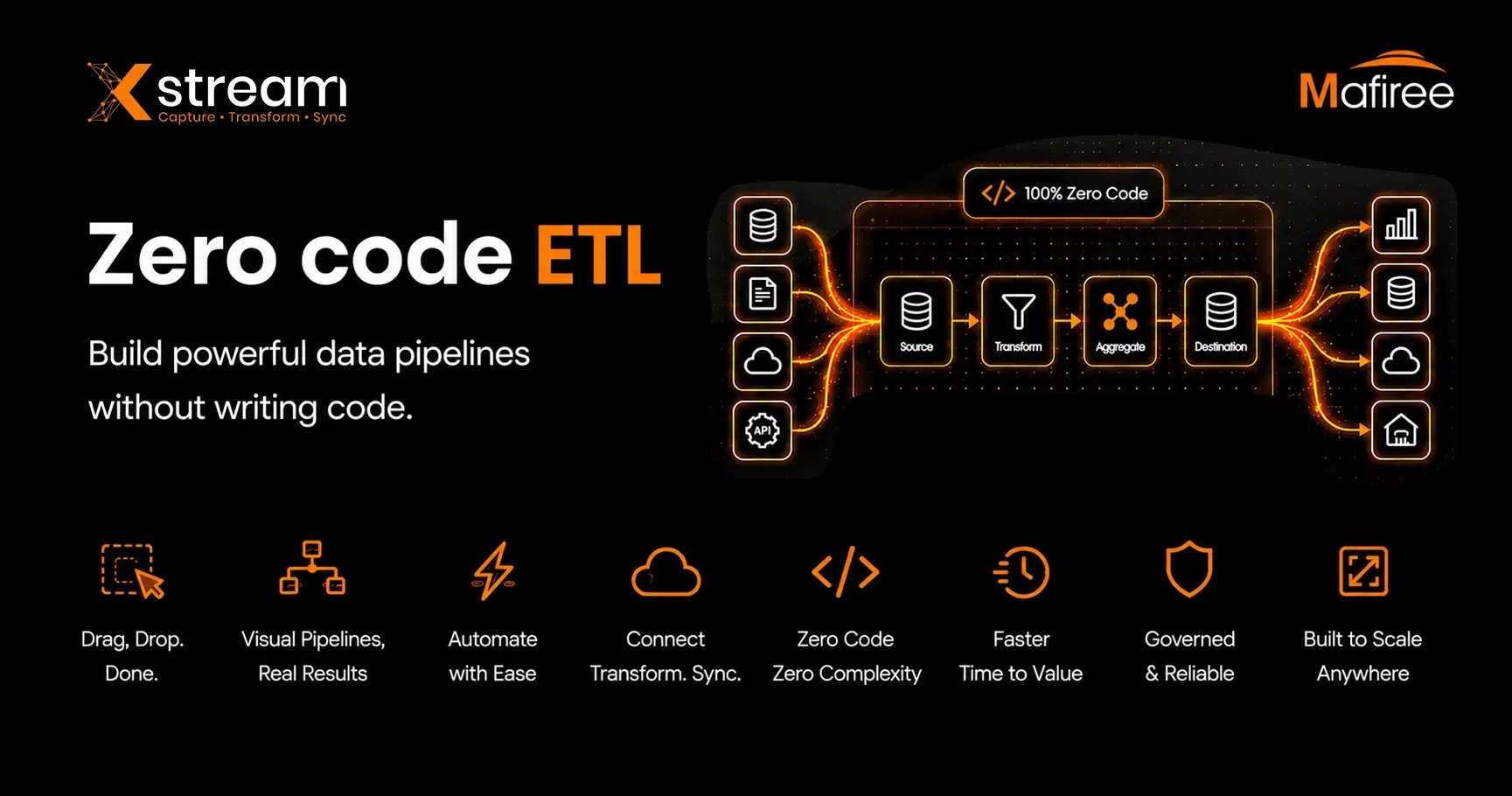
Zero-Code ETL emerged to close that gap. Rather than building pipelines manually through code, teams can now assemble them using visual workflows, automation, prebuilt connectors, and real-time synchronization, reducing reliance on heavy coding and constant maintenance.
How Zero-Code ETL Works
Consider an e-commerce company processing thousands of daily orders that wants sales data flowing automatically into dashboards and analytics tools in real time. Traditionally, this would mean writing integration scripts, configuring APIs, building transformation logic, scheduling workflows, and manually monitoring for failures. With Zero-Code ETL, users instead connect systems through visual interfaces and configure automated workflows while the platform manages the underlying complexity. This connects to the rise of real-time MySQL CDC (Change Data Capture) architectures, where database changes stream continuously instead of waiting on scheduled batch jobs.
Why Businesses Are Moving On From Traditional ETL
As systems scaled, manual pipeline management became increasingly unworkable. Even simple pipelines once required SQL queries, Python scripts, infrastructure setup, and ongoing debugging, and a single failed connection or schema change could halt the entire flow. Organizations realized they were spending more time fixing pipelines than using the data itself. Zero-Code ETL cuts down manual engineering effort, development time, operational overhead, and maintenance complexity, letting teams focus on insights and growth rather than infrastructure.
Why Businesses Zero-Code ETL
Modern operations run in real time, and teams no longer want to wait hours for reports to refresh. Zero-Code ETL enables faster pipeline deployment, less reliance on manual coding, simpler maintenance, better efficiency, and quicker data access, which matters as workloads scale into billions of records streamed continuously across distributed systems.
Making Real-Time Data Easier
Real-time data has become essential everywhere: banks track transactions instantly, e-commerce platforms monitor live orders, AI systems process data continuously, and logistics companies oversee operations in real time. Traditional batch-based ETL wasn't built for this pace, but Zero-Code platforms keep data continuously synced. Many organizations now use operationally simple CDC pipelines that stream only the changes rather than repeatedly transferring full datasets, improving analytics, supporting AI applications, and speeding up issue response.
What Makes Zero-Code ETL So Simple
Usability is the main driver behind Zero-Code ETL's popularity. Instead of writing extensive code, users build pipelines through drag-and-drop interfaces, automated scheduling, prebuilt connectors, monitoring dashboards, and transformation tools, opening integration up to developers, analysts, operations teams, and business users alike.
Zero-Code ETL vs. Traditional ETL
Compared to traditional ETL, Zero-Code ETL relies on visual workflows rather than manual coding, is usable by non-developers, deploys faster through configuration instead of custom builds, needs simplified rather than constant maintenance, scales more easily, adapts better to system changes, carries lower operational overhead, delivers faster time to value, and suits real-time, continuous data needs rather than batch processing.
Where It's Used
This approach spans many industries: e-commerce order dashboards, real-time financial transaction monitoring, healthcare data synchronization, and continuous operational processing in transportation and logistics, where real-time ETL at scale is critical for visibility and fast decisions.
Accessibility and Limitations
A core advantage is accessibility for non-developers, though understanding workflows still matters. Zero-Code ETL isn't a fit for everything; some businesses still need advanced customization, specialized integrations, custom scripting, or large-scale optimization, and may face challenges with scalability planning and vendor dependency.
Why Zero-Code ETL Growing Rapidly
Zero-Code ETL is expanding quickly because data volumes keep rising and manual integration management has become slow and costly. Businesses need faster deployment, real-time access, simplified operations, better scalability, and reduced maintenance.
Simplifying Pipelines With Xstreami
Modern data pipelines often grow complex as systems scale, with schema changes, failed integrations, and growing workloads causing delays. Xstreami by Mafiree simplifies this through automation and real-time workflows. The goal of Zero-Code ETL isn't removing technology, but unnecessary complexity, so businesses can focus on using data effectively.