Your Eyes Are Trying to Tell You Something. Are You Listening?
A colleague of mine ignored a strange flicker in her left eye for four days, assuming it was screen fatigue. It turned out to be an early retinal warning sign. She was lucky. The lesson she took away was simple: most people have no framework for deciding when an eye symptom is routine and when it is urgent.
That gap in knowledge is worth closing, because the difference between the two often comes down to timing.
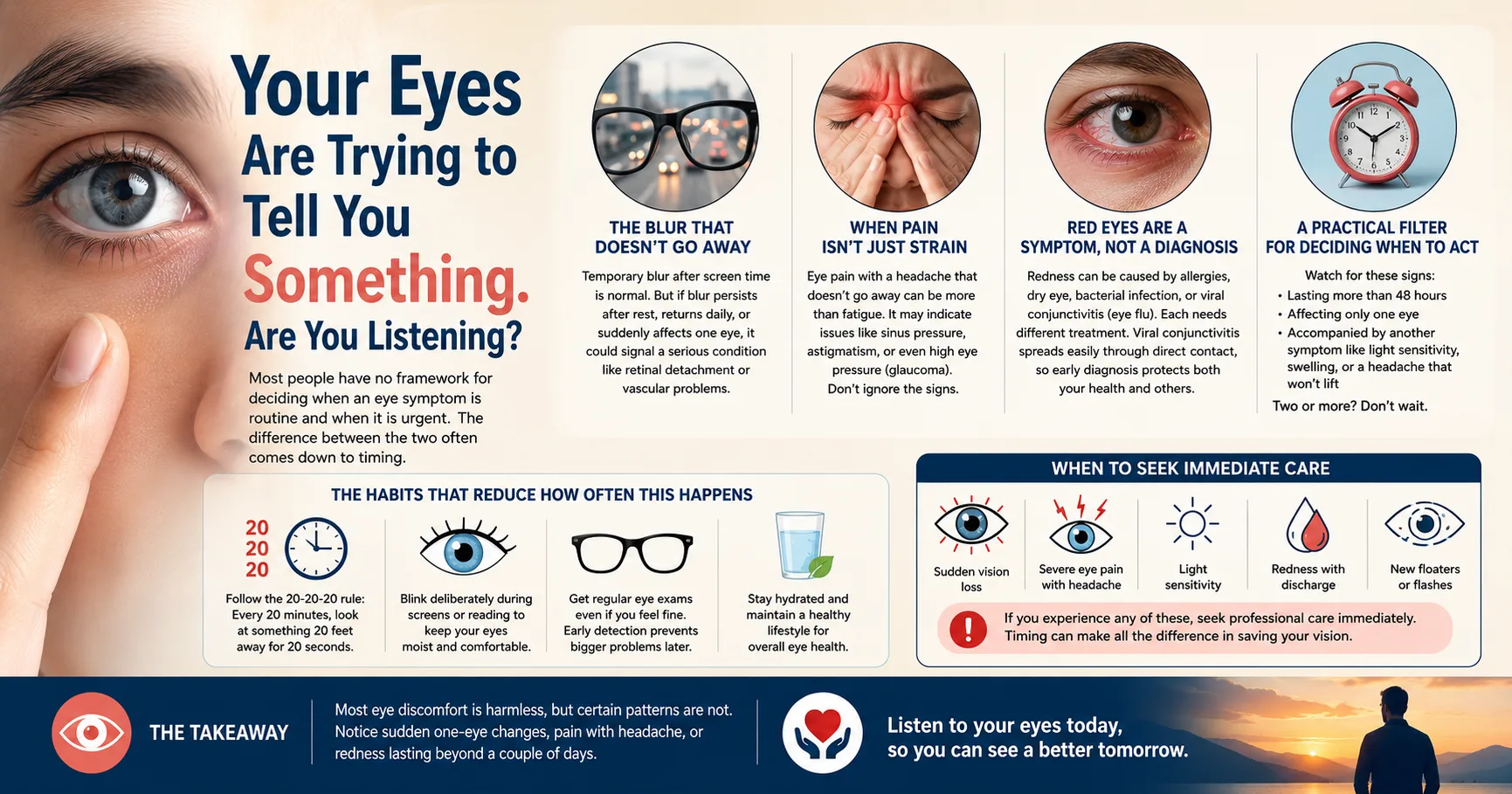
The Blur That Doesn't Go Away
Everyone experiences temporary blur after a long stretch of screen time. It usually clears within minutes once you look away and blink a few times. The pattern worth paying attention to is different: blur that persists after rest, or that returns at the same time every day regardless of activity.
This kind of recurring blur is frequently tied to uncorrected refractive error or early changes in tear film stability, both manageable once identified. What is not routine is a sudden drop in clarity affecting only one eye. The American Academy of Ophthalmology notes that sudden vision changes isolated to a single eye can signal retinal detachment or vascular events in the eye, and that the speed of evaluation directly affects how much vision can be preserved (aao.org, 2024).
In practice, this means a two day old blur in both eyes and a two hour old blur in one eye should never be treated with the same level of urgency. One can wait for a scheduled appointment. The other cannot.
When Pain Isn't Just Strain
Eye pain gets dismissed more often than almost any other symptom, probably because it is so easily blamed on screens. Most of the time that assumption is correct. But there is a specific combination worth flagging: eye pain accompanied by a headache that does not respond to normal rest or hydration.
This pairing can stem from several causes, ranging from sinus pressure to uncorrected astigmatism to, less commonly, elevated intraocular pressure associated with angle closure glaucoma. The overlap in symptoms is exactly why self-diagnosis fails here. A headache from screen strain and a headache from rising eye pressure can feel almost identical to the person experiencing it, but they require completely different responses.
Red Eyes Are a Symptom, Not a Diagnosis
Redness gets treated as a single problem when it is really a symptom shared by at least four unrelated conditions: allergic irritation, dry eye, bacterial infection, and viral conjunctivitis, commonly called eye flu. Each has a different course of treatment, and treating one as though it were another can prolong recovery or, in the case of viral conjunctivitis, extend how long it stays contagious.
The Centers for Disease Control and Prevention notes that viral conjunctivitis typically spreads through direct contact and can move quickly through households and workplaces within days of exposure (cdc.gov, 2023). That contagion window is exactly why an early, correct diagnosis matters more here than with most other eye symptoms.
A Practical Filter for Deciding When to Act
Instead of memorizing every possible diagnosis, a simpler filter works for most people: has the symptom lasted more than 48 hours, is it affecting only one eye when it previously affected both or neither, and is it accompanied by a second symptom such as light sensitivity, swelling, or a headache that will not lift.
Any one of these three on its own is often benign. Two or more together is the point at which waiting stops being a reasonable strategy.
The Habits That Reduce How Often This Happens
Beyond recognizing warning signs, a handful of habits meaningfully cut down how often these symptoms show up in the first place. The 20-20-20 rule, looking at something 20 feet away for 20 seconds every 20 minutes, remains one of the best studied interventions for screen related eye strain. Blinking deliberately during long reading or screen sessions helps maintain tear film, since blink rate drops significantly during focused visual tasks. And routine eye exams, even in the absence of symptoms, catch gradual changes long before they become symptomatic at all.
The Takeaway
Most eye discomfort is exactly as harmless as it feels. The skill worth building is not constant vigilance, but the ability to notice the handful of patterns, sudden one-eye changes, pain paired with headache, redness lasting beyond a couple of days, that separate ordinary fatigue from something that needs a professional look. Getting that distinction right is a small habit with an outsized payoff.
Sources: American Academy of Ophthalmology, "Sudden Vision Loss," aao.org, 2024. Centers for Disease Control and Prevention, "Conjunctivitis (Pink Eye)," cdc.gov, 2023.
For more information:https://corevisioneye.com/