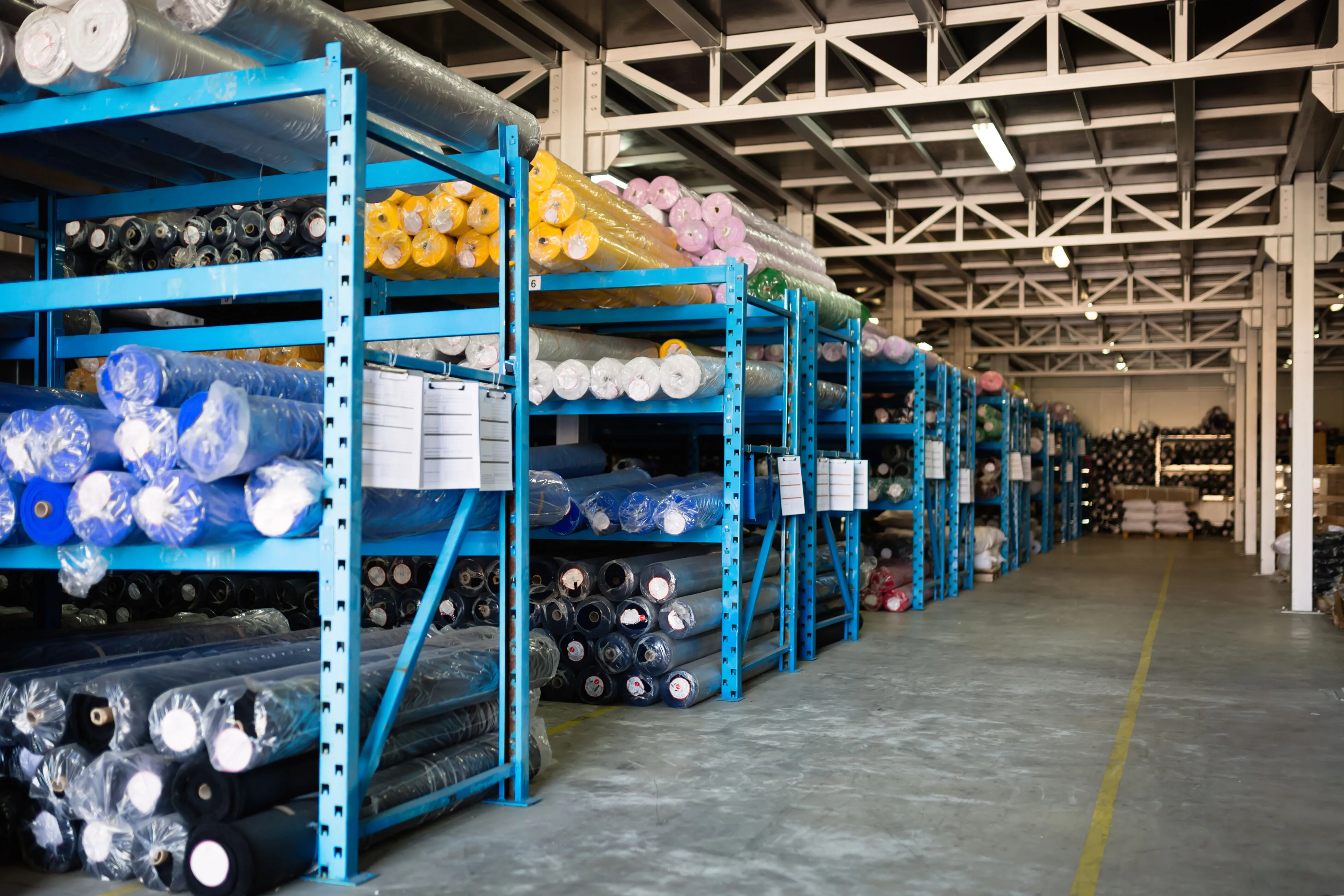
Walk into a carpet warehouse in the UAE and you’ll often notice the same thing.
Large rolls leaning against walls. Carpet stacks taking up floor space. Employees moving one roll just to reach another. Forklifts trying to work around storage that seemed perfectly manageable a few months ago.
Then someone says, “We need a bigger warehouse.”
Maybe.
But here’s the thing: sometimes the warehouse isn’t the real problem.
The storage method is.
Carpets are awkward products to store. They can be long, heavy, rolled, bulky, and difficult to access if they are simply placed wherever there happens to be space.
That is where properly planned Carpet Storage Racking Solutions in Dubai and across the UAE can make a real difference.
Not because racking magically creates more warehouse space.
It doesn’t.
It creates a better way to use the space you already have.
The carpet storage problem is different from normal pallet storage
A pallet is relatively predictable.
It has a defined footprint. You can stack it, rack it, move it with a forklift and generally know what you are dealing with.
Carpet rolls are different.
One roll may be short and compact. Another may be several metres long. Some may be heavy enough to require mechanical handling. Others may need to remain accessible because customers or installers are constantly asking for specific designs, colours or sizes.
This creates an interesting problem.
You can have plenty of floor area and still struggle to find anything.
I’ve seen warehouses where the issue wasn't actually a lack of storage capacity. It was poor accessibility.
And that distinction matters.
If employees have to move three or four rolls before they can reach the one they need, the warehouse is technically storing the product — but operationally, it isn't working very well.
You might think floor storage is cheaper
And at first glance, it can be.
Why spend money on a storage system when you can simply place carpet rolls on the floor?
That approach works when inventory is small and movement is predictable.
The problem starts when the business grows.
Suddenly, the floor becomes a storage map that only experienced employees understand.
One area is for new stock. Another is for customer orders. Another is supposedly reserved for damaged material. Somewhere near the back are older rolls that nobody wants to move because reaching them is a headache.
This is where the hidden cost appears.
Floor space becomes difficult to access.
Handling takes longer.
Products can become harder to identify.
And valuable vertical space above the floor remains unused.
Good warehouse racking solutions address this differently by giving the warehouse a planned storage structure.
So what does carpet racking actually improve?
The first improvement is usually space utilisation.
Not simply “more storage.”
Better use of available storage space.
A properly designed racking arrangement can make use of vertical height while keeping floor-level movement organised. Depending on the carpet type, roll dimensions and handling method, different rack configurations can be considered.
The right choice depends on the actual product.
That sounds obvious, but it is an important point.
There is no single racking system that automatically works for every carpet warehouse.
Accessibility can matter more than capacity
This is one of the biggest things businesses sometimes overlook.
Imagine a warehouse holding 500 carpet rolls.
One storage layout allows you to technically fit 600 rolls, but employees constantly need to move other rolls to reach the required product.
Another layout holds 520 rolls, but individual rolls are easier to identify, reach and retrieve.
Which warehouse is actually more efficient?
The answer isn't necessarily the one holding 600.
Storage capacity is only one part of warehouse efficiency.
Accessibility matters.
If a customer needs a particular carpet urgently, the employee should ideally be able to locate it without turning the surrounding storage into a puzzle.
That can reduce unnecessary handling and make daily warehouse operations more predictable.
Carpet Storage Racking Solutions in Dubai need to consider the building
This is where a generic online recommendation can fall apart.
A warehouse in Dubai may have completely different conditions from one in Sharjah or another UAE location.
The available floor area matters.
So does clear height.
So does the condition and levelness of the floor.
Then there is the question of how the carpet rolls actually enter and leave the warehouse.
Are forklifts being used?
Are workers handling smaller rolls manually?
Are goods loaded directly from delivery vehicles?
How frequently does stock move?
These questions should come before choosing a rack.
Not after.
A storage system should fit the warehouse operation rather than forcing the operation to fit the rack.
What should you check before choosing a carpet storage system?
Start with the carpet itself.
Measure the typical roll length, diameter and weight. Don't base the entire design on the smallest roll in the warehouse.
Look at the heaviest and largest products too.
Then look at inventory movement.
Which products move every day?
Which ones stay for weeks?
Which products need quick access?
Which ones can be stored higher?
This information can influence how the warehouse should be organised.
For example, frequently requested carpet rolls may need to remain in easier-to-access positions, while slower-moving inventory can potentially occupy less convenient locations.
That simple change can make everyday work much easier.
Don't forget the forklift
This is another area where storage plans sometimes look good on paper but become difficult in real life.
A rack may technically fit inside a warehouse.
But can the forklift actually approach it safely?
Is there enough aisle width?
Can the operator turn?
Can the load be lifted to the required height?
Can employees work around the rack without creating unnecessary congestion?
These questions matter because the storage system is only one part of the warehouse.
The aisles, equipment, loading area and people all have to work together.
Vertical space is often the forgotten asset
Look around a typical warehouse.
How much space exists above the products?
A surprising amount.
Many warehouses use only the lower portion of their available height because floor storage feels easier.
But warehouse height is valuable.
If the building allows it and the rack system is properly engineered for the application, vertical storage can reduce pressure on the floor.
This doesn't mean every warehouse should simply build taller racks.
There are practical limits involving building conditions, equipment, product characteristics, access, safety and the overall warehouse layout.
The point is simpler:
Don't design your storage around the floor alone.
Look at the warehouse as a three-dimensional space.
A carpet warehouse is also a picking environment
This is something that becomes obvious once you spend enough time around warehouse operations.
Storage isn't just about keeping products somewhere.
People need to find them.
They need to inspect them.
They need to move them.
They need to prepare customer orders.
They need to receive new stock while existing stock is still moving.
So the storage system has to support these activities.
A good layout can create clearer movement paths between receiving, storage and dispatch.
That can make the warehouse feel less chaotic even before the company adds more capacity.
And that is often the real goal.
Not a warehouse that looks impressive.
A warehouse that works.
What about Sharjah?
The same thinking applies when looking at Carpet Storage Racking Solutions in Sharjah.
A warehouse may have plenty of space, but the available dimensions and operating requirements will determine what makes sense.
For some businesses, the priority may be increasing storage density.
For another, quick access to frequently sold carpet rolls may be more important.
For another, the main challenge may be reorganising an existing warehouse without interrupting daily operations.
There is no useful answer without understanding the operation first.
That's why a proper site assessment is usually more valuable than choosing a rack based purely on photographs or a product catalogue.
The cheapest rack isn't always the cheapest storage solution
This is worth saying clearly.
A low initial purchase price doesn't necessarily mean a low overall cost.
Suppose an inexpensive storage arrangement saves money during installation but makes every retrieval slower.
If employees spend extra time moving products every day, that cost continues long after the rack has been installed.
The same applies to poor space utilisation.
If a badly planned layout forces a company to rent additional warehouse space earlier than expected, the original “cheap” storage solution may turn out to be considerably more expensive.
So when comparing warehouse racking solutions, don't look only at the price of the steel.
Look at what the system changes operationally.
Safety has to be part of the design
Carpet rolls can be heavy.
Improvised storage can create unnecessary handling risks, especially when products are stacked, leaned or placed where they can shift unexpectedly.
A properly planned storage system should take product weight, dimensions, handling equipment, rack configuration, floor conditions and safe working practices into account.
The exact requirements depend on the installation and application, so this is not an area where businesses should rely on guesswork.
Storage should be designed around the actual load.
Not an estimate.
Not “it should be fine.”
The actual load.
When should a carpet business consider racking?
There isn't one magic number.
But there are some obvious warning signs.
If employees regularly move products just to reach other products, that's a sign.
If floor space is disappearing despite reasonable inventory levels, that's another.
If workers struggle to identify where specific rolls are stored, the layout may need attention.
And if the business is considering renting a larger warehouse simply because the current one feels full, it may be worth reviewing the storage arrangement first.
Sometimes a layout change can solve part of the problem.
Sometimes it won't.
But it's worth finding out before taking on a much larger fixed cost.
The real goal isn't “more racks”
This is probably the biggest misconception.
A warehouse doesn't become efficient because someone installed a lot of racking.
It becomes efficient when the storage system supports the way the business actually operates.
For carpet businesses, that means thinking about roll dimensions, weight, movement frequency, access, vertical space, handling equipment and the flow of people and products.
Get those things right, and the racking becomes part of a much bigger improvement.
Final thought: look at the warehouse differently
When a carpet warehouse starts feeling crowded, the natural reaction is to look for more floor space.
But before doing that, stop for a moment.
Look upward.
Look at the aisles.
Look at how employees retrieve products.
Look at how often the same carpet rolls are being moved.
Look at the space being consumed by products that could potentially be organised differently.
That's where Carpet Storage Racking Solutions in Dubai can become more than a storage purchase.
They can become a way of rethinking how the warehouse operates.
And sometimes, the most useful warehouse upgrade isn't moving into a bigger building.
It's making the current building work harder.