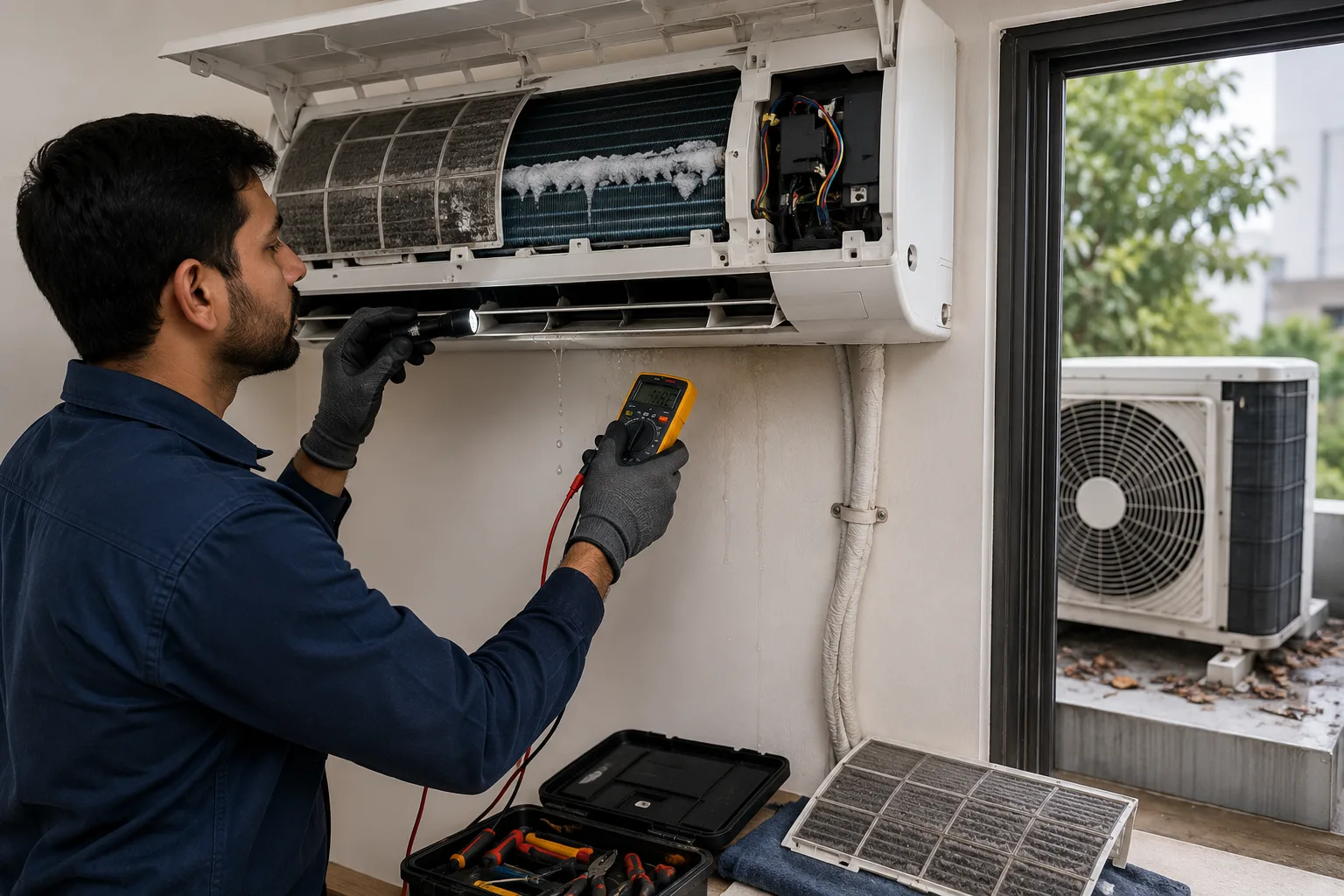
An air conditioner may sound normal, run for a long time, and still fail to cool the room. The air may feel slightly cool near the vent, but the temperature does not drop enough to make the space comfortable.
The cause may be a dirty filter, blocked coil, weak fan, incorrect thermostat setting, refrigerant leak, or compressor problem. Some issues are simple to check, while others need professional testing.
Start with airflow and settings before assuming the AC needs a major repair.
Check the Thermostat Settings
A small setting mistake can make the AC run without providing proper cooling.
Confirm that:
- Cooling mode is selected
- The temperature is below the current room temperature
- Fan-only mode is not active
- A timer is not limiting operation
- The thermostat or remote batteries are working
- An energy-saving mode is not reducing cooling
Lower the temperature by a few degrees and wait several minutes.
Do not set the thermostat extremely low. This will not make the room cool faster and may keep the system running longer than needed.
If the displayed temperature does not match how the room feels, the thermostat or temperature sensor may be giving an incorrect reading.
Clean the Air Filter
A blocked filter is one of the most common causes of weak AC cooling.
Dust and dirt reduce the amount of air passing through the indoor unit. The system may still produce cold air, but it cannot distribute enough of it around the room.
A dirty filter may cause:
- Weak airflow
- Longer cooling times
- Higher electricity use
- Ice on the evaporator coil
- Water leakage
- Dusty or musty smells
Switch off the AC before removing the filter.
Wash reusable filters according to the manufacturer’s instructions and allow them to dry fully. Replace disposable filters instead of washing them.
If cooling improves after cleaning, restricted airflow was probably contributing to the problem.
Check for Blocked Indoor Vents
Furniture, curtains, shelves, and large objects can block airflow from the indoor unit.
Make sure air can move freely across the room.
Also check that the return-air area is not covered. The AC needs to pull warm room air into the unit before cooling it.
Poor furniture placement may cause one part of the room to feel cold while the rest remains warm.
The small details are what make the biggest difference. Moving a sofa or curtain away from the AC may improve air distribution without any repair.
The Evaporator Coil May Be Dirty
The evaporator coil absorbs heat from the room.
Dust can pass through a dirty or damaged filter and collect on the coil. This layer reduces heat transfer and may restrict airflow.
Possible signs include:
- Weak cooling
- Reduced airflow
- Ice around the indoor unit
- Water dripping after the AC is turned off
- A musty smell
- The system running continuously
Surface dust around accessible areas may be cleaned during normal maintenance, but the coil itself often needs proper tools and suitable cleaning products.
Avoid spraying strong household chemicals into the unit. They may damage the coil coating, plastic parts, sensors, or drainage system.
For support with AC systems and other household equipment, you can review local appliance repair services in Sharjah and choose help based on the exact fault.
The Evaporator Coil Is Frozen
Ice on the indoor coil blocks airflow and prevents normal cooling.
A frozen coil may be caused by:
- A dirty filter
- A weak blower fan
- Low refrigerant
- A blocked coil
- A faulty temperature sensor
- Running the AC at a very low setting
- Poor airflow around the indoor unit
Turn the AC off if you see ice. Running it while frozen may damage the compressor and lead to water leakage when the ice melts.
Allow the ice to melt naturally. Keep the area below the unit protected from dripping water.
Do not break the ice with a sharp tool. Cooling pipes and coil fins can be damaged easily.
If the ice returns after cleaning the filter, the system needs inspection.
The Indoor Fan May Be Weak
The blower fan moves cooled air into the room.
If the motor, capacitor, or fan wheel is damaged, the AC may produce cold air internally but fail to move enough of it.
Signs include:
- Weak airflow at every fan-speed setting
- Buzzing or grinding sounds
- Air coming from only part of the vent
- The fan starting slowly
- The indoor unit switching off unexpectedly
Dust can also collect on the blower wheel and reduce its performance.
Fan and capacitor testing involves electrical parts. Do not open the unit or touch the motor wiring yourself.
The Outdoor Unit May Be Blocked
The outdoor unit releases heat removed from the room.
If the condenser coil is covered with dust, leaves, or debris, the system may struggle to release heat. Cooling becomes weaker, and the compressor may run for longer periods.
Check whether:
- The outdoor unit has space around it
- Leaves or rubbish block the airflow
- Stored items sit against the coil
- The fan is turning
- The unit makes unusual sounds
Remove loose debris from around the unit while the power is off.
Do not spray high-pressure water into the coil. The thin fins can bend and restrict airflow further.
A dirty condenser may need professional cleaning, especially if grease or heavy dust has collected deep inside.
Low Refrigerant or a Gas Leak
Refrigerant carries heat from the indoor unit to the outdoor unit.
Low refrigerant can cause:
- Weak cooling
- Ice on the indoor coil
- The AC running continuously
- Warm air from the vents
- Hissing sounds
- Higher electricity use
- Cooling becoming worse over time
Refrigerant does not normally run out through everyday use. If the level is low, there is probably a leak.
The leak should be found and repaired before refrigerant is added. Simply refilling the system may only provide temporary cooling.
Do not handle refrigerant lines yourself. This work requires pressure testing, suitable equipment, and proper technical knowledge.
The Compressor May Be Struggling
The compressor circulates refrigerant through the AC system.
A weak or damaged compressor may allow the fans to run while cooling remains poor.
Possible signs include:
- The outdoor fan runs but the room stays warm
- Repeated clicking from the outdoor unit
- The compressor starts and stops quickly
- The outdoor unit becomes unusually hot
- The circuit breaker trips
- Cooling stops completely
A capacitor, relay, control connection, or power problem can create similar symptoms.
The compressor should not be replaced before the electrical parts, refrigerant level, and airflow have been checked.
The Room May Be Gaining Too Much Heat
Sometimes the AC is working, but the room is gaining heat faster than the system can remove it.
Common causes include:
- Open doors or windows
- Direct afternoon sunlight
- Poor insulation
- Heat from cooking equipment
- Several people in a small room
- An AC that is too small for the space
- Air leaks around windows or doors
Close windows and curtains during the hottest part of the day.
If the AC has never cooled the room properly, the system size or installation may be unsuitable. If cooling was strong before and suddenly became weak, a maintenance or repair issue is more likely.
Safe Checks You Can Do First
Before calling a technician:
- Confirm cooling mode is selected.
- Lower the thermostat slightly.
- Clean the air filter.
- Remove objects blocking airflow.
- Close doors and windows.
- Check for ice on the indoor unit.
- Look for water leakage.
- Clear loose debris around the outdoor unit.
- Listen for the indoor and outdoor fans.
- Note any error code.
Wait long enough after each change to see whether the room temperature improves.
When Professional AC Repair Is Needed
Arrange an inspection when:
- The filter is clean but cooling remains weak
- Ice returns after melting
- The indoor fan has poor airflow
- The outdoor unit makes repeated clicking sounds
- The AC runs continuously
- Water leaks from the indoor unit
- The circuit breaker trips
- There is a burning smell
- The system produces warm air on cooling mode
- Cooling performance keeps getting worse
A technician may need to test refrigerant pressure, fan motors, capacitors, sensors, coils, wiring, the compressor, and the control board.
How to Choose the Best Affordable AC Cooling Repair
A proper repair should identify why the system is not removing enough heat.
Ask the technician:
- Has the filter and coil condition been checked?
- Is the airflow strong enough?
- Is there a refrigerant leak?
- Are the indoor and outdoor fans working?
- Has the capacitor been tested?
- Is the compressor operating correctly?
- Will the room temperature be checked after repair?
- Are parts and labour included in the quote?
A cheap refrigerant refill may not be the best affordable option if the leak remains.
For help with weak cooling, frozen coils, fan faults, refrigerant leaks, sensors, and compressor problems, affordable AC repair in Sharjah may be useful when cleaning and basic setting checks do not improve performance.
Final Thoughts
An AC may run without cooling properly because of incorrect settings, a dirty filter, blocked airflow, dirty coils, weak fans, low refrigerant, or a compressor fault.
Start with the safe checks around the thermostat, filter, vents, doors, windows, and outdoor unit.
If the system still produces weak or warm air, arrange an inspection before repeated operation places more pressure on the compressor and electrical parts.