
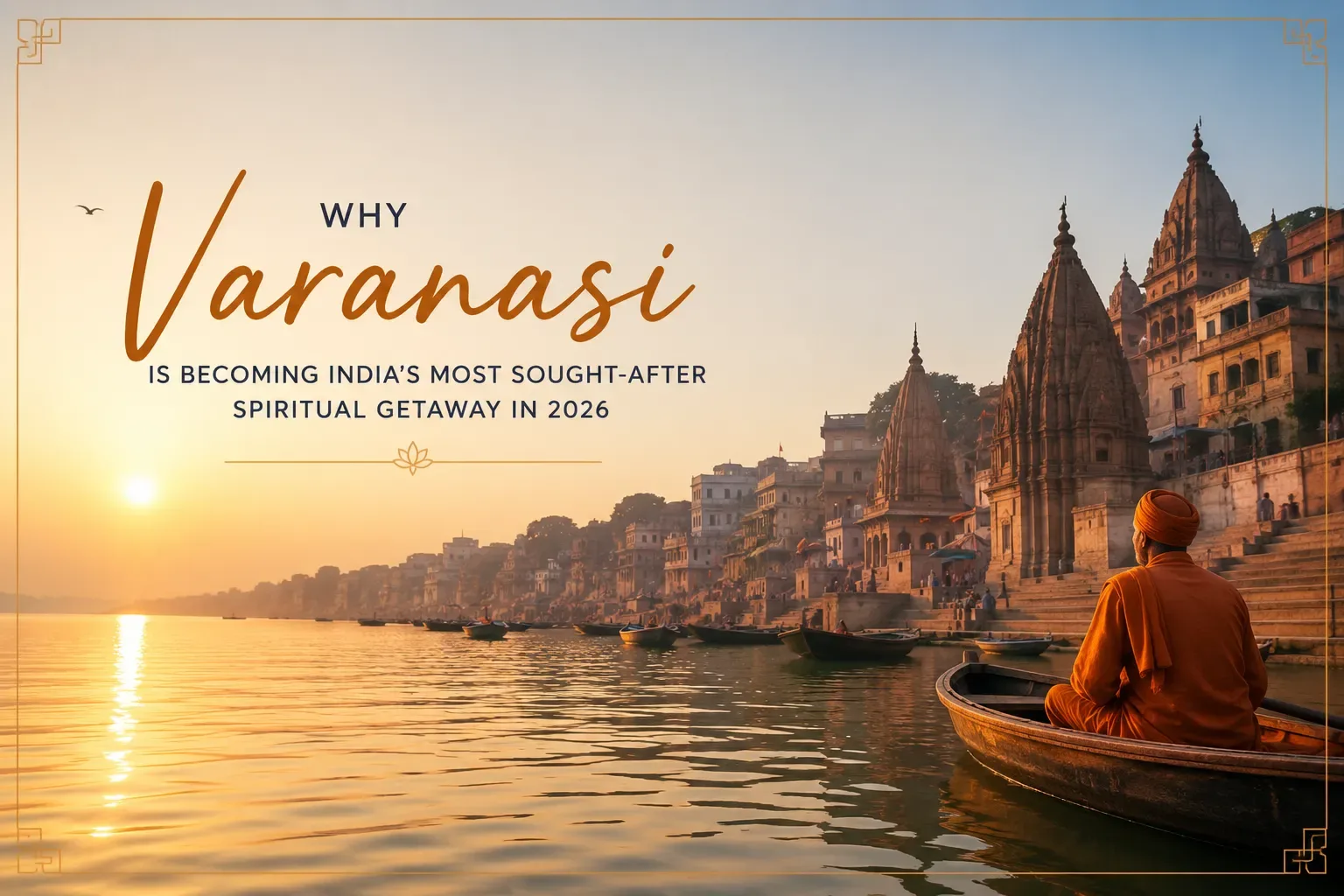
On a foggy October morning in 2026, a small wooden boat drifts quietly along the Ganga. On board are five strangers: a software engineer from Bengaluru, a retired schoolteacher from Pune, and a young couple on their honeymoon. None of them know each other, yet all of them are silent, watching the same thing, the sky over Varanasi turning from grey to gold as the first bells of the morning aarti ring out from the ghats.
This is not a rare scene. It happens every single day in Varanasi, and it is exactly why the city, one of the oldest continuously inhabited places on earth, is seeing a fresh wave of travelers in 2026. People are not just visiting temples anymore. They are searching for something slower, something real, in a world that moves too fast.
Why Everyone Is Suddenly Talking About Varanasi Again
For years, Varanasi was seen mainly as a religious destination, a place pilgrims visited once in a lifetime. That picture has changed. Today, the city is drawing a much wider mix of travelers: young professionals looking for a digital detox, photographers chasing the golden light on the ghats, food lovers hunting down the city's famous street snacks, and families wanting a trip that feels meaningful rather than just relaxing.
A few reasons stand out for this shift.
Better infrastructure. The Kashi Vishwanath Corridor has made it far easier to move between the temple and the river, cutting down the confusion that once put off first-time visitors.
Social media discovery. Short videos of the Ganga Aarti and sunrise boat rides have turned Varanasi into one of the most shared destinations online, pulling in travelers who had never considered it before.
A growing appetite for slow travel. After years of fast, checklist-style tourism, more people now want trips built around presence and reflection, and few Indian cities offer that as naturally as Varanasi.
What Makes a Trip to Varanasi Different
Varanasi does not reveal itself the way most cities do. You do not "see" Varanasi from a car window. You feel it, in the smell of incense drifting through narrow lanes, in the sound of temple bells overlapping with boatmen calling out fares, in the sight of pilgrims taking their morning dip as the sun rises over the river.
The city's rhythm revolves around a few unmissable experiences:
- The Ganga Aarti at Dashashwamedh Ghat, an evening ritual where priests perform a synchronized ceremony with fire, bells, and chanting, watched by thousands from the steps and from boats on the water.
- A sunrise boat ride, widely considered the single best way to experience the city, as the ghats slowly come alive with morning prayers.
- Kashi Vishwanath Temple, one of the twelve Jyotirlingas dedicated to Lord Shiva, and the spiritual center of the entire city.
- Sarnath, a short trip from the main city, and one of the most important Buddhist pilgrimage sites in the world, marking the place of Buddha's first sermon.
- The old city lanes, narrow, chaotic, and full of life, lined with flower sellers, sweet shops, and centuries-old silk weaving workshops.
None of this happens on a fixed schedule that suits every traveler. The aarti has its own timing, temple entry has its own process, and the streets are too narrow for regular vehicles. This is exactly why most visitors, especially first-timers, families, and anyone short on time, prefer to travel with a well-planned itinerary rather than figuring it all out on the ground.
Beyond the Ghats: What Else Comes With a Varanasi Trip
Varanasi rarely stays a solo destination for long. Its location in eastern Uttar Pradesh places it within easy reach of some of the country's most significant pilgrimage sites. Ayodhya, centered on the Ram Mandir, is about 200 km away and pairs naturally with Varanasi for a Ram to Shiva circuit. Prayagraj, home to the Triveni Sangam, the meeting point of the Ganga, Yamuna, and the mythical Saraswati, is barely two to three hours away by road.
This is where trip planning starts to matter. Travelers with two or three days usually stay focused on Varanasi alone. Those with four to five days often add Prayagraj or Ayodhya. And anyone with a week or more can comfortably cover a wider circuit that includes Chitrakoot or Naimisharanya as well. Anyone comparing options can browse a full range of these itineraries through the Varanasi tour packages available online, which lay out day-wise plans for everything from a quick two-day visit to an eleven-day pilgrimage across Uttar Pradesh.
Food, Shopping, and the Small Details That Add Up
No trip to Varanasi is complete without its street food. Kachori sabzi at breakfast, a thick Banarasi lassi served in earthen kulhad cups, and tamatar chaat from the lanes near Godaulia are as much a part of the city as its temples. Winter travelers get an added bonus, malaiyo, a light, saffron-flavored milk foam dessert sold only in the colder months.
Shopping, too, is part of the experience. Varanasi is famous for its Banarasi silk sarees, hand-painted wooden toys, and brassware, much of it made using techniques passed down for generations. Areas like Vishwanath Gali and Thatheri Bazaar sit close enough to the ghats that an evening walk easily turns into an hour of browsing.
The Best Time to Go
Winter, from October to February, remains the most popular season, with cool, clear weather that makes the sunrise boat rides and evening aartis genuinely enjoyable, though this is also when the ghats are busiest, especially around festivals like Dev Deepawali. Summer, from April to June, is hot but far less crowded, which some travelers actually prefer. The monsoon months bring a fuller, greener Ganga, though sudden rain can disrupt plans, so flexibility helps.
A Trip Worth Planning Properly
Varanasi is not a city you rush through. It rewards travelers who take the time to plan, choosing the right ghat for sunrise, understanding temple timings, and deciding in advance how many nearby destinations to include. Done right, a trip here does not just tick off a list of monuments. It leaves you with something harder to put into words, the same feeling that quiet boatload of strangers carried with them, long after their journey down the Ganga had ended.