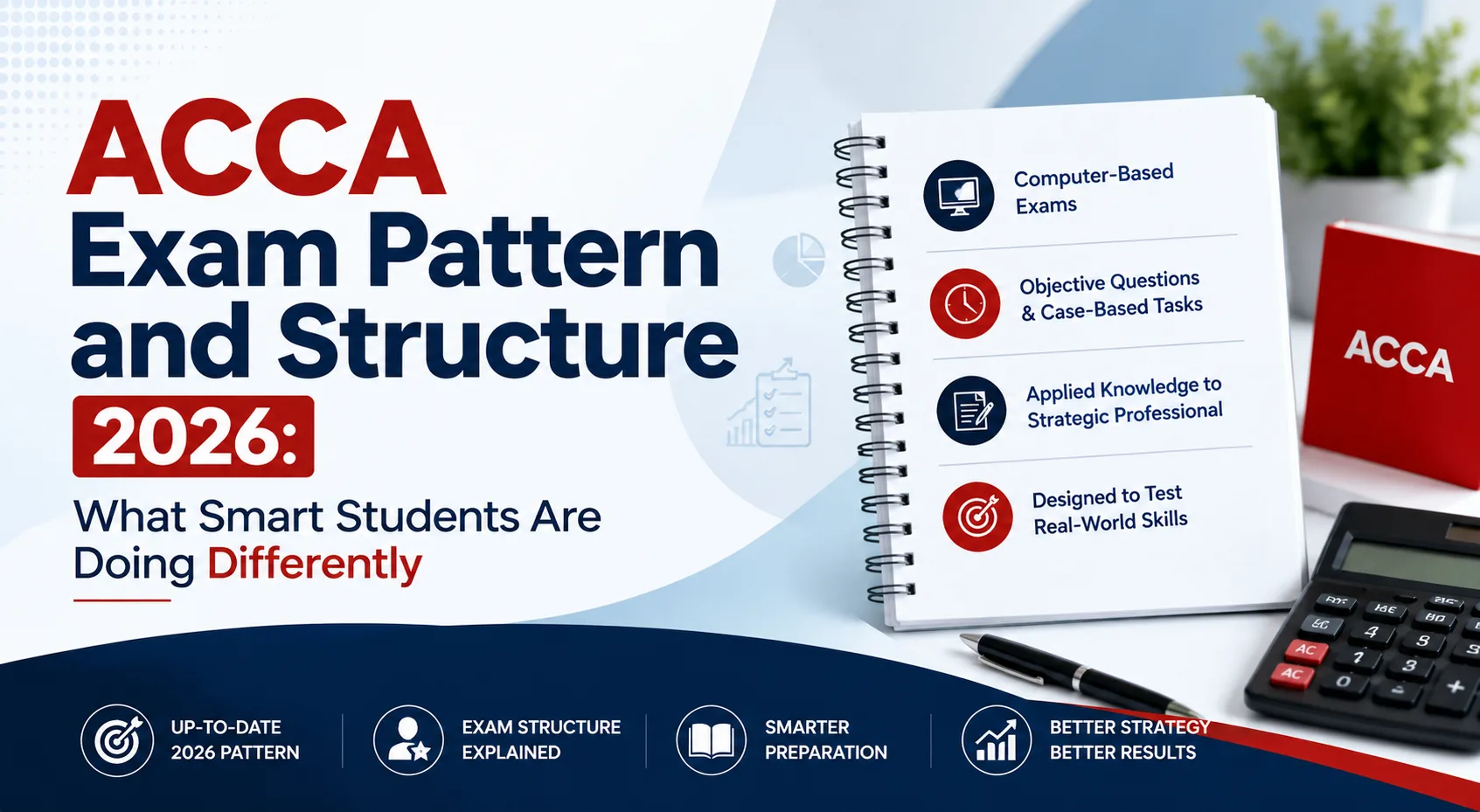
The accounting and finance industry is becoming increasingly competitive, and students pursuing international certifications are now expected to develop both technical expertise and practical business understanding. One of the biggest mistakes many students make while starting their ACCA journey is ignoring the importance of understanding the ACCA exam pattern and structure before beginning preparation.
The ACCA qualification is globally recognized and highly respected across accounting, auditing, taxation, consulting, and financial management industries. However, the examination structure is very different from traditional university-style examinations. ACCA focuses heavily on analytical thinking, professional judgment, scenario-based interpretation, and real-world business application rather than simple memorization.
The ACCA qualification is divided into three major levels:
- Applied Knowledge
- Applied Skills
- Strategic Professional
Each stage is designed to gradually develop professional accounting and finance competencies required in modern global business environments.
The Applied Knowledge level introduces students to core accounting concepts, management accounting principles, and business fundamentals. These exams are computer-based and mostly objective in nature. This stage helps students build a strong technical foundation before progressing to advanced finance topics.
The Applied Skills level becomes more analytical and application-focused. Students study important subjects including:
- Financial Reporting
- Financial Management
- Taxation
- Audit and Assurance
- Performance Management
- Corporate and Business Law
At this stage, students must solve business-oriented scenarios and demonstrate conceptual clarity through structured answers and interpretation-based responses. Time management becomes increasingly important because students are expected to analyze questions quickly and present professional solutions under exam pressure.
The Strategic Professional level is considered the most advanced stage of ACCA. Papers at this level focus on leadership, strategic analysis, business decision-making, risk management, and professional ethics. Examinations such as Strategic Business Leader (SBL) test students through integrated business case studies that simulate real corporate situations.
One of the biggest reasons why understanding the ACCA exam pattern matters is because many students fail due to poor preparation strategies rather than lack of intelligence or effort. Students often focus only on reading theory while ignoring mock test practice, answer presentation techniques, and scenario interpretation skills.
Successful ACCA preparation usually involves:
- Concept-based learning
- Consistent mock test practice
- Time management improvement
- Case-study analysis
- Professional writing techniques
- Strategic revision planning
Students who understand the ACCA exam structure early are generally able to prepare more efficiently and confidently.
Professional mentorship can also significantly improve preparation quality and exam performance. Fintelligents provides ACCA coaching with structured study plans, mock examinations, practical mentorship, and flexible online and offline learning support designed for modern accounting and finance careers.
As global finance industries continue evolving and international compliance requirements expand, ACCA-qualified professionals are expected to remain highly valuable across multinational corporations, consulting firms, investment organizations, and global accounting networks worldwide.