Introduction
The testing laboratory industry is undergoing rapid transformation. Clients now expect faster turnaround times, real-time visibility into testing progress, and unwavering compliance with regulatory requirements. Competition has intensified, and traditional operational models—built on paper records, spreadsheets, and manual workflows—struggle to meet modern demands.
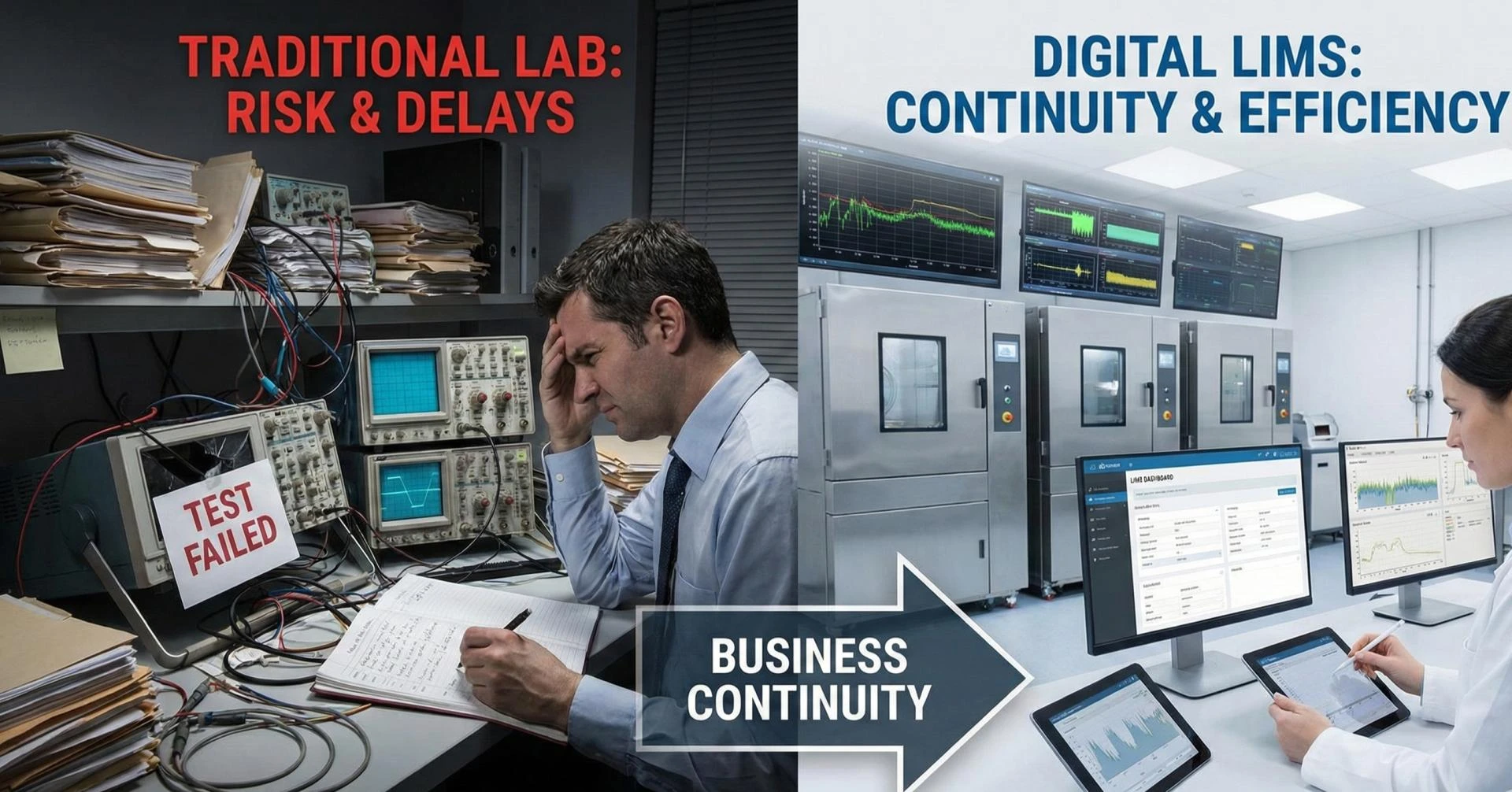
As a result, many laboratories relying on outdated systems face increasing operational pressure. When manual processes fail, the impact spreads quickly: inaccurate data, delayed timelines, audit challenges, and compromised customer confidence. In this environment, business continuity—maintaining consistent, reliable operations despite disruptions—has become essential for the survival of any testing laboratory.
This article explores the root causes of failure in traditional laboratory operations and how digital laboratory management systems (LIMS in general, without promoting any specific platform) support long-term continuity and resilience.
Critical Vulnerabilities in Traditional Laboratory Operations
1. Knowledge Trapped in Individuals
Many laboratories depend heavily on senior technicians whose expertise exists only in their minds. When these individuals are unavailable due to illness, resignation, or retirement, workflow disruptions become unavoidable.
Key risks include:
- Loss of specialized test knowledge
- Inconsistent results due to lack of standardized procedures
- Long onboarding times for new staff
Digital systems help mitigate this by documenting procedures, troubleshooting notes, and historical task information so knowledge is shared rather than isolated.
2. Paper Records as Single Points of Failure
Paper-based management increases the risk of data loss and operational inefficiency. Common issues include:
- Vulnerability to physical damage (fire, flood, etc.)
- Misplaced or incomplete documents
- Difficulty retrieving records during audits
- Inability for multiple users to access the same file
Digitizing documentation reduces these risks and makes records searchable and shareable.
3. Spreadsheets Used as Databases
While spreadsheets are powerful for calculations, they pose limitations when used as primary systems for sample tracking or result management. Problems often include:
- No version control
- Human errors in formulas
- Lack of access restrictions
- Risk of file corruption
- No automated workflow support
Such limitations can lead to data inconsistencies, compliance challenges, and workflow interruptions.
4. Disconnected Systems and Information Silos
Laboratories often use separate tools for sample tracking, equipment maintenance, customer communication, and billing. Without integration:
- Data must be manually re-entered
- Information becomes inconsistent
- Operational visibility is lost
- Coordination between teams becomes difficult
Integrated digital solutions reduce these gaps by allowing data to flow across functions, improving accuracy and transparency.
How Traditional Processes Break Under Pressure
1. Limited Scalability
Manual operations scale linearly—more work requires more staff. As testing demand increases, traditional processes struggle to keep up. This leads to:
- Backlogs and delays
- Increased overtime
- Higher error rates
- Missed business opportunities
Automation and workflow optimization allow labs to expand capacity without proportional staffing increases.
2. Hidden Bottlenecks
Without real-time visibility, managers often find out about delays only after deadlines are missed. Traditional operations lack:
- Live workload dashboards
- Early warning indicators
- Resource utilization insights
Real-time monitoring helps identify bottlenecks before they escalate.
3. Compliance Challenges
Standards like ISO/IEC 17025 require controlled, traceable, and well-documented processes. Paper-based workflows often lead to:
- Missing signatures
- Outdated documents
- Poor traceability
- Difficulty demonstrating compliance during audits
Digitized records and audit trails make compliance easier to maintain continuously.
4. Slow Customer Communication
Modern clients expect immediate status updates. With manual systems, answering even simple questions may require searching through emails or paper logs. This leads to:
- Delayed responses
- Customer dissatisfaction
- Inefficient administrative workload
Self-service portals or centralized information systems can reduce response times significantly.
How Digital LIMS Supports Business Continuity (Non-Promotional View)
1. Knowledge Systematization
Digital LIMS platforms create centralized repositories for:
- Test procedures
- Equipment data
- Client preferences
- Troubleshooting guides
- Quality documentation
This reduces dependence on individuals and supports faster training.
2. Data Protection and Recovery
Modern digital systems include features such as:
- Automated backups
- Redundancy across locations
- Secure cloud storage
- Point-in-time recovery
These measures protect critical information from unexpected disruptions.
3. Consistent Workflow Enforcement
Automated workflows help ensure:
- Mandatory steps are not skipped
- Appropriate approvals are collected
- Deviations are flagged instantly
- Non-conforming results trigger corrective actions
This improves consistency and reduces error rates.
4. Real-Time Operational Insights
Digital LIMS provides visibility into:
- Work-in-progress
- Capacity utilization
- Delays and exceptions
- Resource allocation
- Quality trends
Such insights allow proactive decision-making.
5. Scalability for Growth
Unlike manual systems, digital LIMS can support:
- Higher volume of samples
- More equipment and methods
- Multi-location operations
- Additional staff and departments
This helps laboratories adapt as their workload evolves.
The Economic Benefits of Digital Transformation
Even when not tied to any specific product, LIMS adoption generally supports:
Cost Savings
- Reduced administrative time
- Fewer retesting errors
- Lower audit preparation effort
- Elimination of duplicate data entry
Revenue Opportunities
- Faster turnaround times
- Ability to handle more projects
- Improved client satisfaction and retention
Risk Mitigation
- Lower compliance risks
- Better data security
- Reduced liability from errors
- Greater operational resilience
Key Factors for Successful Implementation
1. Leadership Commitment
Digital transformation requires strong leadership involvement—not just treating it as an IT project.
2. Change Management
Successful adoption includes:
- Clear communication
- User training
- Internal engagement
- Addressing resistance
3. Phased Rollouts
Starting with high-impact areas helps laboratories see early benefits.
4. System Integration
Smooth transformation often requires connecting LIMS with:
- ERP systems
- Equipment interfaces
- Customer portals
- Financial tools
Real-World Scenarios Demonstrating the Need for Digital Continuity
1. Remote Work During Emergencies
Events like pandemics highlighted the limitations of paper-based systems and the advantages of digital accessibility.
2. Sudden Demand Spikes
Digital workflows can adapt quickly to large-scale or urgent testing needs.
3. Employee Turnover
With documented knowledge, operations do not depend on any single person.
Conclusion
Traditional laboratory operations relying on manual workflows, paper records, and spreadsheet-driven processes face significant risks in today’s fast-moving environment. These vulnerabilities impact quality, responsiveness, compliance, and long-term business continuity.
Digital laboratory management systems—regardless of brand—provide a structured way to overcome these challenges by improving process control, visibility, scalability, and resilience. In an industry increasingly shaped by speed, accuracy, and transparency, adopting digital infrastructure is essential for laboratories aiming to operate reliably and sustainably.