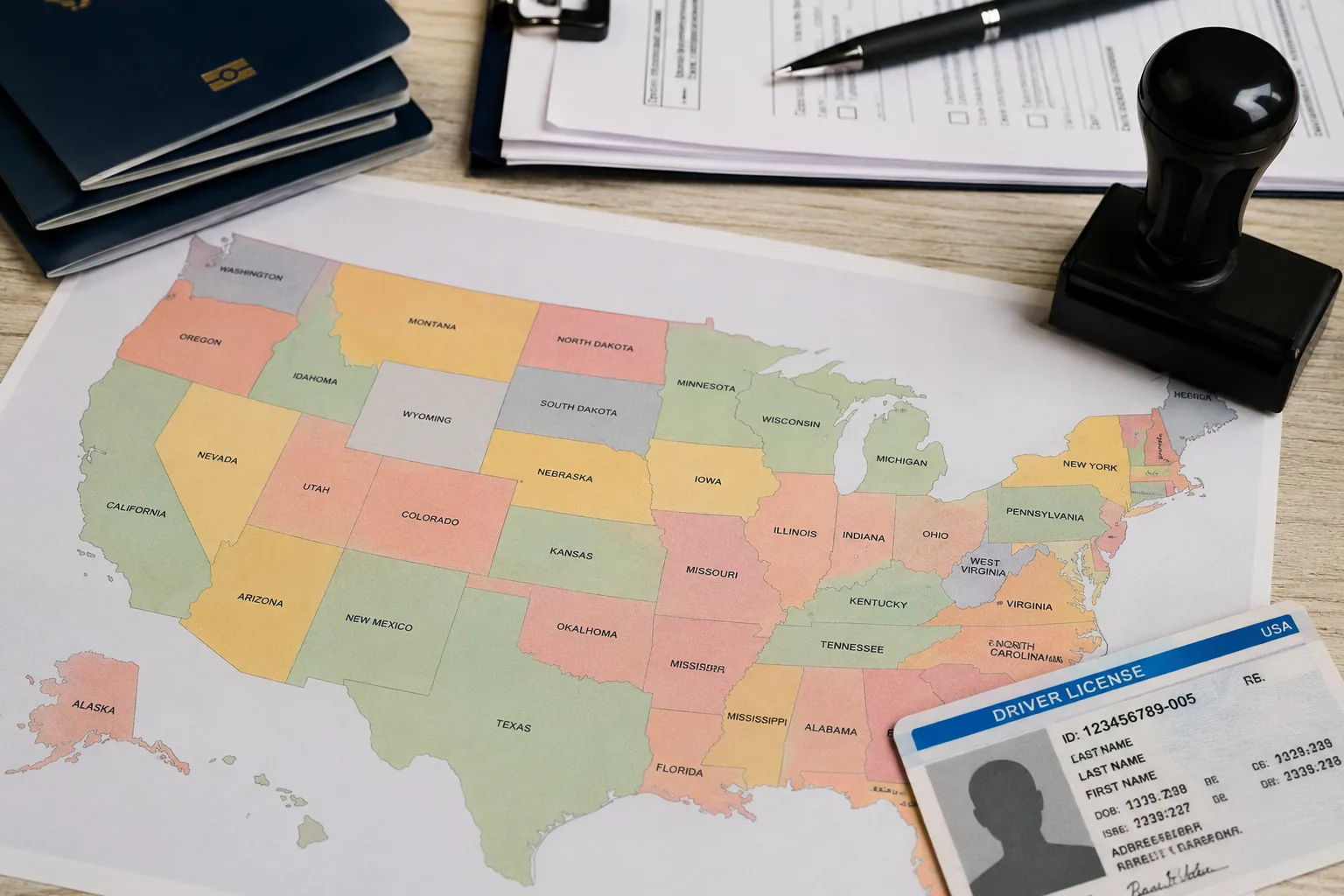
Ask someone from Germany, Australia, or Brazil what they picture when they think about American college life. Odds are, fake IDs come up. Not because they've been following U.S. alcohol policy debates but because the image has traveled far and wide, and it arrived with a very specific story attached to it.
The perception isn't entirely wrong. But it's more interesting than it looks. Because the reason the whole world landed on this particular image of American teenagers says something real about a law that makes the United States genuinely unusual on the global stage.
Start With the Number
109 countries set their minimum drinking age at 18. Only 13 set it at 21. The United States is one of them and among wealthy democracies with developed university cultures, it stands alone at that number.
That single fact explains most of the international reaction. When someone from France or the UK or South Korea hears that American college students routinely obtain fake identification just to buy beer, the response isn't moral outrage. It's confusion. They're not surprised teenagers want to drink. They're surprised the law creates a three-year window where doing so requires a forged government document.
From the outside, that looks less like a public health policy and more like a system designed to produce exactly the behavior it's trying to prevent.
The People Who Bring the Story Home
The global perception didn't form entirely through film and television, though that helped. A significant part of it travels person to person.
Every year, hundreds of thousands of international students arrive at American universities. Many of them are 19 or 20. Many of them have been legally drinking at home for a year or two already. They land in Ann Arbor or Austin or Boston and immediately discover that the American legal system has reclassified them as underage.
What do they do? Mostly what American students do. They adapt. And when they go home or call their friends, or come back for breaks they bring the story with them. A Brazilian student who figured out how to get into a bar in Cambridge tells that story differently than a film does. It's specific. It's funny. It's personal. And it spreads.
That word-of-mouth pipeline has been running for decades. Multiply it across every international student cohort since the 1980s and you have a genuine transmission network for the American fake ID experience that operates completely independently of Hollywood.
What Hollywood Actually Did
That said, cinema did the bulk of the work.
American teen films have been a global export since the 1970s. Superbad alone grossed over $170 million worldwide. American Pie, Dazed and Confused, Fast Times at Ridgemont High these films screened in countries where the drinking age is 18 and the entire premise of needing a fake ID is legally alien.
And here's the thing: audiences in those countries didn't need the legal context explained. They understood the emotional logic immediately. A young person wants access to something. A rule blocks them. They find a way around it. That structure is universal. The specific American version where the thing being accessed is a bar and the workaround is a forged state ID just becomes one more distinctly American detail, filed alongside school buses, college campuses, and prom nights.
By the time McLovin became a globally recognized reference, the fake ID had crossed from legal phenomenon into cultural mythology. International audiences stopped thinking of it as a response to a specific law and started thinking of it as simply what American teenagers do. That's how stereotypes work. The law that created the behavior fades from view. The behavior itself becomes the story.
Why the Emotional Framing Traveled Better Than the Facts
Most cultures have rites of passage connected to alcohol. The first legal drink, the first time you walk into a bar as an adult, the first round you buy yourself these moments carry weight in nearly every society that drinks.
In the U.S., the legal threshold for that moment sits three years past legal adulthood. So the culturally significant crossing gets displaced. It doesn't happen at a bar on your 18th birthday. It happens earlier, illegally, with a fake ID in your pocket. The fake ID becomes the marker of the passage rather than the legal purchase.
That displacement is what exported so well. When audiences abroad watch an American teenager nervously hand over a bad ID to a bouncer, they're not watching a crime. They're watching a version of a story they already know the story of wanting to be older than you are, of crossing a line you're not quite supposed to cross yet. The American legal specifics become wallpaper. The emotional truth in the center is universal.
Where the Perception Goes Wrong
The global image implies that virtually every American teenager is walking around with a fake ID. The reality is messier.
Research consistently shows that around 40 percent of college-age drinkers have owned or used one at some point during their undergraduate years. That's significant. But it's 40 percent of drinkers, not of all young Americans. A substantial number of 18-to-20-year-olds don't drink at all, or drink at house parties where nobody asks for ID, or rely on older friends to buy alcohol. The fake ID is widespread, not universal.
What film and personal anecdote both do is amplify the dramatic case. The liquor store scene, the nervous bouncer interaction, the fake Hawaiian ID with one name on it these are vivid, memorable, shareable stories. The quieter reality of people who simply drink at home or don't drink at all doesn't travel, because it has nothing interesting to show.
This is the basic mechanics of how a stereotype hardens. The colorful minority case circulates. The statistical majority stays invisible. Eventually the minority case becomes the representative image of the whole.
The Four Conditions No Other Country Has Simultaneously
The stereotype attached itself to America specifically because no other comparable country produced the same combination of circumstances.
The drinking age sits three years above the age of legal adulthood. An 18-year-old American can vote, sign contracts, enlist in the military, and be tried as an adult in criminal court but can't legally buy a beer until 21. That gap doesn't exist in most of the world. Most countries set alcohol restrictions at or near the age of majority.
American university culture is unusually alcohol-integrated. Greek life, tailgates, bar strips near campus, house parties alcohol is woven into the social fabric of American higher education in ways that aren't universal. The social cost of being legally excluded from that culture is higher here than it would be in a university environment where alcohol is more peripheral.
The American ID system is standardized and sophisticated. State driver's licenses and IDs function as the universal age verification document for almost every alcohol purchase in the country. That creates a single, clearly defined bottleneck. To access alcohol, you need a specific document. To get around the law, you need a fake version of that specific document. In countries where age verification is more informal or varies by establishment, there's no single document to replicate.
Enforcement is sparse but the law is absolute. Roughly two of every thousand instances of underage drinking result in an arrest. But the law itself has no exceptions, no state-level flexibility, no gray zones. Every state requires 21. That uniformity creates nationwide demand that doesn't taper off at state borders.
Put all four together and you get a stable, self-renewing market. No other country produced that exact combination, which is why no other country produced the same cultural phenomenon.
What the Perception Gets Right
For all its distortions, the international image isn't invented. The fake ID really is embedded in American youth culture in a way that has no genuine parallel elsewhere.
The document has a lifecycle that most countries' equivalent workarounds don't. Someone turns 21, gets a real ID, and no longer needs the fake one. So the fake ID gets passed down to a younger sibling, a friend, someone in the dorm. It circulates. It gets used by multiple people over time. It has secondary market value. Those are the properties of an object inside a genuine subculture, not just an occasional workaround someone improvised once.
The international perception is correct that America produced something unusual here. The stereotype exaggerates the scale. It doesn't exaggerate the existence.
The Gap Between the Myth and the Legal Reality
The part the global perception almost entirely misses is what actually happens when it goes wrong.
The McLovin version where the worst outcome is a stolen ID and a funny story — is the cinematic version. In the real legal system, depending on the state, possessing a fake ID can mean a misdemeanor or felony charge. It can mean a fine, probation, or jail time. It can affect financial aid, bar someone from certain professional licenses, and show up on background checks years later.
The film never shows that part. Films need narrative resolution, not consequence spirals. So the international image of the American fake ID comes with the stakes stripped out. It reads as a charming quirk. It's actually a criminal offense that follows people.
That gap between the perceived risk and the actual risk is one of the more significant things the global stereotype gets wrong — and honestly, it's something a lot of American teenagers get wrong too, for the same reason. They learned about it from the same films.
What the Stereotype Is Really About
The world thinks every American teen has a fake ID because a specific law, passed in 1984, created a specific demand — and that demand was amplified by fifty years of American cinema, carried home by millions of international students, and simplified through retelling into something that feels like a comment on American youth.
It isn't. It's a comment on American policy. The teenagers are just responding rationally to the conditions the law created. The same 19-year-old who would walk into a bar legally in Berlin is navigating a fake ID in Boston not because they're different people, but because the law drew the line in a different place.
The stereotype stuck to America because only America built all the right conditions for it. Change the law, and within a generation, the image fades. Keep the law, and four million new college freshmen every year will reliably regenerate the exact behavior the world is watching.
Global drinking age data is tracked by the World Health Organization's Global Status Report on Alcohol and Health. U.S. policy research is available through the National Institute on Alcohol Abuse and Alcoholism at niaaa.nih.gov.