
The role of CFOs and risk leaders in the UAE has moved far beyond financial reporting. Today, they are expected to quantify non-financial risks with the same precision as credit exposure or cash flow volatility. One area rising quickly to the top of that priority list is sustainability scoring.
This is not a branding exercise. It is becoming a measurable, decision-driving KPI that directly impacts financing, supplier selection, regulatory compliance, and long-term enterprise value.
Sustainability Scoring Is Now a Financial Signal, Not Just an ESG Metric
In the UAE, sustainability scoring is increasingly treated as a proxy for future risk and resilience. Banks, investors, and global partners are no longer asking whether a company has ESG policies. They are asking for quantified ESG performance backed by data.
For CFOs, this creates a shift:
- Sustainability performance now influences the cost of capital
- ESG risk exposure affects valuation and creditworthiness
- Poor supplier ESG scores can translate into operational disruption and reputational loss
This is where ESG scoring platforms come into play. They convert fragmented sustainability data into structured scores that can be tracked, benchmarked, and integrated into financial decision-making.
The UAE Context: Regulation, Capital, and Global Trade Pressure
Three forces are driving this shift in the UAE:
1. Regulatory Alignment with Global ESG Standards
Frameworks linked to IFRS sustainability disclosures and regional initiatives are pushing companies toward structured reporting. CFOs are now accountable for ESG compliance metrics, not just financial disclosures.
2. Access to Sustainable Finance
Banks and investors in the region are increasingly linking lending terms to ESG performance. A strong corporate sustainability score can influence loan approvals, interest rates, and investor confidence.
3. International Trade Requirements
UAE-based exporters face pressure from European and global buyers who require transparent ESG data across the supply chain. Without a reliable supplier ESG scoring system, companies risk losing contracts.
Why CFOs Are Treating Sustainability Scoring as a KPI
1. It Quantifies Non-Financial Risk
Traditional risk models often miss environmental and social exposure. Sustainability scoring fills that gap by translating ESG factors into measurable risk indicators.
For example:
- Environmental inefficiencies can signal future cost escalation
- Weak governance can indicate compliance vulnerabilities
- Poor supplier ESG performance can expose Scope 3 risk
CFOs can now include these insights in enterprise risk models alongside financial metrics.
2. It Enables Data-Driven ESG Decision Making
One of the biggest challenges in ESG adoption has been fragmentation. Sustainability scoring consolidates:
- Internal ESG data
- Supplier assessments
- Industry benchmarks
This allows CFOs to move from static reports to data-driven ESG decision making, where actions are based on real-time insights rather than annual disclosures.
3. It Strengthens Supplier Risk Management
Supply chains are now a major ESG risk area. A company may have strong internal policies but still fail ESG expectations due to vendor practices.
With supplier ESG scoring, CFOs and risk leaders can:
- Identify high-risk vendors
- Prioritize audits and corrective actions
- Align procurement with sustainability goals
This is especially critical for sectors like retail, construction, and manufacturing in the UAE.
4. It Supports Capital Allocation Decisions
Sustainability scoring is increasingly influencing how capital is deployed.
CFOs are using ESG scores to:
- Evaluate the long-term viability of projects
- Prioritize investments aligned with sustainability goals
- Avoid assets exposed to regulatory or environmental risk
This makes sustainability scoring a core input in strategic financial planning, not just reporting.
From Reporting to Real-Time Monitoring
A key shift happening now is the move from static ESG reports to continuous monitoring.
Instead of annual disclosures, CFOs are asking:
- How is our ESG score changing month over month?
- Which suppliers are causing score volatility?
- Where are the biggest sustainability risks in our operations?
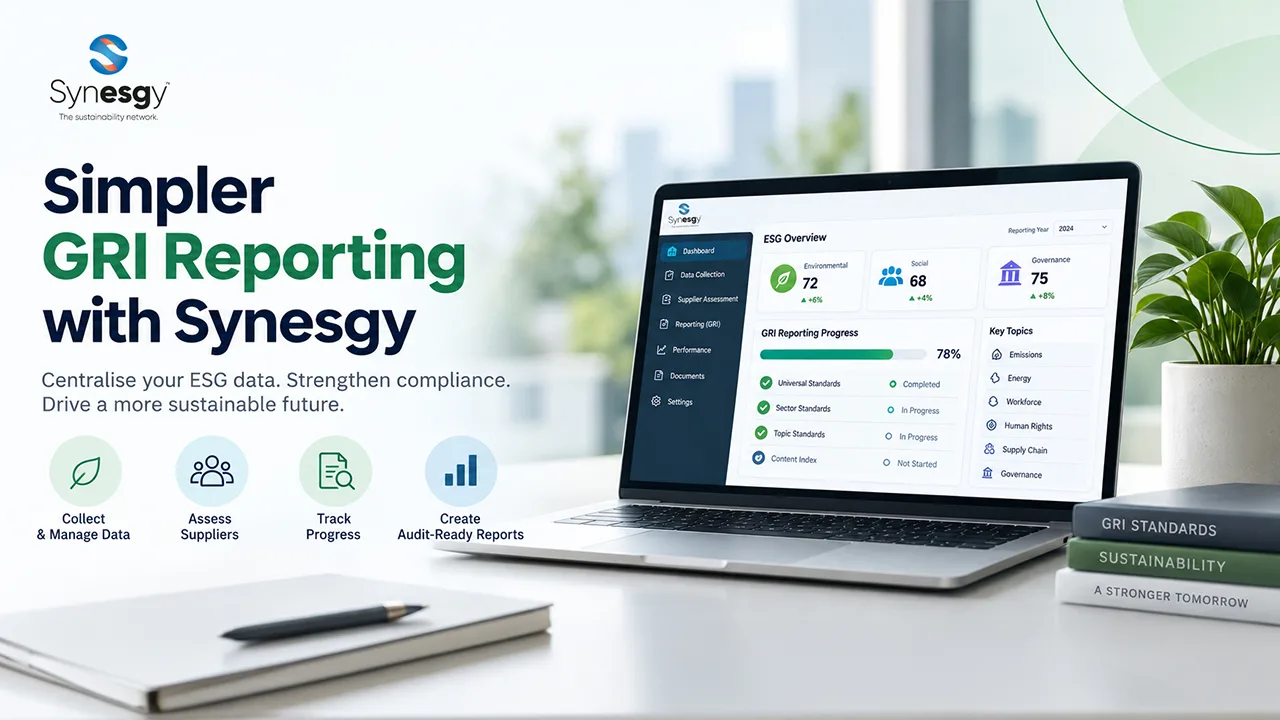
This is where platforms like Synesgy play a role by enabling:
- Continuous ESG assessment
- Benchmarking against industry peers
- Automated sustainability scoring across supply chains
This transforms ESG from a compliance activity into an operational control system.
Long-Term Business Impact: Beyond Compliance
Treating sustainability scoring as a KPI is not just about avoiding risk. It creates measurable business advantages:
- Stronger investor confidence through transparent ESG performance
- Improved supplier quality via ESG-driven procurement
- Better access to global markets where ESG compliance is mandatory
- Reduced long-term operational risk through proactive monitoring
For CFOs, the equation is clear: sustainability scoring is directly linked to financial stability and growth.
What UAE CFOs Should Focus on Next
To fully leverage sustainability scoring, finance and risk leaders should prioritize:
- Integrating ESG scores into enterprise risk management frameworks
- Embedding sustainability metrics into financial dashboards and KPIs
- Aligning procurement strategies with supplier ESG evaluation systems
- Using ESG data to support investment and financing decisions
This is not about adding another metric. It is about redefining how performance is measured.
Final Take
Sustainability scoring is becoming a critical KPI because it does something traditional metrics cannot. It connects environmental, social, and governance factors directly to financial outcomes.
For UAE CFOs and risk leaders, the shift is already underway. The question is no longer whether sustainability should be measured. It is how effectively that data is being used to drive smarter, lower-risk decisions across the business.