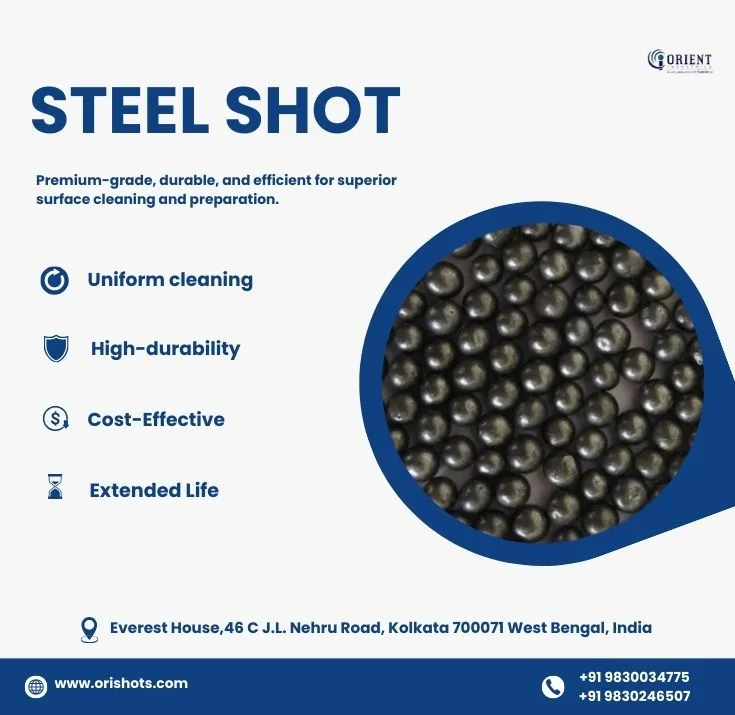
Ask anyone who has repainted a rusty gate, and they'll tell you the same thing: the paint wasn't the problem; the surface was. Coatings only hold when the metal underneath is clean, properly roughened, and free of scale. It's the unglamorous truth behind every durable finish, and it helps explain why Steel Shot remains widely used in blast machines today.
At Orient, we see this play out week after week. Foundries, fabricators, and forging units keep coming back to the same media because it performs reliably across demanding applications. Let's look at why.
What Makes Steel Shot Different from Other Abrasives?
Walk into any workshop, and you'll spot a few different media on the shelf: sand, slag, glass beads, crushed grit. Some break down faster than others, generate more dust, or require more frequent replacement. Steel Shot behaves differently. Each hard, round pellet strikes the surface, cleans it, and bounces back to work again. It wears down slowly, so one batch keeps going long after other media have turned to powder.
The round shape matters too. Instead of cutting into the metal like angular media, the pellets strike and peen the surface, helping create a more uniform finish. That makes the treated surface more suitable for subsequent coating and finishing processes than a smooth or poorly prepared base. Orient controls hardness and size grading closely, so what you order is what lands in your hopper.
Why Cast Steel Shot Earns Its Place on the Shop Floor?
Think about what a blast machine goes through in a normal month. Long shifts, constant impact, pellets cycling through again and again. The media has to cope. Cast steel shot is made by melting steel, atomising it into droplets, and heat-treating the result, which gives a dense pellet with a consistent internal structure. That consistency helps keep the finish predictable over long production runs. Poorly made pellets do the opposite. Hollow or cracked ones break early, clog the system, and leave patchy results that someone then has to rework by hand.
The benefits show up quickly on the floor:
● Longer working life: pellets recirculate many times before they fracture
● Less dust: cleaner air and easier housekeeping around the machine
● Even surface profile: the same finish, batch after batch
● Lower machine wear: the rounded shape can reduce the abrasive action on certain machine components compared with angular media
● Less waste: fewer refills and fewer disposal headaches
Taken together, these factors can make a noticeable difference to operating costs over time.
Steel Shot Blasting in Everyday Applications
A forged shaft and a fabricated steel beam look nothing alike, yet both start with the same question: is the surface ready? Steel shot blasting answers it across a surprising range of jobs. Foundries use it to strip sand and scale from castings. Forging shops rely on it to clear heat scale before machining.
Fabricators blast structural steel and pressure vessels ahead of painting or galvanising. Spring and gear makers also use smaller grades for shot peening, a related process that can improve fatigue performance.
Different jobs, same logic, and that's why Orient keeps its grades matched to these everyday needs rather than offering one size for everything. Because the pellets can be reused many times, the cost per cleaned square metre can be competitive with other abrasives, while the resulting surface remains consistent.
How to Buy Steel Shot Without Second-Guessing?
The initial quote doesn't always tell you what the media will cost over its working life. It's tempting to compare steel shot price per kilo and stop there, but a cheaper product that breaks down much faster can cost more by month-end. A few things are worth checking before you place an order:
● Hardness range: matched to your machine and the job in hand
● Size grading: a balanced mix keeps the cleaning action steady
● Consistency: look for uniform shape and few broken or hollow pellets
● Supplier support: technical guidance when settings need adjusting
● Delivery reliability: a stalled line costs far more than a delayed pallet
It also helps to talk to the supplier before ordering. At Orient, buyers can ask for guidance on grade selection first, which saves a lot of trial and error on the shop floor and avoids the costly habit of changing media mid-project.
Orient's Approach to Steel Shot Supply
A good supplier does more than load a truck. At Orient, we treat every order as a long-term relationship rather than a one-off sale. Our team helps match the right grade to your machine, checks quality before dispatch, and stays reachable when something doesn't look right. That's the part customers tend to remember.
When a line runs smoothly for months, nobody thinks about the media, and that's exactly how Orient wants it. Whether you run a small blast cabinet or a full production line, the focus stays on a steady supply of reliable Steel Shot and honest advice.
Conclusion
Surface preparation rarely gets the credit it deserves, yet it can have a major effect on the performance and durability of a finished part or coating. Steel Shot remains popular because it delivers where it counts: a clean, evenly textured surface, long working life, low dust, and a cost per job that holds up over time.
Its round, durable pellets suit everything from foundry castings to structural steel and precision components. The real value comes from choosing consistent material, matching it to your machine, and judging cost over the long run rather than the first invoice.
If you're looking to buy steel shot, choosing a reliable supplier can help you get the right grade and consistent quality for your application. With dependable quality and practical support, Orient helps workshops and industrial units get that balance right.