
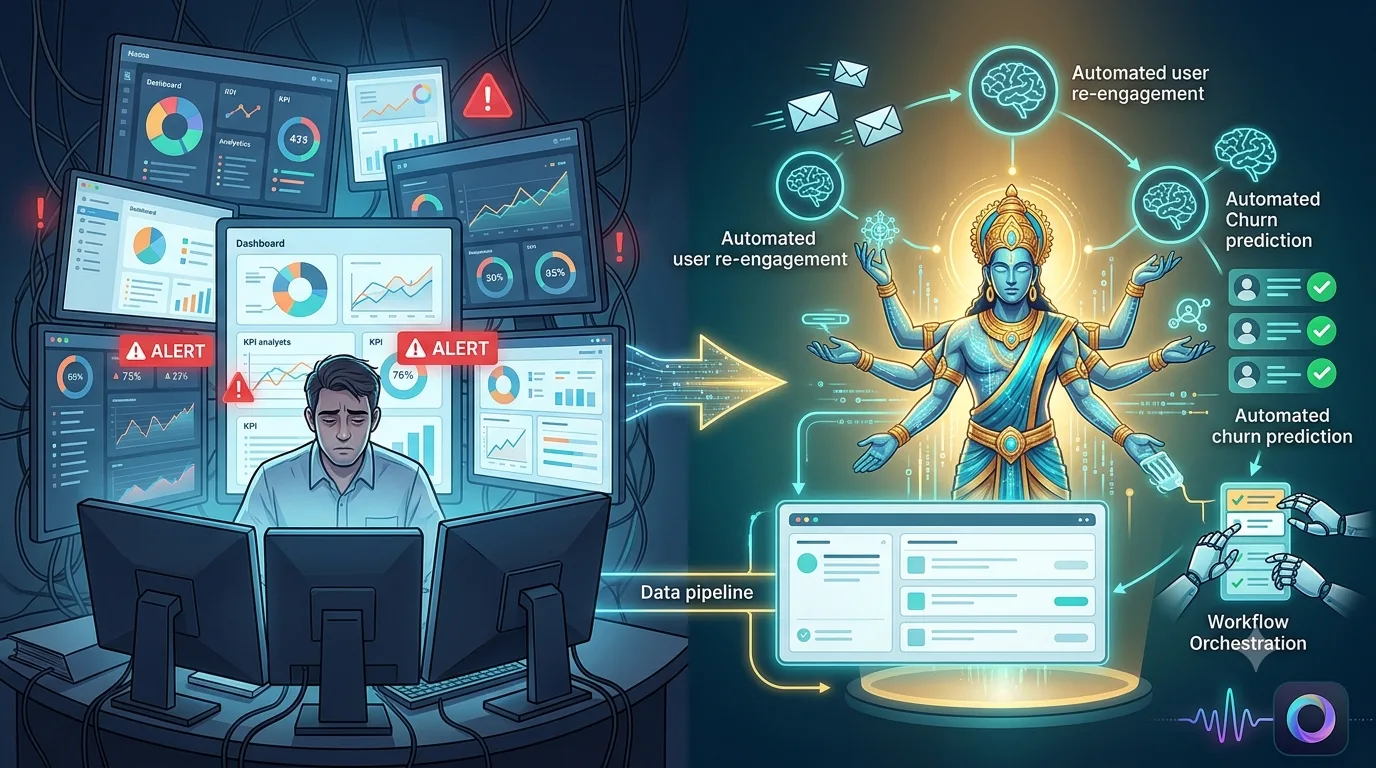
The modern Software-as-a-Service (SaaS) landscape is heavily fixated on visualization. Walk into any data-driven startup, and the walls are inevitably lined with glowing monitors displaying complex dashboards. These screens meticulously track everything from daily active users and customer acquisition costs to subtle fluctuations in monthly recurring revenue. However, a growing number of organizations are discovering a harsh reality: simply seeing data does not equate to leveraging it. Collecting vast amounts of information without a mechanism to instantly act upon it merely creates expensive administrative overhead.
This phenomenon is commonly referred to as the "dashboard trap." Companies invest heavily in cutting-edge analytics tools, yet their operational responses to that data remain entirely manual. When a critical metric drops, a human analyst must first notice the anomaly, diagnose the underlying issue, and manually trigger a response strategy across different departments. To break free from this operational bottleneck, forward-thinking SaaS businesses are shifting their focus away from passive visualization and toward active, intelligent infrastructure. By integrating a robust platform for AI automation, companies can seamlessly bridge the gap between data generation and operational execution, ensuring that critical metrics immediately trigger corrective workflows.
The cost of passive data monitoring becomes painfully apparent as a SaaS platform attempts to scale. In the early stages of a startup's lifecycle, a small, dedicated team might be able to manually monitor user engagement and proactively reach out to at-risk accounts. But as the user base expands into the thousands or millions, human monitoring becomes impossible. The result is alert fatigue, where teams become so overwhelmed by thousands of daily data points and red flags that they begin to ignore them entirely, leading to missed opportunities and preventable customer churn.
Consider the critical metric of user retention. A standard dashboard might reveal that users who fail to complete the core onboarding sequence within the first forty-eight hours are seventy percent more likely to cancel their subscriptions by the end of the month. Visualizing this trend is undeniably helpful. But if the response relies on a customer success manager manually downloading a list of these at-risk users every Friday afternoon and sending a generic follow-up email, the intervention is already too late. The data is stale, and the customer’s attention has moved elsewhere.
Furthermore, the dashboard trap is often exacerbated by siloed technological stacks. A SaaS company might use one tool for marketing analytics, another for product usage data, and a third for customer support ticketing. While a dashboard might aggregate these views, the manual effort required to transfer insights from the dashboard into the CRM or marketing automation tool slows down reaction times significantly.
The paradigm must fundamentally shift from "tracking metrics" to "automating responses to metrics." The next evolution of SaaS infrastructure involves deploying intelligent systems that do not just display data anomalies but act upon them in real-time. If user engagement drops below a predefined threshold, the operational system should autonomously trigger a personalized re-engagement sequence, alert the dedicated account manager, and adjust the user's risk score within the CRM—all without requiring a human to click a single button or analyze a chart.
Ultimately, the competitive advantage in the SaaS sector no longer belongs to the company with the most comprehensive data dashboard. It belongs to the organization that can translate its data into immediate, scalable action while keeping human experts in the loop for high-level approvals. Startups that prioritize automated workflows over passive metrics position themselves to manage growth efficiently and provide a superior, proactive customer experience. For businesses looking to understand the broader implications of this shift, organizations like McKinsey & Company offer extensive research on data-driven enterprises, highlighting how the true value of analytics is only realized when it fundamentally changes how a company operates on a daily basis.