As enterprises adopt Agile across dozens or even hundreds of teams, one challenge repeatedly undermines results: value gets diluted as work moves from strategy to delivery. Features are shipped, yet outcomes remain unclear. Teams stay busy, but customers see limited impact.
This breakdown rarely happens because teams lack skill. It happens because product decisions lose clarity at scale.
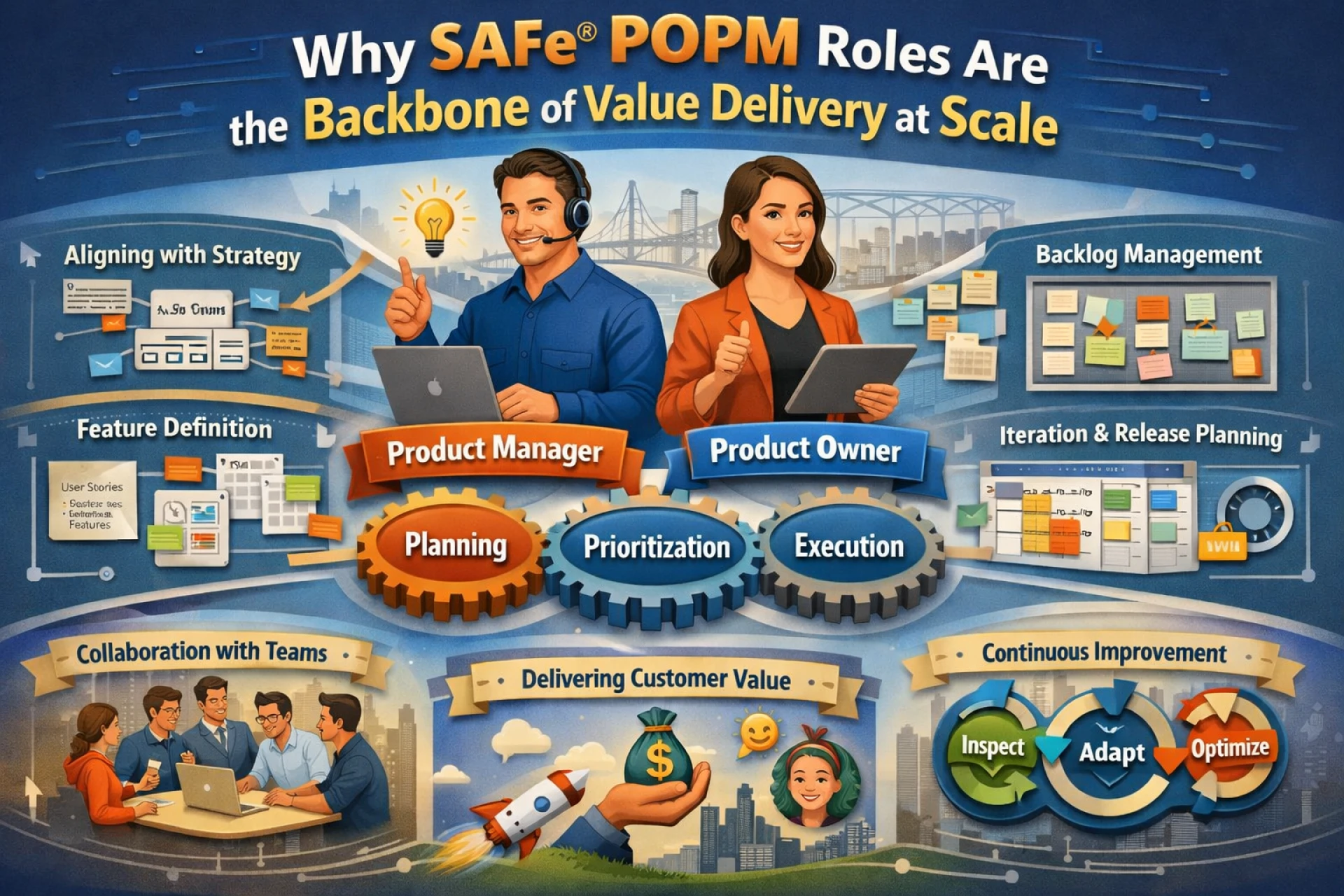
SAFe® Product Owner and Product Manager roles exist to protect value as work flows through complex enterprise systems. Together, they ensure that what teams build aligns with strategy, customer needs, and measurable outcomes.
Where Value Gets Lost in Scaled Agile Environments
In small Agile setups, product decisions are close to the team. As organizations scale, decision distance increases. Priorities pass through multiple layers, and intent often gets distorted.
Common value leaks include:
- Backlogs driven by competing stakeholder demands
- Features approved without clear business outcomes
- Teams building technically correct solutions to the wrong problems
Without clear POPM accountability, these issues compound, leading to wasted effort and frustrated teams.
SAFe® POPM Roles Protect Value Flow
SAFe® 6.0 defines Product Managers and Product Owners as complementary roles with shared responsibility for value delivery.
Together, they ensure:
- Strategy is translated into actionable features and stories
- Priorities are continuously refined based on value
- Teams understand the “why” behind the work
Rather than acting as requirement messengers, POPM professionals act as value guardians across the delivery lifecycle.
From Strategy to Backlog With Clear Intent
Strategy often fails at the point of translation. High-level objectives sound clear, but teams struggle to turn them into actionable work.
SAFe® POPM roles bridge this gap by connecting Strategic Themes and roadmaps to program and team backlogs. Product Managers define the vision and economic priorities, while Product Owners ensure that team backlogs reflect those priorities accurately.
When intent remains intact, teams deliver with confidence and purpose.
Making Tradeoffs Visible and Decisive
Every enterprise faces more demand than capacity. The real challenge is not choosing what to do, but choosing what not to do.
Effective SAFe® POPM professionals manage tradeoffs by:
- Prioritizing work based on value and urgency
- Saying no to low-impact requests
- Making decision criteria transparent
This discipline reduces chaos and allows teams to focus on the most valuable outcomes.
Collaboration That Reduces Friction
SAFe® POPM roles operate at the center of collaboration. They work across business, technology, and delivery.
Strong POPM collaboration emphasizes:
- Continuous stakeholder engagement
- Clear acceptance criteria
- Early validation of assumptions
This collaboration prevents late-stage surprises and reduces rework across teams.
Improving Flow Without Speeding Up Teams
Delivery delays are often blamed on team performance, but the real issue is usually poorly prepared work.
SAFe® POPM roles improve flow by ensuring that work enters the system ready, prioritized, and aligned. By maintaining healthy backlogs and clarifying dependencies, they help teams deliver more predictably without increasing pressure.
Flow improves not because teams work faster, but because work flows better.
Measuring Value Instead of Output
A critical mindset shift in SAFe® 6.0 is moving from output-based metrics to outcome-based thinking.
SAFe® POPM professionals focus on:
- Customer impact
- Business results
- Learning from delivered features
This approach ensures that teams continuously improve based on evidence rather than assumptions.
Leading Without Formal Authority
POPM professionals often influence more than they control. Their leadership comes from clarity, trust, and decision quality.
Effective POPM leaders:
- Facilitate alignment conversations
- Communicate priorities clearly
- Build trust through consistency
This form of leadership is essential in scaled Agile environments where command-and-control no longer works.
Reducing Waste Through Better Product Decisions
Waste in Agile systems often comes from building the wrong things well.
SAFe® POPM roles reduce waste by validating priorities early, refining backlogs continuously, and aligning delivery with real customer needs. Clear intent reduces rework and increases the likelihood that delivered features create value.
Building Strong POPM Capability for Enterprise Scale
SAFe® POPM roles require more than basic Agile knowledge. They require product thinking, economic decision making, and the ability to manage complexity.
Skillbook Academy focuses on developing practical SAFe® POPM capability aligned with SAFe® 6.0. The learning emphasis is on real enterprise scenarios, prioritization challenges, and value-driven decision making.
By supporting professionals in mastering POPM responsibilities, Skillbook Academy helps enterprises strengthen value delivery at scale.