
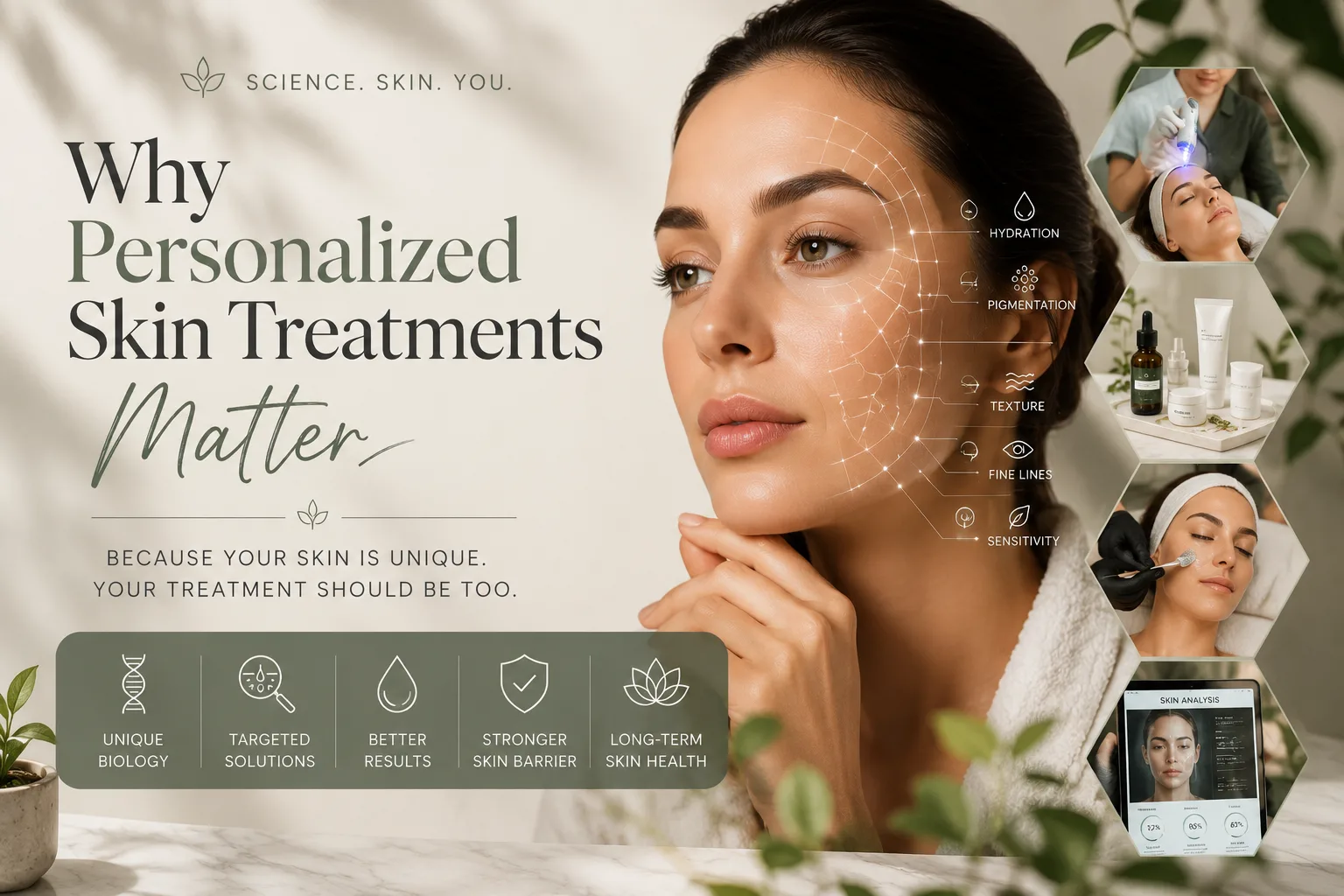
Why Personalized Skin Treatments Matter
Walk down any skincare aisle or scroll through 30 seconds of social media and you'll find an overwhelming number of products promising the same results to everyone. Brightening serums. Anti-aging moisturizers. Acne-clearing cleansers. Each one marketed with glossy before-and-afters and the quiet implication that it will work for you, too.
But here's the truth most of that marketing skips: your skin is biologically, genetically, and environmentally unlike anyone else's.That’s why more people are now choosing wellness-focused medspas like Beulah MedSpa for customized skincare treatments designed around their individual skin concerns and goals.The cleanser that transformed your friend's complexion might be stripping yours. The serum that erased your sister's fine lines might be sitting inert on the surface of your skin, doing nothing. Generic skincare isn't failing you because you're doing something wrong. It's failing because it was never designed for you specifically.
That's what personalized skin treatments change and why the shift toward them isn't a trend. It's the most logical evolution skincare has ever made.
The Problem With One-Size-Fits-All Skincare
Most skincare products on the market are built around a hypothetical average. They're formulated to be gentle enough to avoid irritating sensitive skin, effective enough to satisfy normal skin, and broadly positioned to appeal to the widest possible consumer base. That approach works well for product sales. It works less well for your actual face.
Think about what skin type is. While the classification system of oily, dry, combination, sensitive, and normal provides a good starting point for understanding skin types, it only begins to touch on the underlying factors that affect the way our skin behaves. Take oily skin, for example. It can mean one person’s skin overproduces sebum due to fluctuations in hormones, and another has a broken lipid barrier causing the skin to produce excess oil. A product formulated for oily skin addresses neither precisely.
Indeed, this theory has been supported by scientific evidence. Personalized skincare has proven to be more effective by 35% at increasing hydration and pigmentation compared to traditional care in just 12 weeks, as measured using biomarkers such as transepidermal water loss and melanin index instead of patient-reported satisfaction levels. The reason behind this phenomenon is quite simple – when active ingredients are carefully selected depending on the state of skin, they become more efficient compared to the use of identical formulas on everyone's face.
The skincare market has picked up on this trend. The current value of the global personalized skincare market has been estimated at $25.1 billion in 2024, while by 2034, this number is expected to grow to $47.4 billion, showing a consistent annual increase of 8.3%. Today's consumers do not want to settle for products that do not target their specific problems, as they actively look for personalized skincare solutions that can help them solve problems such as acne, sensitivity, dehydration, hyperpigmentation, or aging symptoms.
Many individuals are now combining personalized skincare routines with professional facial treatments to improve hydration, skin texture, acne concerns, hyperpigmentation, and long-term skin health naturally.
Your Skin Is Biologically Unique - Treat It That Way
Personalization begins right down to the cell level.
There are significant variations among human skin cells caused by different genetics, thus affecting how skin behaves to environmental stimuli, how skin reacts to aging, and how skin reacts to skin care products. The genetic variations are directly related to such elements as skin pigmentation, skin structure, and skin response to UV exposure. In practice, this translates to how even two people who share the same weather condition, lifestyle, and diet may experience different skin aging, respond to retinoids differently, and experience different levels of skin exfoliation tolerance due to the genetic coding.
And then we have the skin microbiome, which refers to the microbial life that exists on the surface and within the skin that helps determine the state of skin health and its appearance. The skin microbiome shows great variation between different individuals and affects diseases such as acne, eczema, and rosacea. And it's no small matter. Skin microbe composition determines how prone the skin is to inflammation, how effective its barrier system works, and its response to therapy.
Regular antibacterial methods, which are typically found in acne face wash and other abrasive treatments, tend to kill off healthy bacteria and can even make existing problems worse. In personalized treatment plans, on the other hand, it’s possible to create a method that doesn’t disturb natural balance but helps promote it. This makes a lot of difference in cases of people suffering from acne, rosacea, or eczema, where regular methods have not helped much.
Skin type as per the Fitzpatrick scale is yet another factor to consider when discussing customization of the treatment. Since the level of melanin and skin color influences sensitivity to sun exposure, heat, lasers, chemicals used for exfoliation, and inflammations, any treatment not taking into consideration skin color risks causing complications such as post-inflammatory hyperpigmentation, skin damage, and ineffective outcomes. Treatment options for pigmentation suitable for light-colored skin may not work well for dark skin.
The Clinical Case for Personalized Treatment
The science behind personalized skincare has matured significantly. This is no longer a category driven primarily by marketing claims; rigorous clinical trials now validate personalized skincare's superiority over generic approaches.
A 28-day bespoke cosmetic study on compromised skin demonstrated that a tailored formulation improved sebum regulation by over 100%, increased elasticity from 25% to 44%, reduced hyperpigmentation from 7.2% to 2.3%, and improved hydration across multiple skin layers. Those aren't marginal improvements, they're the kind of results people spend years chasing with drugstore products and never quite achieve.
A randomized controlled trial comparing machine learning-guided personalized skincare recommendations against self-selected treatments for mild-to-moderate acne found that the personalized approach produced meaningfully better outcomes. Many skincare products at beauty stores and pharmacies are inefficient, and users usually lack knowledge about which ingredients are effective and beneficial for their specific skin condition. Personalized guidance fills exactly that knowledge gap not with generic advice, but with data-driven matching of treatment to individual biology.
Acne, hyperpigmentation, sensitive skin, and aging concerns are highly susceptible to a consultative approach. These skin concerns require individual ingredient selections and program designs that do not irritate the skin. Skin concerns that consist of more than one issue and prior unsuccessful treatments are even better suited for this process.
This is the key insight: personalization matters most for the people who need it most. If your skin concern is mild and uncomplicated, a broadly formulated product might serve you reasonably well. But if you're dealing with persistent hormonal acne, stubborn melasma, rosacea, or the frustrating combination of aging and sensitivity, a generic approach isn't just less effective it can actively work against you.
What Personalization Actually Looks Like in Practice
It's worth demystifying what a personalized skin treatment approach actually involves, because it's more accessible than many people assume.
Professional Skin Analysis
The foundation of any personalized treatment plan is a thorough assessment that goes beyond asking you what skin type you think you have. At the clinical level, comprehensive assessments measure hydration levels via transepidermal water loss, sebum production rates, melanin distribution indicating pigmentation concerns, and erythema index revealing inflammation. Advanced evaluations may include pH measurement, elasticity testing, and microscopic analysis of pore characteristics and surface texture patterns.
This level of analysis creates an objective picture of what your skin actually needs, not what you've been told you need based on your skin category, or what worked for someone who looks like you.
Customized Treatment Protocols
Once a clinician understands your skin's specific profile, treatment selection becomes precise. Someone with hormonal acne needs a different protocol than someone with comedonal acne from product buildup. Someone with hyperpigmentation on Fitzpatrick Type V skin needs different treatment parameters than someone with the same concern on Fitzpatrick Type II skin. Someone with a compromised moisture barrier needs a fundamentally different approach than someone with genuinely oily skin.
Modern-day aesthetics have come quite a long way from generic facials. From lasers, microneedling, radio frequency therapy, and LED lights, these treatments can all be customized to suit your particular skin type and needs according to the results you want to achieve. This is where the art of customization comes into play, and when done correctly, you will see real results.
Ongoing Adjustment
Personalized skincare isn't a one-time prescription, it's a responsive relationship between treatment and skin. Your skin changes seasonally, hormonally, with age, and in response to environmental shifts. A truly personalized approach adapts accordingly. This is the APIA framework in practice Assessment, Program, Implementation, and Accompaniment, a systematic methodology that includes continuous support and plan adjustment throughout your skin health journey. Consultations using this methodology significantly improve skin health indicators because the treatment evolves with the patient.
The Hidden Cost of Generic Skincare
There's a financial argument for personalization that rarely gets made explicitly: generic skincare is often far more expensive than it appears.
When a product doesn't work, you buy another one. And another. The trial-and-error cycle that most people go through trying a new moisturizer, abandoning a serum after a month, cycling through three different acne treatments adds up quickly. By the time someone books their first professional consultation, they've often already spent significantly more than the consultation would have cost, on products that never gave them what they were looking for.
The improvements are tangible. Because your daily habits are based on information and not assumptions, you waste neither time nor money trying out ineffective items. You also cut down on the chances of making yourself sensitive by adding extra chemicals. In dealing with conditions like acne, rosacea, and PIH, the process of using effective and necessary measures cannot be considered a luxury; it is the best course of action.
Personalized treatment also reduces the risk of making things worse which generic products frequently do. A harsh scrub on a compromised barrier, a brightening serum with the wrong acid concentration on reactive skin, a "natural" deodorant with botanical extracts that cause contact dermatitis these are real clinical consequences that dermatologists see regularly. Personalized guidance avoids these missteps before they happen.
Why 70% of Dermatologists Have Made the Shift
Many assume personalized skincare is just clever marketing, yet 70% of dermatologists now integrate it into clinical practice. That adoption rate isn't driven by consumer trends, it's driven by outcomes.
Dermatologists see the failure of generic products daily: patients who've been using the "right" products for the wrong skin, patients whose acne has been treated with cleaners that disrupt rather than restore, patients whose hyperpigmentation has been worsened by exfoliants that weren't calibrated for their skin tone. The clinical frustration with one-size-fits-all approaches has made personalization not a premium add-on, but a core clinical standard.
The inclusion of AI and diagnostic technology has further enhanced this transition significantly. Artificial intelligence and machine learning have enabled a drastic change in the way that brands and dermatologists create custom products according to the specific skin condition and lifestyle of the consumer. AI analysis of the microbiome helps formulate custom skin care formulations that help bring back the balance to the microorganisms in the skin. Pharmacogenomics is the study of how genetics affect an individual's reaction to skin care products.
This isn't science fiction. It's available now, at MedSpas and aesthetic clinics that have invested in the diagnostic tools and clinical training to offer it properly.
Skin Concerns That Benefit Most From Personalized Treatment
While every skin type benefits from personalization, certain conditions show the most dramatic response when treatment is properly tailored:
Hyperpigmentation and Melasma
Among the most undertreated conditions because approach matters enormously. Vitamin C, niacinamide, and retinoids work best in combination, but the concentrations, delivery systems, and complementary treatments need to be calibrated to skin tone and sensitivity level. A protocol that works on lighter skin can worsen pigmentation in darker skin personalization isn't optional here, it's essential.
Hormonal Acne
One of the most frustrating conditions to treat generically, because hormonal acne has internal drivers that topical-only approaches can't address. Personalized treatment accounts for the hormonal pattern, skin type, and potential sensitivity to specific active ingredients and often coordinates topical and systemic approaches rather than treating topically alone.
Aging Skin With Sensitivity
The combination of declining collagen, dehydration, and reactive sensitivity is increasingly common and particularly poorly served by generic anti-aging products, which often prioritize active ingredient concentration at the expense of tolerability. A personalized protocol finds the balance between efficacy and comfort that generic formulas typically miss.
Rosacea and Chronic Redness
Highly individual in its triggers, presentation, and response to treatment. What calms one person's rosacea can flare another's. Personalized treatment identifies specific triggers, avoids aggravating ingredients, and builds a protocol that strengthens the skin barrier over time rather than managing symptoms temporarily.
The Most Important Investment Your Skin Will Ever See
There's a reason noticeable improvements can often appear in as little as 28 days with personalized treatment improvements in elasticity, reduced hyperpigmentation, and measurable hydration gains documented in clinical case studies. When treatment is matched to the skin rather than the average, the skin responds.
The skincare industry has spent decades selling the idea that the right product is out there and you just need to find it. The reality is that the right product for you might not exist yet until someone creates it specifically for your skin profile, your concerns, your biology. That's what personalized skin treatment does. It stops the guessing. It stops the cycling. It stops the years of products that almost work.
Your skin is the largest organ in your body, and the most publicly visible one. It deserves treatment built around its actual needs not around the needs of the widest possible market.
Personalized skin treatment isn't the premium option. It's simply the one that works.
Ready to stop guessing and start seeing real results? A professional skin assessment is the first step and often reveals that the solutions you've been looking for are simpler, and more effective, than anything you've tried before.