Most enterprises believe the hard part of AI is deploying it. Once the model goes live, the team celebrates, and leadership moves on.
But this is often when the real risk quietly takes hold.
AI does not break the way traditional software does. It drifts. The data shifts, and your model keeps running on a version of reality that no longer exists. No error messages. No alerts. Just decisions that slowly, invisibly lose accuracy over time.
That is exactly what model monitoring is designed to catch. And in the age of GenAI and Agentic AI, enterprises that treat it as an afterthought are leaving both performance and trust on the table.
Why Do Enterprises Monitor AI Models Beyond Deployment?
In 2026, the question is no longer whether enterprises should monitor their AI models after deployment. The question is how much they have already lost by not doing it sooner.
For this reason, businesses tend to spend more on dynamic AI design and deployment services that go beyond simple implementation. They are creating AI ecosystems that continuously monitor model correctness, identify performance drift, reduce operational risk, and ensure AI systems stay aligned with changing business objectives long after they are deployed.
Now, let’s look at why model monitoring has become a critical part of every modern AI deployment strategy:
1. AI Models Drift Quietly
There is no alarm when an AI model starts losing its edge. No notification, no error log.
In one quarter, your fraud detection model catches 94% of suspicious transactions. Next, it catches 78%. The model did not fail. The world changed, and the model failed to keep up. That gap is one of the costliest silent risks in enterprise AI today.
Because of this, ongoing model monitoring is now an essential component of any significant AI deployment plan. Without it, businesses are effectively operating in the dark, relying on results from a system that may have silently stopped being reliable weeks or months ago.
2. Small Mistakes Turn Into Huge Losses
Whether a pricing algorithm damages margins or a churn model incorrectly classifies high-value clients as low-risk, little AI faults rarely remain small.
Model monitoring breaks that cycle by catching performance degradation early, before small inaccuracies scale into significant financial or reputational exposure.
For finance, for instance, a lending model that drifts by just a few percentage points in its risk assessments can translate into millions in unexpected defaults. Not wrong enough to raise flags. Just wrong enough, consistently enough, to matter at scale.
3. Customer Trust Declines Fast
No matter whether you are running an AI-powered recommendation engine, a virtual assistant, or a personalization platform, customers do not experience your model. They experience your brand. And when the model starts getting things wrong, the brand takes the hit.
Irrelevant recommendations, tone-deaf responses, and poorly timed outreach do not make customers think "the AI drifted." They make customers think, "This brand does not understand me." Trust erodes fast and rebuilds slowly.
For this reason, top businesses are now making ongoing monitoring an essential component of their AI deployment strategy rather than a post-launch add-on.
And in a market where loyalty is fragile and alternatives are one click away, that early catch is worth far more than any post-damage recovery effort.
4. GenAI Needs Constant Oversight
If left unchecked, GenAI systems may produce outputs that are off-brand or biased. With the support of ongoing monitoring, businesses can easily preserve quality and governance during AI-generated interactions
Unlike traditional AI models, GenAI produces open-ended responses that vary based on context and user input. This is why enterprises monitor response quality, hallucinations, and user feedback to keep outputs reliable and consistent.
5. Business Priorities Keep Changing
When it comes to business priorities, change is the only constant. However, AI models don't adjust automatically. Even after the original goal is no longer important, they continue to optimize for it.
For this reason, businesses these days are spending more on AI design and deployment services that go beyond initial implementation to include long-term monitoring capabilities.
When the target audience changes, a marketing firm, for example, may find its campaign optimization model quietly hurting performance. The model continues to perform precisely as it was taught. The problem is that the business no longer wants that.
Without active monitoring, enterprises risk running AI that is perfectly tuned for a strategy they no longer have.
4 Emerging Trends in AI Monitoring and Governance
According to PwC’s AI Agent Survey, 88% of executives plan to increase AI-related budgets over the next 12 months. This shows that enterprise confidence in AI is not slowing down.
Let’s explore the key trends shaping AI monitoring and governance:
- Transition from Policy to Operational Controls: While important, governance policies are often insufficient. Instead of appearing in a quarterly audit, businesses are now integrating controls directly into their AI pipelines, enabling real-time monitoring and intervention.
- Governance of Agentic AI as Digital Identities: Agentic AI doesn't wait for commands, unlike conventional models. It takes action. Governance cannot be neglected when an AI agent handles processes or conducts transactions on its own. Businesses are now giving AI agents distinct digital identities with limitations, authorization, and complete audit records for each action they take.
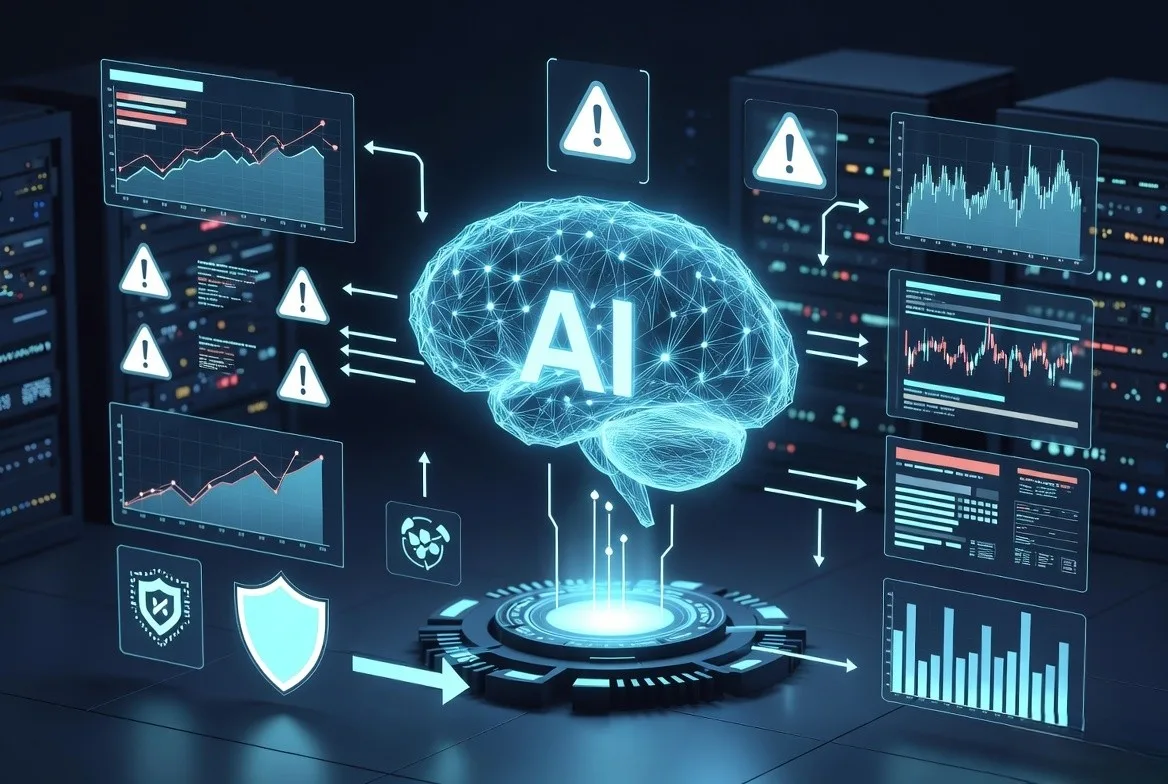
- AI-Powered Governance ("AI for AI"): As AI scales across business units, enterprises are using AI systems to monitor other AI systems, detect anomalies, and flag issues in real time.
- Emergence of Self-Healing Models: Businesses are adopting AI systems that can automatically detect and fix performance issues with minimal human intervention.
Build AI Systems That Stay Reliable After Deployment
Deployment is a milestone, not a destination.
In fact, the real measure of an AI system is not how well it performs on launch day. It is how well it performs six months later, in a market that has shifted, on data that has evolved, against business goals that may have changed entirely.
Straive partners with enterprises to make this continuity operational. Through comprehensive AI design and deployment services and a structured AI deployment strategy built for real-world complexity, Straive ensures your AI not only goes live successfully but also performs effectively. It stays that way.
Don’t wait for AI drift to become a business problem. Start building AI systems designed to evolve with your enterprise now!