Modern travel is frequently organised around quantity. Travellers try to visit the maximum number of attractions, take photographs quickly and move to the next location before fully understanding the previous one.
This approach can produce an impressive itinerary, but it may not create a meaningful connection with the destination.
Slow travel offers a different method. It encourages visitors to select fewer experiences, give each one sufficient time and pay closer attention to the place around them. In a historic city such as Bharatpur, this approach can help travellers appreciate architecture, local identity, hospitality and natural heritage without turning the trip into a race.
Choosing slow heritage travel in Bharatpur does not necessarily require a long holiday. Even a short visit can feel more complete when its schedule contains enough room for observation and rest.
What does slow travel actually mean?
Slow travel does not simply mean moving physically slowly or extending every trip for several weeks.
It means travelling with greater attention and less unnecessary urgency.
A slow traveller may:
- Select fewer principal attractions
- Spend longer at meaningful places
- Avoid scheduling every available hour
- Learn about the destination before arrival
- Allow time for meals and conversations
- Observe architecture and local surroundings
- Include rest within the itinerary
- Prefer locally connected accommodation
- Accept that everything cannot be covered in one visit
The emphasis moves from completing a list to understanding the experience.
Why do travellers often rush through historic destinations?
Limited holiday time creates pressure. Visitors fear missing an important attraction, so they attempt to include as much as possible.
Online travel content can intensify this pressure through lists such as “everything to see in one day.” These guides may be useful for planning, but travellers can misinterpret them as mandatory checklists.
As a result, the day becomes dominated by:
- Entry and exit timings
- Transport between locations
- Searching for parking
- Taking rapid photographs
- Checking maps
- Monitoring the next booking
- Eating in a hurry
- Worrying about delays
Travellers may physically visit many places while retaining little understanding of them.
Why is Bharatpur suited to slower exploration?
Bharatpur carries several interconnected identities. It is associated with fort history, palace architecture, regional culture and internationally recognised birdlife.
These dimensions cannot always be understood through one hurried stop. Historical architecture requires attention to scale, construction and context. Natural environments operate according to seasonal and environmental conditions rather than a visitor’s checklist.
Slower exploration allows travellers to recognise the variety within the destination instead of reducing Bharatpur to one attraction.
How does accommodation influence travel pace?
Accommodation can either support or disrupt the rhythm of a trip.
If travellers choose a stay only as a place to sleep, they may spend most of the day moving continuously. If their accommodation has a meaningful connection with the destination, returning to it can remain part of the travel experience.
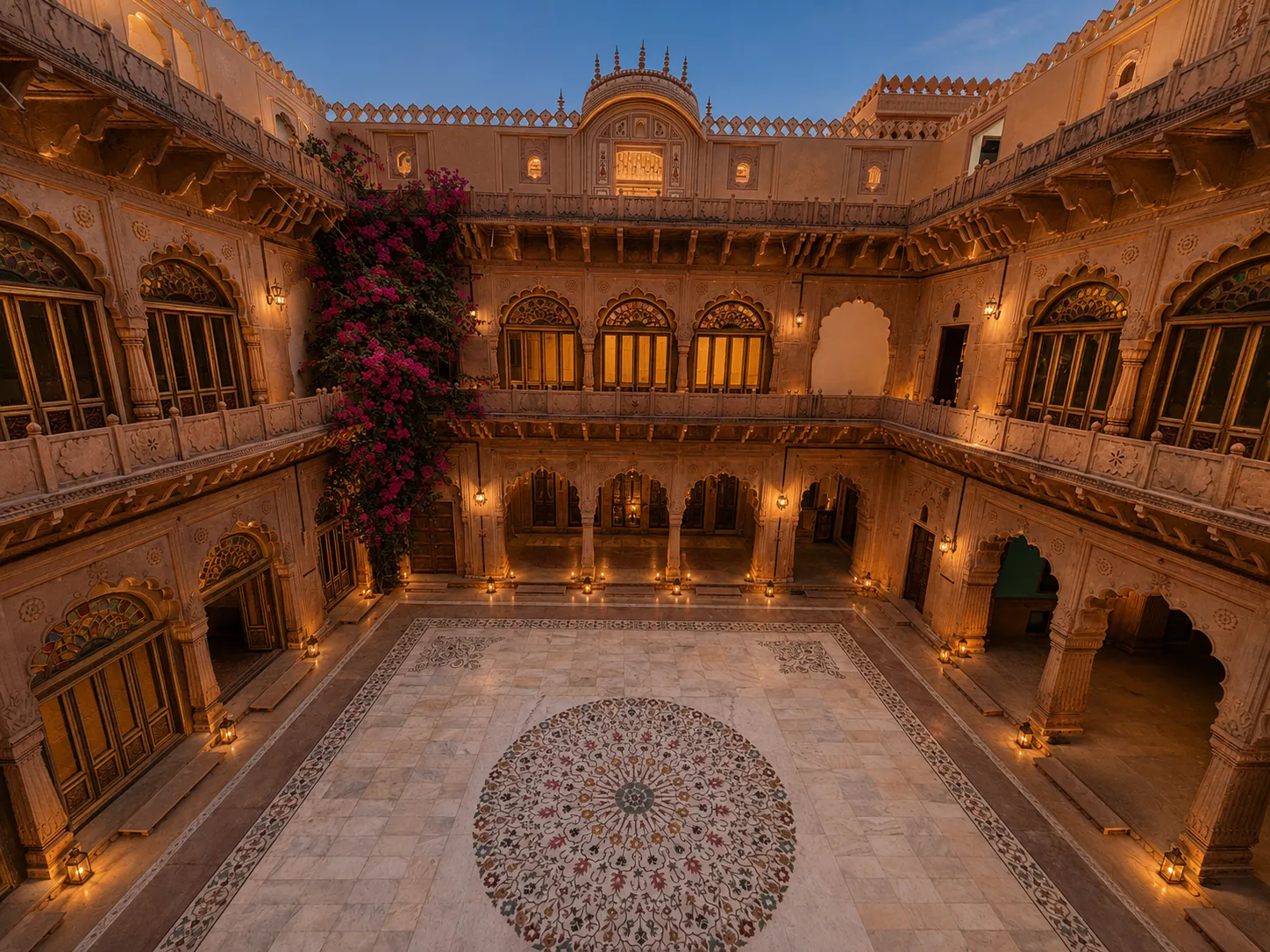
An immersive palace accommodation can extend the sense of history beyond formal sightseeing hours. Guests can pause, notice their surroundings and retain a connection with Bharatpur’s heritage atmosphere even while resting.
This does not mean travellers should remain inside the property throughout their visit. The accommodation acts as a contextual base for exploring the wider destination.
What does a slow one-day itinerary look like?
A slower one-day plan might include:
- One principal morning experience
- Adequate time for breakfast or refreshments
- A comfortable meal rather than a rushed stop
- An afternoon rest period
- One additional cultural or local experience
- Free time for walking, conversation or photography
- An unhurried evening
The exact schedule depends on the season, opening hours, individual interests and physical comfort.
The important principle is that each stage should have enough flexibility to absorb small delays without damaging the rest of the day.
Is slow travel suitable for families?
Yes, particularly for families travelling with children or elderly relatives.
A highly compressed itinerary may be physically tiring and difficult to coordinate. Children can become restless, while senior family members may need additional time for walking, meals and rest.
A slower plan allows:
- Different waking and preparation times
- Comfortable meal breaks
- Flexible activity choices
- Short recovery periods
- Conversations between generations
- Changes based on energy levels
- More meaningful shared moments
Families should identify a few experiences everyone wants to share and avoid requiring every person to participate in the complete schedule.
How can travellers observe historical architecture more carefully?
Instead of photographing only the entire façade, travellers can look for:
- Door and window proportions
- Wall thickness
- Repeated design patterns
- Materials
- Courtyards and passageways
- Use of light and shade
- Relationship between different structures
- Evidence of later changes
- How old spaces are used today
Visitors should follow access rules and avoid touching or climbing restricted elements.
Observation becomes more valuable when combined with accurate information. Travellers should distinguish verified history from legends or promotional language.
Why is unplanned time important?
Unplanned time gives the journey room to respond to reality.
Weather may change. A family member may need additional rest. An attraction may take longer than expected, or travellers may discover a place they want to understand more deeply.
A rigid itinerary treats these changes as problems. A flexible itinerary allows them to become part of the experience.
Free time can also create memorable conversations and observations that would never appear in a formal schedule.
Does slow travel mean avoiding technology?
No. Technology can be useful for navigation, photography, translation and obtaining current information.
The problem begins when travellers experience the destination mainly through their screens. Constantly searching for the next photograph or checking social media can reduce attention to the place itself.
A practical balance is to use phones for necessary tasks and photographs, then keep them away during selected walks, meals or observation periods.
The objective is mindful use, not complete rejection of technology.
How does slow travel support more responsible tourism?
Slower travellers may develop a stronger awareness of the environment they are visiting.
They are more likely to:
- Follow heritage-site instructions
- Understand local context
- Avoid rushing through restricted areas
- Interact respectfully with service teams
- Support legitimate local businesses
- Reduce unnecessary short-distance movement
- Give greater value to accurate information
- Appreciate places beyond photo opportunities
Responsible tourism is not automatically guaranteed by travelling slowly, but additional attention can encourage better decisions.
How should wildlife experiences be approached?
Natural environments do not operate according to guaranteed entertainment schedules.
Bird or wildlife sightings depend on season, weather, timing and natural behaviour. Travellers should appreciate observation itself rather than expecting a particular species or photograph.
They should follow official instructions, maintain appropriate distances, avoid loud behaviour and never disturb wildlife to create a better image.
Slow travel is especially relevant here because patience and silence often matter more than speed.
Can a short trip still follow slow-travel principles?
Yes. Slow travel relates more to choices than duration.
A traveller with one available day can select two meaningful experiences rather than attempting six rushed visits. A family can schedule an extended meal and one heritage walk instead of constantly moving.
The trip may appear less ambitious on paper, but it can produce clearer memories and lower fatigue.
What should travellers verify before arriving?
Travellers should check:
- Current operating hours
- Seasonal conditions
- Accommodation policies
- Exact location and access
- Transport arrangements
- Weather
- Appropriate clothing
- Photography rules
- Mobility requirements
- Direct booking information
Reliable preparation allows visitors to travel slowly without creating avoidable uncertainty.
Who benefits most from a slower approach?
Slow travel may particularly suit:
- Heritage enthusiasts
- Architecture lovers
- Birdwatchers
- Photographers
- Couples
- Families with children
- Senior travellers
- Writers and artists
- Visitors returning to Bharatpur
- People seeking a break from city routines
It may be less suitable for travellers whose only objective is covering the maximum number of locations within a fixed time.
How can a historic stay support meaningful memories?
Memories become stronger when travellers have time to connect a place with emotion and observation.
A hurried guest may remember that a building looked impressive. A slower traveller may remember the changing light, the proportions of a doorway, the quietness of a passage or a conversation that happened within the setting.
A meaningful historic stay can help create these layered memories by allowing the destination’s heritage character to remain present between sightseeing experiences.
Final Thoughts
Slow travel does not ask visitors to see less because the destination has less to offer. It encourages them to select carefully because the destination deserves more attention.
In Bharatpur, history, architecture, nature and hospitality can form parts of one connected experience. Travellers who leave space in their itinerary may notice relationships that a hurried schedule would conceal.
The true value of a trip is not always measured by the number of places visited. Sometimes it is measured by how clearly one place is understood and how long its atmosphere remains in memory.