
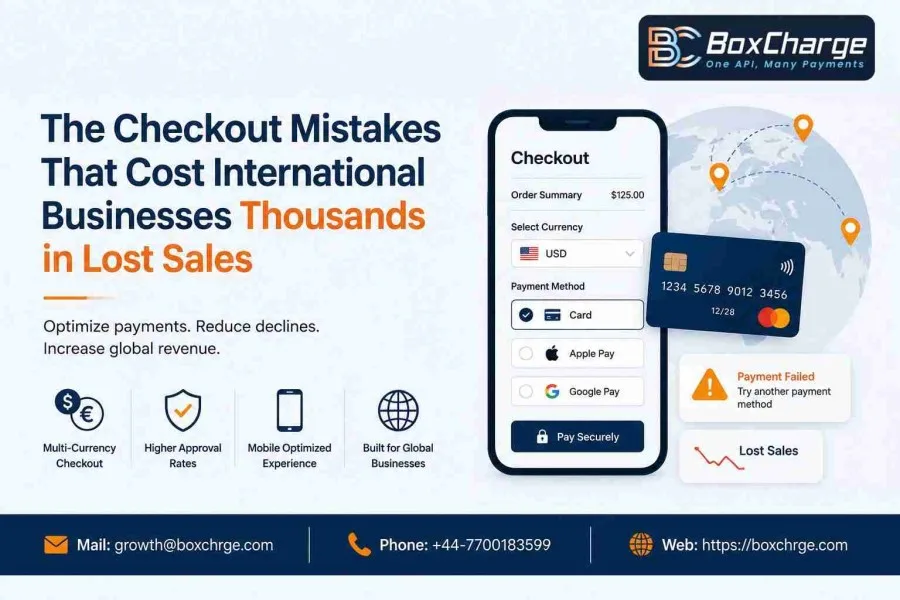
International checkout optimization is no longer a technical detail—it is a revenue decision. Many global eCommerce brands spend heavily on advertising, SEO, and customer acquisition, only to lose buyers at the final payment step. According to Statista, global retail eCommerce sales are projected to exceed US$8 trillion by 2028, making checkout performance one of the most important conversion drivers for international businesses.
For businesses operating across the United States, United Kingdom, Germany, Canada, Australia, Singapore, and the UAE, a poorly optimized checkout can quietly drain thousands of dollars in revenue every month.
This is especially true for high-risk merchants such as online gaming platforms, forex brokers, nutraceutical brands, subscription businesses, travel operators, digital services, and cross-border marketplaces.
Why International Checkout Failure Is A Bigger Problem Than Most Businesses Realize
A customer who reaches checkout has already shown strong buying intent. The advertising cost has been paid. The product has been selected. The only remaining task is completing the payment.
Yet many international merchants still use a checkout designed for a single domestic market.
In practice, that creates friction that customers rarely explain—they simply abandon the transaction.
I recently spoke with a payment consultant working with a UK-based supplement brand selling into Germany and the UAE. The company believed its Facebook campaigns were underperforming. After reviewing the payment data, the real issue became clear: a large percentage of international cards were being declined because the checkout lacked local acquiring and proper cross-border routing. Once the payment setup was restructured, approval rates improved within weeks.
That experience is common across high-risk industries.
Mistake #1: Forcing Customers To Pay In A Foreign Currency
One of the fastest ways to lose an international sale is showing prices only in USD when the customer is shopping from Germany, Canada, or Australia.
Customers often hesitate when they cannot see the final amount in their local currency. Exchange-rate uncertainty creates doubt at the exact moment they are ready to buy.
Why It Hurts Conversions
- Unexpected bank conversion fees
- Lack of price transparency
- Reduced trust in the merchant
- Higher cart abandonment
Multi-currency checkout and dynamic currency display are now standard expectations for global commerce.
Mistake #2: Using A Domestic Merchant Account For Global Traffic
Many businesses begin with a local merchant account and continue using it even after expanding internationally.
A U.S. merchant account may perform well for American cards but struggle with transactions from Europe, the Middle East, or Asia-Pacific.
Real-world Pain Point
A German digital subscription company processing payments through a single domestic acquirer saw a spike in customer declines in the UAE and Singapore. The issue was not fraud—it was cross-border authorization friction.
High-risk merchants experience this more frequently because issuers apply stricter risk controls to categories such as:
- Online gaming
- Forex trading
- CBD and wellness products
- Travel bookings
- Recurring subscriptions
- Digital content
Mistake #3: Triggering Unnecessary 3D Secure Friction
Strong Customer Authentication is essential, but poor implementation can damage conversions.
Many merchants apply the same authentication flow to every transaction, including low-risk repeat customers.
What Happens
A returning customer enters card details, receives an OTP, switches apps, the session times out, and the purchase is abandoned.
For subscription businesses, this is a major revenue leak.
Better ApproachUse risk-based authentication and smart 3DS routing so that additional verification is applied only when necessary.
Mistake #4: Offering Too Few Payment Methods
International customers do not all prefer credit cards.
A buyer in Germany may prefer bank transfer or local payment methods. A customer in the UAE may expect regional wallet support. A shopper in Australia may prefer alternative payment options.
When the preferred method is missing, many customers do not look for alternatives—they leave.
High-converting Payment Mix
- Visa
- Mastercard
- Apple Pay
- Google Pay
- Local bank transfer options
- Alternative payment methods (APMs)
- Recurring payment support
Mistake #5: Poor Mobile Checkout Performance
In most international markets, mobile traffic dominates eCommerce sessions.
A checkout that loads slowly, requires excessive typing, or fails on certain devices can destroy conversion rates.
A Common High-risk Merchant Experience
A travel booking operator targeting customers in the UK and Canada discovered that its payment page took several seconds longer to load on mobile networks. Users were abandoning before the authorization request was even sent to the processor.
Mobile Checkout Essentials- One-page checkout
- Autofill support
- Digital wallet integration
- Fast payment-page loading
- Minimal form fields
Mistake #6: Weak Fraud Controls That Create False Declines
Fraud prevention is critical, but aggressive rules often block legitimate customers.
This is one of the biggest frustrations I hear from high-risk merchants.
ExampleA forex broker serving clients across Europe and the UAE implemented strict velocity and geolocation rules after a fraud incident. The result was a surge in false declines from genuine traders using corporate cards while traveling internationally.
The business reduced fraud losses but simultaneously lost a significant amount of approved revenue.
The Balance That MattersModern payment orchestration platforms combine:
- Device intelligence
- Behavioral analysis
- Network tokenization
- Real-time issuer data
- Adaptive fraud scoring
This approach protects revenue without rejecting large numbers of legitimate buyers.
The Hidden Most Finance Teams Miss
Lost sales are only part of the problem.
A failing checkout also increases:
Hidden costBusiness impactHigher ad CACMore spend required per customerChargeback disputesOperational overhead increasesCustomer support ticketsLonger resolution timesFailed subscription renewalsRecurring revenue declinesLower LTVReduced long-term profitabilityFor subscription and high-risk businesses, even a 2–5% improvement in authorization rates can translate into substantial annual revenue gains.
What a Revenue-Focused International Checkout Should Include
A modern global checkout should provide:
- Multi-currency pricing
- Local acquiring coverage
- Smart payment routing
- Alternative payment methods
- Optimized 3D Secure
- Real-time fraud management
- Mobile-first design
- Recurring billing support
- Cross-border settlement options
These are no longer enterprise-only features; they are becoming the baseline for international commerce.
Final Takeaway
The biggest checkout mistake is assuming that a payment page is merely a technical requirement. For international businesses, it is a conversion engine.
A customer in London, Berlin, Dubai, Toronto, or Sydney expects a fast, local, secure, and familiar payment experience. When that expectation is not met, the sale is often lost silently.
For high-risk merchants, the stakes are even higher because authorization rates, fraud controls, chargebacks, and cross-border compliance directly affect profitability.
Businesses that invest in high-risk payment gateways, multi-currency processing, payment orchestration, alternative payment methods, and cross-border merchant infrastructure consistently recover revenue that would otherwise disappear at checkout.
In a global eCommerce market projected by Statista to surpass US$8 trillion by 2028, fixing checkout friction is not just a UX improvement—it is one of the fastest ways to increase international sales and protect long-term growth.
Stop losing international customers at checkout—partner with BoxCharge for high-risk payment solutions that improve approval rates, reduce declines, and turn more global visitors into paying customers. Apply now