
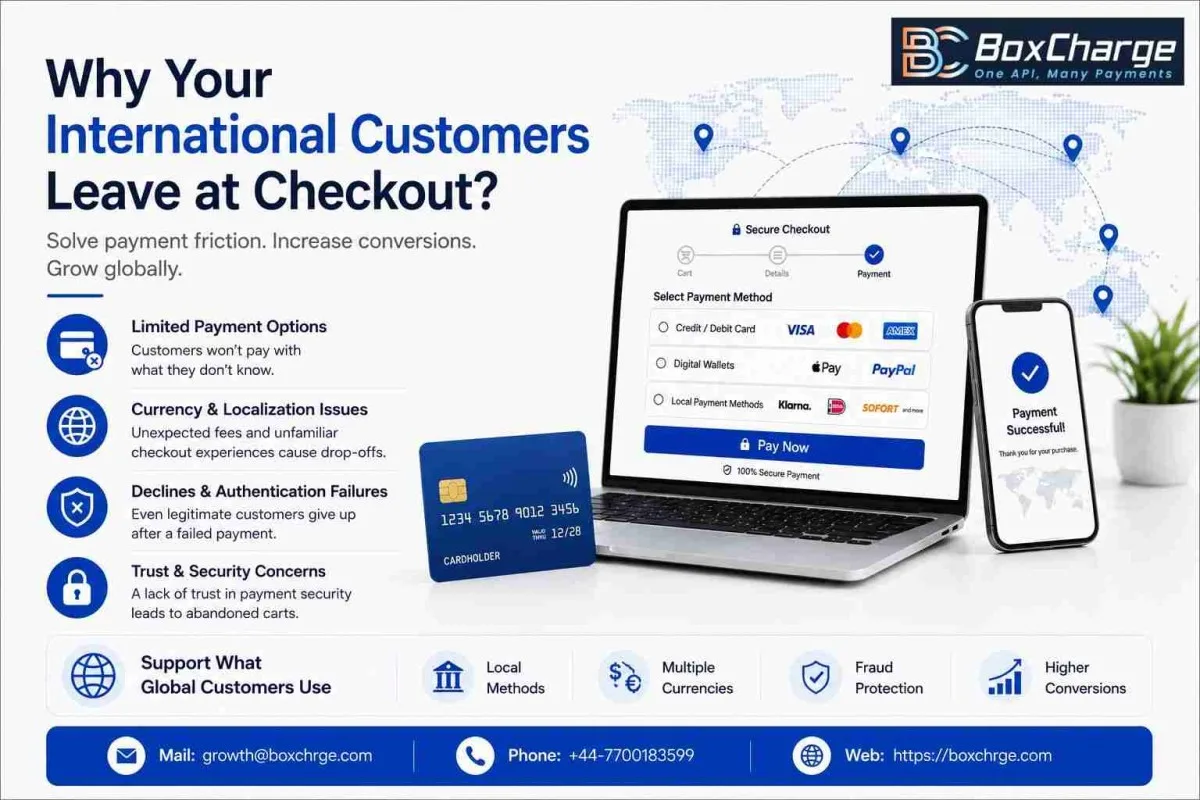
International payment processing can be the difference between a completed sale and an abandoned checkout. A customer may find the right product, accept the price and trust the brand, but still leave when the final payment experience feels unfamiliar, complicated or unreliable.
This matters even more for merchants selling across the UK, US, Canada, Australia, Singapore and European markets. Payment preferences differ by market, and customers increasingly expect businesses to support the payment methods, currencies and checkout experiences they already know.
Baymard Institute's ongoing checkout research currently puts the average e-commerce cart abandonment rate at 70.19%. Its research is based on more than a decade of checkout usability studies involving real users and major e-commerce websites.
For international merchants, however, checkout abandonment is not always caused by pricing or website design. Payment infrastructure itself can create friction.
Your Customers May Not Want to Pay the Way You Expect
One of the biggest mistakes international merchants make is assuming that accepting Visa and Mastercard is enough.
Cards remain important, but payment preferences are becoming increasingly diverse. According to Worldpay's Global Payments Report 2026, digital wallets represented 56% of global e-commerce spend in 2025. Worldpay also notes that wallet usage reflects local payment habits and digital ecosystems, meaning merchants need to understand how customers prefer to pay in each market.
Consider a merchant selling into the UK, Germany and the United States.
A UK shopper may expect a digital wallet. A US customer may be comfortable with cards and wallets. A European customer may prefer a payment method that is particularly familiar in their country.
The checkout does not need every payment method available worldwide. It needs the right payment methods for the markets being targeted.
That makes local payment methods a commercial consideration rather than simply a technical feature.
High-Risk Merchants Have Even Less Room for Payment Friction
For high-risk merchants, a payment failure can be particularly expensive.
Consider a gaming customer who reaches the deposit page but receives a card decline. A forex customer may be ready to fund an account but discover that their preferred currency or payment method is unavailable. A subscription merchant may successfully collect the first payment but lose recurring revenue when subsequent transactions fail.
The same challenge can affect adult businesses, gaming operators, forex platforms, dating businesses, travel companies, nutraceutical merchants and other higher-risk sectors.
These businesses often have to balance payment conversion with fraud prevention.
Security cannot simply be removed to make checkout easier. The FCA's guidance on Strong Customer Authentication explains that SCA requirements are intended to enhance payment security and limit fraud when customers access accounts or make certain electronic payments.
The commercial objective is therefore smarter payment processing: protect legitimate transactions while avoiding unnecessary friction for genuine customers.
Your Website Can Feel Local While Your Checkout Feels Foreign
A merchant can spend heavily on localization and still lose customers at the payment stage.
Imagine a French customer browsing prices in euros before reaching a checkout with an unfamiliar payment experience. Or an Australian shopper who expects a familiar wallet but only sees a lengthy card form. A UK customer may hesitate if the payment page suddenly looks disconnected from the merchant's website.
These inconsistencies can undermine confidence at exactly the moment the customer is deciding whether to pay.
This is why multi-currency payment processing, localized payment methods, and a reliable international payment gateway matter to global merchants.
The underlying cross-border infrastructure also presents challenges. The Bank for International Settlements' 2026 research on cross-border payment technologies states that cross-border payments remain more costly, slower, less accessible, and less transparent than domestic payments. The BIS identifies limited interoperability and differences between countries as important contributors to these inefficiencies.
For merchants, those infrastructure challenges can eventually appear as payment delays, higher costs, failed transactions or an unpredictable checkout experience.
One Payment Decline Can End the Customer Journey
Customers rarely know why a transaction has failed.
Behind a single decline could be issuer rules, fraud screening, authentication, currency issues, routing decisions, or other risk controls.
The customer sees only one message:
“Payment failed”.
Most customers are not going to investigate the reason.
This is particularly important for high-value transactions. A customer making a £500 purchase, funding a trading account or starting an expensive subscription may have little patience for repeated payment attempts.
For merchants, payment acceptance should therefore be measured beyond one overall approval figure.
Look at transaction performance by:
- Country
- Currency
- Payment method
- Device
- Issuer
- Authentication stage
- Transaction type
- Domestic versus cross-border route
This can reveal problems that ordinary conversion reports miss.
A merchant might discover that UK transactions perform well while transactions from another target market experience significantly more declines. Another might find that card payments work, but customers abandon when their preferred wallet is unavailable.
The problem is no longer simply checkout abandonment. It becomes a payment optimization issue.
Geography Changes What a Good Checkout Looks Like
There is no universal definition of the perfect international checkout.
The European Central Bank's 2024 SPACE study found that cards represented 48% of online payments in the euro area, while e-payment solutions such as payment wallets and mobile apps represented 29%. The study also found considerable differences between countries in how consumers pay online.
For example, the ECB reported that e-payment solutions were particularly prominent for online payments in the Netherlands, while cards remained the most frequently used online payment instrument across many other euro-area countries.
That is an important lesson for international merchants.
A checkout configuration that works well in the US should not automatically be copied into Germany, the Netherlands, the UK or Australia.
The better approach is to understand:
- Where customers are located
- Which currencies they prefer
- Which payment methods they recognize
- Where legitimate transactions are declining
- Which authentication steps create friction
- How payment performance differs between markets
That market-level approach is particularly valuable for merchants using global payment processing.
What High-Risk Merchants Should Check Before Changing Providers
A merchant experiencing checkout abandonment does not necessarily need to replace its entire payment infrastructure.
Start with the data.
Review decline rates, payment-method performance, authentication failures, recurring billing failures, chargebacks and checkout abandonment by market.
For high-risk businesses, also examine whether transaction routing and risk controls are affecting legitimate customers.
A gaming merchant may find that certain transactions are being unnecessarily declined. A forex business may discover that cross-border transactions create more friction than domestic payments. An e-commerce merchant may find that customers in a specific European market are leaving because a preferred local payment option is missing.
These are problems that can often be investigated before making a major infrastructure change.
The payment infrastructure itself also needs strong operational controls. The FCA states that payment service providers should maintain effective security systems, risk-management processes, incident management and business continuity arrangements.
Meanwhile, the BIS's 2026 work highlights interoperability, standardized messaging and API frameworks as important areas for improving cross-border payment efficiency.
For merchants, this means evaluating a payment partner on more than headline processing fees.
The Checkout Should Adapt to the Customer
International expansion is not simply about attracting visitors from more countries. It is about giving those customers a payment experience they recognize and trust.
A capable international payment gateway can support multiple currencies, relevant payment methods, authentication, fraud controls, routing and reporting. For high-risk merchants, the infrastructure also needs to accommodate more complex risk and compliance requirements.
The commercial lesson is straightforward.
If customers consistently reach your checkout but fail to complete payment, do not automatically assume the problem is your product, pricing or advertising.
The payment experience may be costing you the sale.
For merchants targeting customers across the UK, US, Canada, Europe, Australia and Singapore, improving payment acceptance, local payment coverage, currency support, routing and checkout usability can make international traffic more valuable.
The customer journey does not end when someone clicks "Buy Now."
It ends when the payment succeeds.