
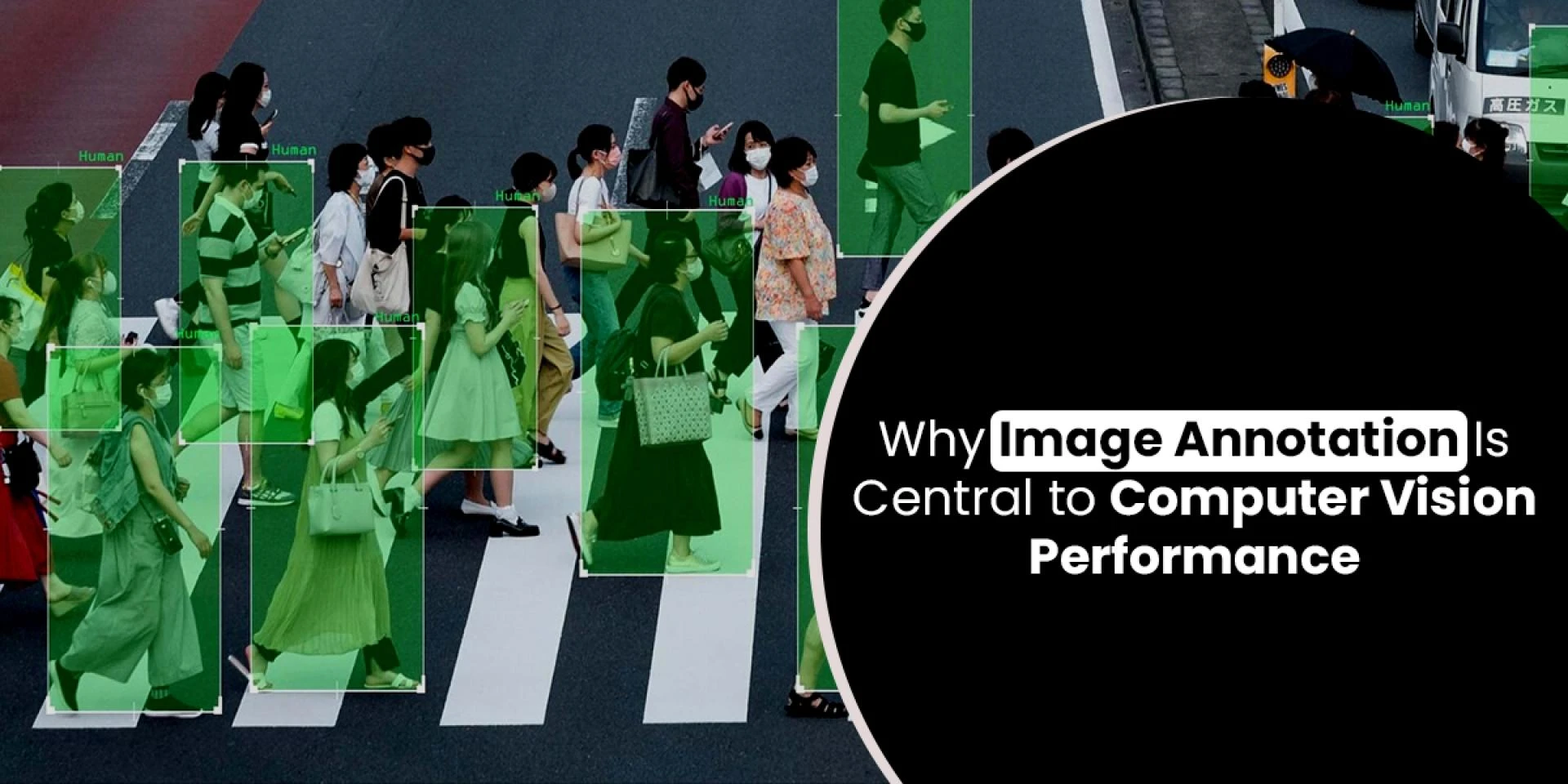
Data annotation for computer vision is the process of labeling images with metadata to accurately recognize objects, interpret scenes, and understand visual context at scale.
The increasing relevance of image annotation over the last decade underpins AI applications as diverse as monitoring road traffic, factory production lines, scanning medical images to detect anomalies, autonomous driving, and surveillance. All these capabilities of a computer vision application depend on the quality and quantity of the annotated images it uses as a reference.
This blog seeks to understand why improved image annotation is crucial for CV performance, acknowledging that annotation is not just a technical step but a crucial factor that influences model performance, fairness, and reliability.
Dataset Bias: The Hidden Risk in Computer Vision Models
Many computer vision models fail when they misinterpret what they see. The failure is not because computer vision models lack algorithms; it can result from poor-quality image datasets used for training, because even the most sophisticated models can misclassify, hallucinate, or act biased when the data is unclear, inconsistent, or not diverse.
The model internalizes overrepresented or underrepresented patterns in training data as the normative response. When faced with scenarios outside these constraints or edge cases, the model fails to interpret intent and frequently produces inaccurate results.
When image generation models fail to reflect diversity, it reveals a deeper issue, i.e., sampling bias.
How Sampling Bias Undermines Facial Recognition Systems?
There is an important question developers need to ask themselves when developing CV models: Is the model intended for a specific group or for a wide range of people in the real world? It is because building reliable facial recognition systems goes beyond simply increasing dataset size.
For example, imagine a facial recognition model trained predominantly on images from a single demographic (such as white or European groups). If the annotations always use small demographic groups to label facial features, such as the shape of the eyes, nose, or even the color of the skin, the model's understanding becomes very narrow.
When the same model is used to identify faces from different groups (e.g., African), it may misclassify and generate erroneous identities. These kinds of dataset discrepancies cause the model to hallucinate, thereby preventing long-term use or even global acceptance.
This is a classic case of representation or sampling bias, where a facial recognition model trained on a single demographic fails to generalize across diverse populations due to unbalanced, non-representative annotated datasets.
Common Factors That Degrade Computer Vision Model Performance
Before we find out what happened in the creation of a reliable CV model, let us discuss what makes them underperform. We describe the factors that disrupt a CV model as follows:
- Poor-quality annotations: Labels that don't align with the project guidelines can confuse the model to learn the wrong visual patterns. Even low-quality images in the form of motion blur, shadow differences, or noisy data reduce the performance, and so skilled annotators are assigned to label visual features correctly.
- Lack of data diversity: Bias and poor generalization arise when the training data covers only specific environments or object variants. In facial recognition, this often results in demographic bias; for retail computer vision models, training on seasonal clothing can lead to misclassification of new trends, while vehicle navigation systems trained on US signs may fail in other countries.
- Biased datasets: Models trained in controlled environments often break. It can be found that they contain over- or underrepresented datasets, which can lead to inequitable outcomes and exclusionary practices when exposed to real-world conditions they haven’t encountered before.
- Incomplete edge-case coverage: Rare scenarios, unusual angles, occlusions, or uncommon conditions are not accounted for, leading to poor model performance.
- Failure to include human annotators: A human-in-the-loop validates the data. Without it, errors go unreported, which are likely to accumulate over time, having a cascading effect on model outcomes. Specialist assessment and constant feedback are crucial as AI continues to evolve.
Key Principles That Make Better Computer Vision Models
So, what makes a model reliable? Let us now take a closer look at how a computer vision model comes together.
- Demographic diversity is essential
Maintaining diversity in the training data is crucial because global acknowledgment and accessibility of a model depend on how well it represents different ethnicities, age groups, genders, cultures, and communities.
- Consistency in annotation matters
Clear and standardized annotation guidelines help prevent conflicting labels. Techniques like bounding boxes, polygons, and semantic segmentation can be used to maintain consistency when creating ground-truth data suitable for intelligent machine learning systems.
- Social impact must be considered
Poorly curated datasets can harm sentiment by excluding or misrepresenting communities, leading to loss of trust in AI systems. Even ethical correctness, including fairness and long-term acceptance, is needed to avoid stereotypes or assumptions that may reinforce social or cultural bias.
- Global usability depends on responsible data practices
More than ethical and diverse data, the focus on compliant-ready datasets makes up for developing even advanced computer vision suitable for worldwide deployment. There are ethical problems associated with creating and deploying computer vision technology, especially regarding the use of publicly available datasets. The extensive use of visual data, often collected without consent and without an informed discussion of its ramifications, raises significant concerns about privacy and bias.
Taken together, the above factors illustrate the value of relying on professional data annotation services rather than solely on publicly available datasets.
Why Professional Outsourcing Providers Are Essential for Scalable AIWhen the annotations do not capture family types, gender identities, and cultural images, the model lacks the context it needs for realistic outputs. Over time, that lack of knowledge makes the systems unintentionally perpetuate stereotypes and miss changing norms. That is why data annotation and outsourcing providers are essential, because building datasets is not as easy as it seems.
The professional data annotation company defines labeling rules, adds quality checks, and accelerates project completion by leveraging expert teams. They strategically involve human-powered work and sometimes computer-assisted help, which expedites the creation of large volumes of training datasets. It can be seen that reliable professional providers ensure that datasets keep pace with changes in the modern world and that models do not fall behind.
In terms of model application and universality, there is a need to embed ethical considerations into the annotation process. Having diverse data alone is insufficient. The data must be ethically curated, respectful, and free from assumptions. Ethical considerations mean the service providers guide the labeling work and spot bias in ways that are fair and inclusive.
ConclusionIn a world where understanding of identity, family, and relationships evolves, businesses must incorporate these concepts into the training of a CV model through accurate visualization. Developers seeking scalable solutions and entrepreneurs rebuilding their existing platforms with AI need data to move beyond assumptions and better reflect the real world. Without image annotation, even advanced image generation models risk becoming outdated, excluded, and out of sync with the communities they aim to serve.
The success of computer vision models depends not on innovation. It also depends on how people responsibly create the training data for computer vision models. It means the partner you choose provides scalable image annotation services using AI tools, quality control measures, and human-in-the-loop techniques to manage large datasets efficiently.