
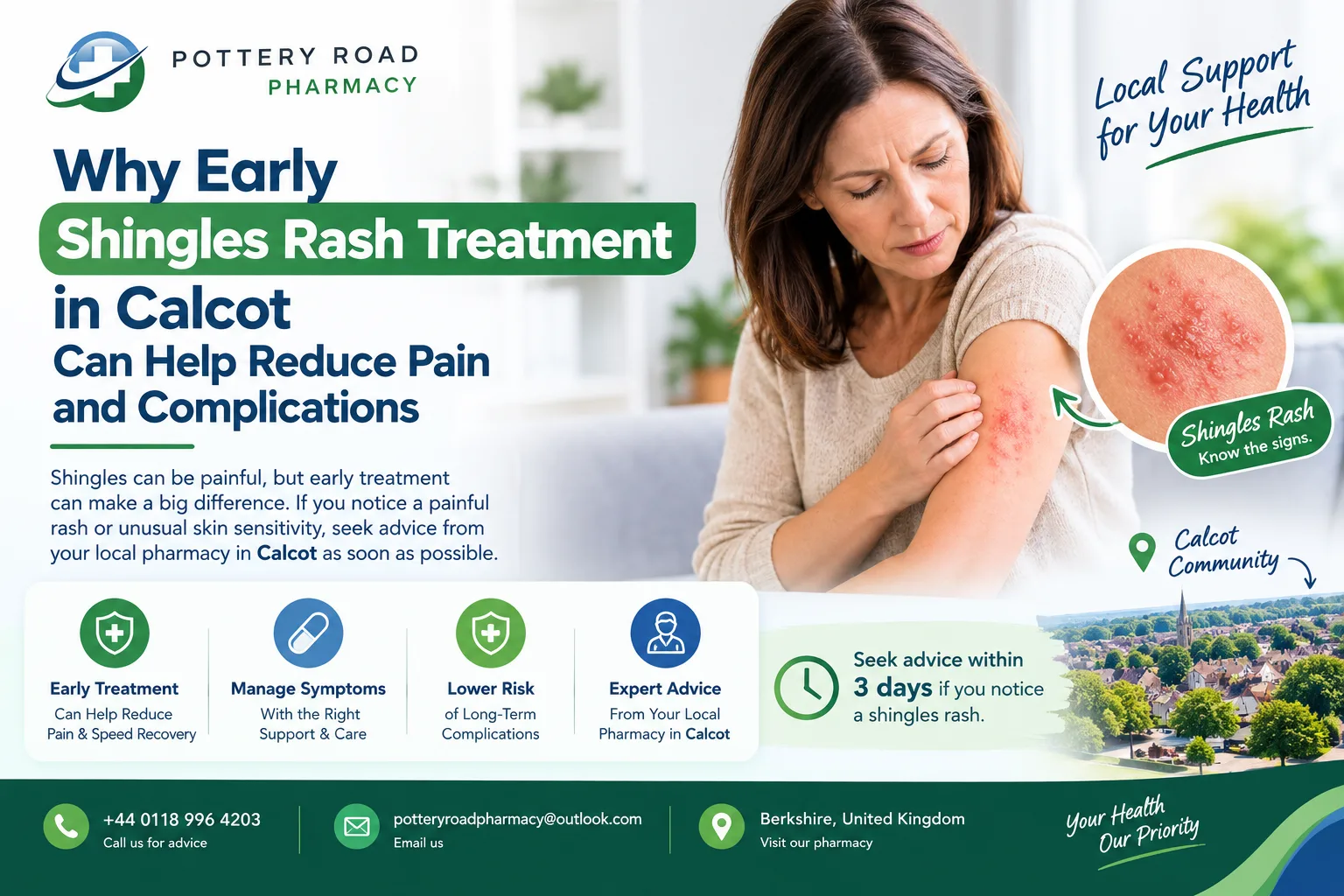
Shingles often doesn't announce itself clearly. Before any rash appears, you might notice a patch of skin that tingles, burns, itches or feels oddly sensitive. You might have a localised pain that you put down to a pulled muscle, or a headache and a general feeling of being unwell. When a rash finally shows up, it's easy to mistake it for an insect bite, an allergic reaction or another skin problem.
The key message is simple: don't ignore a new, painful or unusual rash, especially one that appears on one side of the body. NHS guidance advises adults who think they have shingles to get advice from a pharmacist, ideally within 3 days of the rash appearing. If you're looking for shingles rash treatment in Calcot, getting advice early can help you understand what your next step should be.
Think you may have shingles? Don't wait for the rash to become more painful. If you're looking for shingles rash treatment in Calcot, speak with a pharmacist promptly to discuss your symptoms and the appropriate next step.
This article is general information, not a diagnosis. If you're unsure about your symptoms, speak to a pharmacist, your GP or NHS 111.
What Is Shingles and Why Does It Cause a Painful Rash?
Shingles is caused by the varicella-zoster virus, the same virus that causes chickenpox. After you recover from chickenpox, the virus doesn't leave your body. It can lie inactive in your nerve tissue for years. Later in life it can reactivate, travelling along a nerve to the skin it supplies.
That's why shingles usually affects one area, often a band on one side of the body. The result is typically pain, followed by a rash and blisters. The NHS describes shingles as a painful rash that can appear on one side of the body and that may also affect areas such as the face and eyes.
Not everyone who has had chickenpox will develop shingles, and it's more common as people get older or if their immune system is weakened. It can still affect adults of other ages.
What Are the Early Signs of Shingles?
Tingling, burning and skin sensitivity
The first signs often come before any visible rash. People commonly describe:
- Tingling or burning in one area of skin
- Itching
- Skin that's sensitive to touch, even to clothing
- Localised pain
- A headache
- Feeling generally unwell
This early stage can last a few days, which is one reason shingles is sometimes confused with something else.
When the shingles rash appears
The rash commonly:
- Appears on one side of the body
- Develops in a particular area rather than spreading all over
- Forms clusters of small blisters
- May be painful or itchy
- Eventually dries out and forms scabs
If you have a one-sided, painful rash like this, treat it as a reason to seek advice promptly rather than waiting to see what happens.
How shingles can look on different skin tones
On lighter skin, the rash often looks red. On brown and black skin, it may look darker than the surrounding skin or be harder to see, and redness may not be obvious. Because of this, pay attention to how the area feels as well as how it looks. A one-sided band of pain, tingling or blistering is worth checking, whatever your skin tone.
Why Early Shingles Rash Treatment Matters
The reason timing matters is that antiviral treatment tends to work best when it's started early. Current NHS guidance says treatment is usually most effective when started within 3 days of the rash appearing. Decisions still depend on individual factors, including age, how severe the illness is, immune status and where the rash is.
Why timing can matter for antiviral treatment
Antiviral medicines work by slowing the virus down. The sooner they're started in a suitable patient, the more opportunity they have to help. Appropriate treatment can help shorten the illness for people who are suitable for it. That's why a quick assessment is valuable: a pharmacist or doctor can work out whether antiviral treatment is appropriate for you.
If you're past the 3-day mark, don't assume it's too late. In some situations, particularly for higher-risk people, treatment can still be considered. Get advice rather than deciding for yourself.
Managing shingles pain
Shingles can be very painful, and early assessment also means you can get appropriate advice on managing symptoms. This can include suitable pain relief and self-care, and guidance on what to do if your pain isn't well controlled.
Reducing the risk of longer-lasting problems
Some people continue to have nerve pain after the rash has cleared. This is known as post-herpetic neuralgia. Early assessment and appropriate treatment may help reduce the risk of longer-lasting problems in some people, but it can't be promised for every patient. Some people recover well with or without treatment, while others have lingering symptoms.
When Should You Seek Shingles Treatment in Calcot?
Seek advice promptly if:
- You develop a painful or unusual rash
- You suspect you might have shingles
- The rash appeared within the last few days
- You're in significant pain
- The rash is spreading or becoming more severe
- You're worried about possible complications
NHS guidance advises adults with suspected shingles to speak to a pharmacist and, where possible, to seek advice within 3 days of the rash appearing. If you're not sure whether it's shingles, the safest approach is to ask early. A pharmacist can help you decide whether you need further assessment.
How Is Shingles Treated?
The right approach depends on your symptoms, your health and how long you've had the rash. This section is for information only; it isn't personal treatment advice, and doses should always come from a healthcare professional.
Antiviral medicines
Suitable patients may be offered antiviral medicines such as aciclovir or valaciclovir. NHS England's current Pharmacy First clinical pathway includes antiviral treatment for eligible adults, based on factors such as timing, age, pain, rash severity and immune status. Not everyone with shingles will need or qualify for antivirals, which is why assessment matters.
Pain relief
Pain management is part of shingles care. NHS guidance lists options such as paracetamol for symptom relief and advises getting further medical advice if your pain isn't adequately controlled. Always check with a pharmacist or doctor about what's suitable for you, especially if you take other medicines or have other health conditions.
Self-care at home
Simple measures that are consistent with NHS self-care advice include:
- Keeping the rash clean and dry
- Wearing loose, comfortable clothing
- Using a cool compress on the affected area
- Avoiding irritation of the affected skin
If you have shingles, take care to avoid close contact with people who haven't had chickenpox and who are at higher risk, such as pregnant women and people with weakened immune systems, until your blisters have scabbed over. Ask a pharmacist or the NHS website for current guidance.
Can a Pharmacist Help With Shingles?
Yes, in many cases. Pharmacists can assess suitable adults with suspected shingles and give advice or treatment where appropriate under the relevant NHS service arrangements. NHS guidance states that pharmacists can provide the same antiviral medicines as a GP where appropriate, and can direct you to other medical help when you need it.
For people searching for shingles rash treatment in Calcot, Pottery Road Pharmacy can provide a convenient place to seek professional advice about your symptoms and the appropriate next step. To be clear, a pharmacy can't treat every case. Depending on your symptoms and eligibility, you may be referred to your GP, NHS 111 or urgent care. Reading more about advice about shingles on the pharmacy website is a good place to start.
When Should You Seek Urgent Medical Help?
Some situations shouldn't wait for routine pharmacy advice. Get urgent medical help from your GP, NHS 111 or an emergency service if:
- The rash is on or near your eye, or on your nose
- You have any changes to your vision, or your eye is painful or red
- You have a severely weakened immune system
- You're pregnant
- You're aged 17 or younger
- You become seriously unwell
- There are signs of significant complications, such as a rash that is spreading widely or symptoms that are getting worse quickly
Shingles that affects the eye can be serious and can threaten sight, so it needs prompt medical assessment and shouldn't be managed through routine pharmacy advice alone. If you notice a rash near your eye or on the tip or side of your nose, don't wait. In an emergency, call 999.
What can happen if shingles isn't assessed early?
This isn't meant to alarm you, because many people recover well. But delayed assessment can mean missing the best window for treatment, and some people experience:
- Persistent nerve pain that continues after the rash has gone
- Eye complications, which need urgent assessment
- More severe symptoms, particularly in people with weakened immune systems
- Slower recovery, because treatment wasn't considered early
Delay doesn't automatically cause complications, but prompt assessment gives you and your healthcare professional more options.
How Long Does Shingles Take to Clear?
Shingles typically follows a pattern: early symptoms, then a rash, then blisters, then scabbing, then healing. According to NHS guidance, the rash can take up to around 4 weeks to heal. In some people the pain lasts longer, and a small number experience nerve pain for months. If your pain isn't settling, speak to a healthcare professional rather than putting up with it.
What to Expect When Seeking Shingles Advice in Calcot
If you visit a pharmacy about a suspected shingles rash, the process is usually straightforward:
- Discuss your symptoms. The pharmacist will ask about the rash, your pain and when your symptoms began.
- Assess whether shingles is likely. They'll consider your symptoms and how the rash looks.
- Check whether pharmacy treatment is appropriate. Eligibility and clinical suitability are assessed, including your age, health and any medicines you take.
- Treatment or referral. Where appropriate, treatment may be supplied under the relevant service. If your situation needs your GP, NHS 111, urgent or specialist care, you'll be directed to the right place.
- Self-care advice. You'll get advice on managing your symptoms and looking after the rash.
It helps to know roughly when your symptoms started and to bring a list of any medicines you take.
Why Choose Pottery Road Pharmacy?
Pottery Road Pharmacy provides pharmacy services for people looking for accessible healthcare advice in the local Reading area. If you're concerned that a new painful rash could be shingles, speaking with a pharmacist promptly can help you understand whether further assessment or treatment is appropriate.
For patients searching for shingles rash treatment in Calcot, getting professional advice early can be an important first step. Availability of services and eligibility for NHS treatment can vary, so it's best to contact the pharmacy to confirm what's currently available.
Frequently Asked Questions
When should I seek shingles rash treatment in Calcot?
Seek advice as soon as you suspect shingles, ideally within 3 days of the rash appearing. A painful or unusual rash, especially on one side of the body, is a reason to speak to a pharmacist promptly. If the rash is near your eye or nose, get urgent medical help instead.
Can a pharmacist treat shingles in the UK?
Yes, in many cases. Pharmacists can assess suitable adults with suspected shingles and, where appropriate, provide antiviral treatment under the relevant NHS service. They can also give advice and refer you to a GP, NHS 111 or urgent care if you need it.
How quickly should shingles treatment start?
NHS guidance says antiviral treatment is usually most effective when started within 3 days of the rash appearing. Treatment can sometimes still be considered later, particularly for higher-risk people, so it's worth asking for advice even if you're past 3 days.
What does a shingles rash look like?
It commonly appears on one side of the body as a cluster of blisters in a specific area, often preceded by tingling, burning or pain. The rash can be itchy or painful and eventually dries and scabs over. On brown and black skin, it may look darker rather than red.
How long does a shingles rash usually last?
The rash can take up to around 4 weeks to heal, according to NHS guidance. Pain can last longer in some people. If your symptoms aren't improving, speak to a healthcare professional.
Can shingles cause pain after the rash disappears?
Yes. Some people develop long-lasting nerve pain called post-herpetic neuralgia after the rash has cleared. If you still have pain, ask a pharmacist or your GP about ways to manage it.
When does shingles require urgent medical attention?
Seek urgent help if the rash is around your eye or nose, you have vision changes, you have a severely weakened immune system, you're pregnant, you're aged 17 or younger, or you become seriously unwell. Contact your GP or NHS 111, or call 999 in an emergency.
Can shingles affect the eyes?
Yes. Shingles near the eye can cause serious problems, including to your sight, so it needs urgent medical assessment. Don't rely on routine pharmacy advice alone if you have a rash around your eye or on your nose.
Can I get shingles treatment from a pharmacy in Calcot?
Possibly. Pharmacies can assess suitable adults and provide treatment where appropriate under the relevant NHS service. Pottery Road Pharmacy can give advice about your symptoms and the right next step, and refer you if needed. Contact the pharmacy to confirm current availability.
What can I do at home to relieve shingles symptoms?
Keep the rash clean and dry, wear loose clothing, use a cool compress and avoid irritating the skin. Paracetamol can help with pain, but check with a pharmacist that it's suitable for you, and seek further advice if your pain isn't controlled.
Conclusion
Shingles can start quietly and look like something else, but acting early gives you the best chance of getting the right advice and, where suitable, treatment. If you notice a painful or unusual rash on one side of your body, don't wait for it to get worse. Seek advice, ideally within 3 days of the rash appearing, and get urgent medical help if the rash is near your eye or nose or if you're in a higher-risk group.
If you're looking for shingles rash treatment in Calcot, a conversation with a pharmacist can help you understand what to do next.
Concerned about a shingles rash? Pottery Road Pharmacy can help you understand what to do next. If you're experiencing symptoms, contact the pharmacy for advice or appropriate referral. You can also read more about shingles treatment on our website.
Pottery Road Pharmacy Phone: 0118 996 4203 Email: [email protected]