The Digital Revolution Behind Every Modern Smile
Not long ago, visiting the dentist often meant uncomfortable impression trays, multiple appointments, and waiting weeks for a crown or bridge to be completed. While these methods served the dental industry for decades, they also introduced challenges such as impression distortions, inconsistent fit, communication delays, and repeated adjustments.
Today, dentistry is experiencing one of the biggest technological transformations in its history.
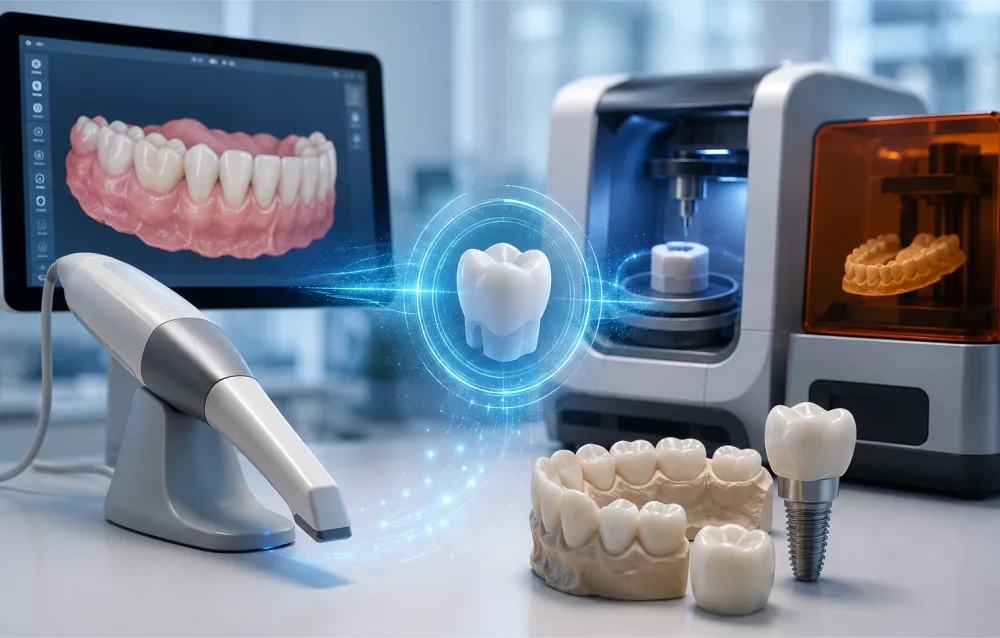
Digital dentistry has changed how dental practices and laboratories collaborate, making restorations more accurate, treatment faster, and the overall experience better for both dentists and patients. Technologies such as CAD/CAM systems, intraoral scanners, 3D printing, and cloud-based communication have streamlined workflows that once depended heavily on manual processes.
Rather than replacing skilled dental professionals, digital technology enhances their expertise by reducing human error and improving consistency throughout every stage of treatment.
So, why are more dental practices transitioning from traditional methods to digital workflows? Let's explore.
Understanding Traditional Dental Workflows
For many years, the conventional workflow followed a familiar sequence.
A dentist prepared the tooth, captured a physical impression using impression material, packaged it carefully, and shipped it to a dental laboratory. Once received, technicians poured stone models, manually designed the restoration, fabricated it, and shipped it back to the practice.
Although this process has produced countless successful restorations, it also presents several limitations.
Common challenges include:
- Impression distortions
- Shipping delays
- Communication gaps
- Manual remakes
- Inconsistent accuracy
- Longer turnaround times
- Increased chairside adjustments
Even a minor error during the impression stage could affect the fit of the final restoration, often requiring additional appointments for the patient.
What Is Digital Dentistry?
Digital dentistry refers to the use of advanced digital technologies to diagnose, design, manufacture, and deliver dental restorations.
Instead of relying on physical impressions and manual production methods, digital workflows capture precise three-dimensional data that moves electronically between the dental office and the laboratory.
This workflow often includes:
- Digital intraoral scanning
- CAD (Computer-Aided Design)
- CAM (Computer-Aided Manufacturing)
- 3D printing
- Digital smile design
- Cloud-based case submission
- Digital quality verification
The result is a faster, more accurate, and highly predictable restorative process.
Digital Impressions Have Replaced Traditional Impression Materials
One of the biggest improvements in modern dentistry is the adoption of intraoral scanners.
Instead of asking patients to bite into impression trays filled with material, dentists now capture thousands of detailed images within minutes.
These images create a highly accurate 3D model of the patient's teeth that can be reviewed instantly.
- Digital impressions offer several advantages:
- Improved patient comfort
- Higher scanning accuracy
- Instant verification of missing areas
- Faster case submission
- Reduced material waste
- Better communication with dental laboratories
Patients appreciate the more comfortable experience, while dentists benefit from greater confidence before sending the case.
Even with advanced intraoral scanners, scan quality remains critical for achieving accurate restorations. Following a consistent digital scan checklist before sending a crown case can help reduce missing margins, incomplete data, and unnecessary remakes while improving communication between the dental practice and laboratory.
Faster Communication Between Dentists and Dental Laboratories
Traditional workflows depended heavily on shipping physical models and paper prescriptions.
Digital dentistry eliminates many of these delays.
Once a scan is completed, the digital file can be securely transferred to the laboratory within minutes.
Laboratory technicians can immediately review the preparation, verify margins, request additional information if needed, and begin designing the restoration without waiting for physical deliveries.
This significantly shortens production timelines while improving collaboration.
CAD/CAM Technology Has Improved Precision
Computer-Aided Design and Computer-Aided Manufacturing, commonly known as CAD/CAM, have become the foundation of modern restorative dentistry.
Using advanced software, technicians design restorations with exceptional precision.
Every contour, contact point, margin, and occlusal surface can be carefully refined before production even begins.
Once the design is finalized, milling machines manufacture restorations from high-quality materials such as zirconia, PMMA, or ceramic with remarkable consistency.
Compared to manual techniques, CAD/CAM technology provides:
- Better marginal accuracy
- Improved contacts
- Consistent quality
- Reduced production errors
- Greater design flexibility
Rather than replacing craftsmanship, CAD/CAM gives technicians more control over every restoration.
3D Printing Is Transforming Dental Manufacturing
3D printing has become one of the most exciting innovations in dental laboratories.
Instead of manually producing diagnostic models or surgical guides, laboratories can now print highly detailed models within hours.
Applications include:
- Study models
- Surgical guides
- Custom trays
- Temporary restorations
- Full-arch prototypes
- Implant planning models
This technology accelerates production while maintaining exceptional accuracy.
As printing materials continue to improve, the role of additive manufacturing in dentistry will only expand.
Digital Workflows Reduce Human Error
Every manual process introduces opportunities for small mistakes.
Traditional impressions may shrink.
Stone models may chip.
Wax patterns may distort.
Shipping can damage physical models.
Digital workflows remove many of these variables.
Captured scan data remains unchanged throughout the process, allowing dentists and technicians to work from the same accurate digital model.
This consistency helps reduce remakes and improves treatment predictability.
Better Collaboration Creates Better Restorations
Modern dentistry is increasingly collaborative.
Digital case files allow dentists and laboratory technicians to communicate more effectively throughout treatment.
Questions can be answered quickly.
Additional photos can be shared instantly.
Margin clarification becomes easier.
Complex implant cases can be reviewed together before production begins.
This collaborative environment ultimately benefits the patient by reducing surprises during delivery appointments.
Shorter Turnaround Times
Speed has become an important advantage for both patients and dental practices.
Traditional workflows often required several weeks from impression to final delivery.
Digital workflows eliminate shipping delays and simplify production, allowing many laboratories to complete restorations much faster.
Reduced turnaround time means:
- Fewer patient visits
- Faster treatment completion
- Improved practice efficiency
- Better patient satisfaction
While every case varies, digital workflows consistently improve production efficiency.
Patients Benefit From Digital Dentistry Too
Although much of the technology operates behind the scenes, patients experience its advantages directly.
They enjoy:
- Shorter appointments
- More comfortable scanning
- Better-fitting restorations
- Fewer adjustments
- Faster treatment completion
- Greater confidence in the final result
For many patients, digital impressions are far more comfortable than traditional impression materials.
Digital Dentistry Supports Long-Term Growth
As dental practices continue adopting digital technologies, laboratories are evolving alongside them.
Today's leading laboratories invest in:
- Advanced CAD software
- High-precision milling systems
- 3D printing technology
- Digital quality control
- Scanner compatibility
- Continuous technician education
These investments allow laboratories to deliver increasingly accurate and predictable restorations while adapting to future innovations.
Technology Still Depends on Skilled Professionals
One common misconception is that digital technology replaces experienced dental technicians.
In reality, technology is only a tool.
Successful restorations still depend on the knowledge, judgment, and craftsmanship of trained professionals.
Digital software can assist with design, but experienced technicians remain responsible for:
- Evaluating margins
- Designing natural anatomy
- Managing occlusion
- Selecting materials
- Performing quality inspections
Technology enhances expertise—it does not replace it.
A Practical Example of Digital Collaboration
Imagine a dentist preparing a patient for a zirconia crown.
Instead of taking a traditional impression, the dentist captures a digital scan using an intraoral scanner.
The scan is securely transmitted to a digital dental laboratory where technicians review the preparation, design the restoration using CAD software, verify every detail, and manufacture it with advanced milling technology.
Many modern laboratories—including Palm Beach Dental Lab, a Florida-based digital dental laboratory—support this fully digital workflow with compatibility for leading intraoral scanning systems such as TRIOS, iTero, Medit, DEXIS, CS Connect, and STL files. By combining digital design, precision manufacturing, and efficient communication, they help dental practices deliver accurate restorations while simplifying the treatment process.
The finished restoration is then delivered to the practice with greater confidence in its accuracy, reducing the likelihood of chairside adjustments.
Looking Ahead
Digital dentistry continues to evolve rapidly.
Artificial intelligence, cloud collaboration, digital smile design, and next-generation manufacturing technologies are already shaping the future of restorative care.
As these innovations become more accessible, patients can expect faster treatment, improved comfort, and even greater accuracy.
Practices that embrace digital workflows today are positioning themselves for a future where technology and clinical expertise work together to deliver exceptional outcomes.
Conclusion
The transition from traditional workflows to digital dentistry is more than a technological upgrade—it's a transformation in how dental care is delivered.
By integrating intraoral scanning, CAD/CAM technology, 3D printing, and digital collaboration, modern dental practices and laboratories can improve efficiency, reduce errors, enhance communication, and provide better experiences for patients.
While traditional techniques laid the foundation for restorative dentistry, digital workflows are setting a new standard for precision, speed, and predictability. As technology continues to advance, the partnership between skilled dental professionals and innovative digital tools will remain at the heart of modern dentistry, helping clinicians create healthier, stronger, and more confident smiles for years to come.