Ask anyone who has spent a few years on a blasting floor, and they’ll tell you the same thing. The finish on a part is only as good as the media that created it. At Orient, this is a familiar pattern. Customers try different media to reduce costs, but consistent results often bring them back to cut wire shot. Very often, that’s the media they trust.
Understanding its performance, applications, and selection criteria helps buyers decide whether cut wire shot suits their surface treatment requirements.
What Makes Cut Wire Shot Different From Other Media?
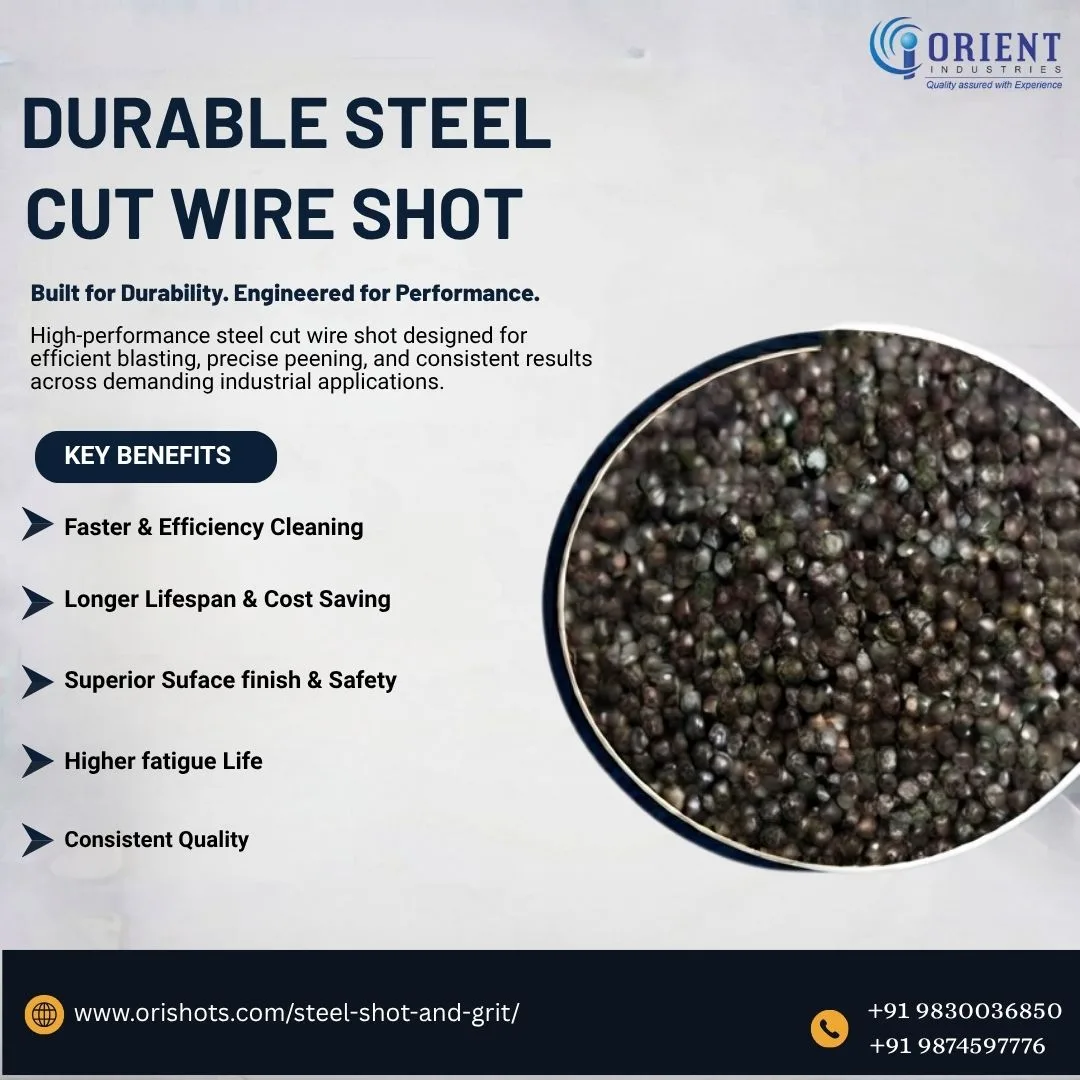
Most people picture shot as tiny steel balls, and that’s fair. But this one isn’t cast or melted into shape. It starts as drawn wire of a controlled diameter, which is chopped into short pieces about as long as the wire is wide. Then it’s conditioned so the sharp edges round off.
The controlled manufacturing process helps Orient maintain consistent particle dimensions, reducing variations that can affect surface finish from one batch to the next. A steel cut wire shot particle is dense, uniform, and tough, which is why shops that run the same part every day lean on it.
- Uniform size and weight, so cleaning and peening results stay repeatable
- High density that delivers solid impact on every pass
- Low breakdown rate, meaning less dust and longer life inside the machine
- Steady hardness from one lot to the next
These characteristics make cut wire shot a practical option for industrial processes where consistent results and media durability matter.
Where Cut Wire Shot Earns Its Place in Surface Treatment?
Think about a spring that has to survive millions of cycles. Or a gear that can’t afford even a tiny surface flaw. These jobs need a surface that is strengthened, not just cleaned. That’s where this media has a long track record.
When each particle strikes the metal, it leaves a compressive layer behind. That layer resists fatigue cracks, which is why it shows up in automotive springs, gears, shafts, and aerospace parts. Orient supplies cut wire shot for industrial applications where consistent media performance is important.
It also does well in everyday cleaning work:
- Rust and scale removal on forged and heat-treated components
- Cleaning castings before machining or coating
- Shot peening of springs, connecting rods, and crankshafts
- Preparing surfaces to help paint and protective coatings adhere properly
Why Operators Trust It Day After Day?
For machine operators, downtime is a practical concern. Media that breaks down quickly can increase replenishment, dust removal, and production interruptions. Frequent breakdowns mean refilling hoppers, cleaning dust, and slowing the line down.
The conditioned shape of cut wire shot helps it withstand repeated impacts. Lower particle breakdown can reduce dust generation and make media consumption and equipment maintenance easier to manage. Over time, reduced media replacement and lower dust-related maintenance can help offset a higher initial cost per kilogram.
Orient Industries keeps its focus on consistency for this reason. A blasting cabinet doesn’t care about brochures. It cares whether the media in the hopper behaves the same way today as it did last week.
Consistent media performance can also help maintain the required surface profile, making quality checks more straightforward when operating conditions are properly controlled. This is particularly useful if you operate a production line where you process large quantities of similar parts on a daily basis.
Choosing the Right Size and Hardness
Not all Abrasives are suitable for all surface treatment applications. For cut wire shot, the right choice depends on the component, the required finish, and the intended process.
- What is the part made of, and how thick is it?
- Do you need a fine, even finish or aggressive scale removal?
- Is the goal cleaning, peening, or both?
- What does your machine recommend for media size and flow?
Smaller sizes tend to give a finer, more uniform surface. Larger sizes hit harder and work better on heavy scale, depending on the component and blasting conditions. Hardness matters too. The appropriate hardness depends on the component material and treatment objective, as well as the required surface finish. When in doubt, run a small trial lot and inspect the surface under good light.
Talk to the supplier, too. A good one will ask about your process before quoting anything. Orient Industries can help buyers assess the appropriate grade based on their application and operating requirements, helping them avoid unnecessary media costs and inconsistent results.
Common Mistakes Worth Avoiding
A few habits quietly eat into results:
- Mixing old and new media without checking size distribution
- Running the machine well past the point where the media has worn down
- Picking a grade purely on price
- Ignoring the working mix, which should be topped up in small, regular amounts
Small corrections here can improve finish quality with cut wire shot without the need to change equipment. Orient Industries recommends keeping simple records of media top-ups so changes in performance can be spotted early, before they lead to a rejected batch.
Conclusion
Reliability in surface treatment rarely comes from anything dramatic. It comes from media that behaves the same way every time. Cut wire shot offers that through uniform size, strong density, and a rounded form that resists breaking.
It cleans, descales, and strengthens parts, which is why automotive, aerospace, and general engineering units keep returning to it. Choosing the right size and hardness still matters, and so does a supplier who understands the process behind the order.
With its focus on consistency, Orient Industries helps buyers get steady results from their steel cut wire shot and other Abrasives, batch after batch. It’s a quiet performer, and that’s exactly what a busy plant needs. Choose well once, and the savings show up in every shift that follows.