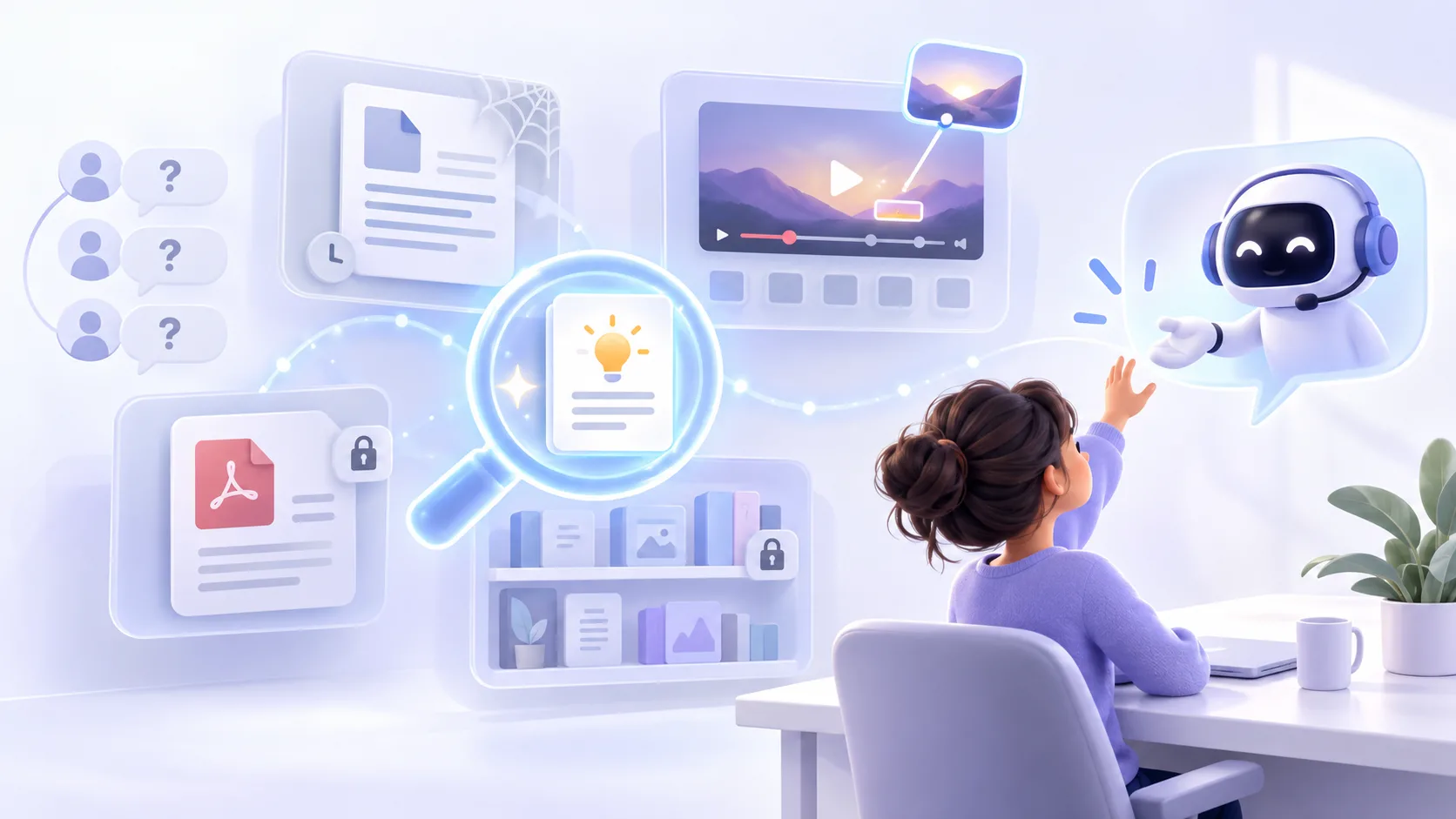
A company may have help articles, PDF guides, and tutorial videos covering common customer questions. Yet customers still contact support for answers that already exist.
This does not always mean customers avoid self-service. Often, the answer is difficult to find, unclear, outdated, or disconnected from their situation.
Publishing support content is not enough. Customers must also be able to locate, understand, and trust it.
The answer is difficult to find
Support knowledge is often spread across help centers, shared folders, videos, webinars, and product documentation.
A customer may find a general article but miss the exact answer hidden inside a 30-minute recording. If searching takes longer than opening a ticket, contacting support becomes the easier choice.
Cincopa helps teams bring videos and supporting documents into organized Galleries, Pages, and CincoTube portals. This gives customers a structured place to look instead of making them search across unrelated locations.
Customers use different words
Companies and customers often describe the same issue differently.
A product team may use “authentication failure,” while a customer searches for “I cannot log in.” Documentation may refer to “workspace permissions,” while users ask how to give a teammate access.
Titles, descriptions, transcripts, tags, and FAQs should include the words customers actually use. Support tickets and search queries can help teams identify that language.
Cincopa VideoGPT allows users to ask questions in their own words across approved videos and documents. They do not need to know the exact title of a tutorial or the official name of a feature.
The answer is hidden inside a video
A video may contain the correct solution but still be difficult to use.
For example, instructions for fixing a failed upload may appear halfway through a long product webinar. Without chapters or a searchable transcript, the customer must watch the entire recording.
Cincopa can create captions and transcripts for hosted videos. VideoGPT can use transcripts and other available content to answer questions. When timestamped transcript data is available, users can also be guided to the relevant moment in the video.
This turns a long recording into searchable knowledge rather than a file customers must watch from beginning to end.
The documentation is incomplete
Some documentation explains what a feature does but not how to resolve a specific problem.
A useful support resource should answer:
- What problem will the customer notice?
- What is the likely cause?
- Which permissions or requirements apply?
- What steps will resolve the issue?
- How can the customer confirm that it worked?
- What should they do if the problem continues?
Videos and documents can support each other. A video can demonstrate the workflow, while written instructions provide exact steps, warnings, and values the customer may need to copy.
Cincopa allows teams to place videos and supporting documents in the same knowledge environment so customers can use both formats together.
Customers do not trust outdated answers
Old screenshots, conflicting instructions, and missing review dates reduce confidence. Customers may contact support simply to confirm that an article or video is still accurate.
Every important resource should have an owner, review date, intended audience, and product version when relevant. When the product changes, outdated content should be updated or archived.
Organizing content in Cincopa makes related videos and documents easier to manage, but teams still need a clear review process. Technology can surface an answer, but it cannot make an outdated answer correct.
The answer does not match the customer’s situation
An answer may be technically correct but apply only to administrators, enterprise plans, mobile devices, or an earlier product version.
Support resources should clearly state:
- Who the instructions are for
- Which product or version they cover
- What access level is required
- Any limits or exceptions
- When an agent should be contacted
Cincopa’s access controls can help teams provide different knowledge collections for customers, partners, and employees. VideoGPT should answer from content the user is permitted to access.
Support questions can improve the content
Repeated questions reveal where documentation is not working.
If customers continue asking about the same workflow, the topic may be missing or poorly explained. If they ask several follow-up questions, the original answer may lack important context.
Cincopa’s VideoGPT Insights helps teams review repeated questions, weak-answer signals, and missing-topic patterns across supported knowledge environments.
For example, if customers repeatedly ask whether a workflow changed after a product release, the team may need to:
- Update an existing tutorial
- Record a shorter walkthrough
- Add a clearer release document
- Improve the video transcript
- Reorganize the relevant Gallery
VideoGPT helps customers retrieve existing answers, while VideoGPT Insights helps content owners understand what should be improved next.
Measure resolution, not just content volume
Publishing more articles and videos does not automatically reduce support requests.
Teams should monitor:
- Searches producing no useful answer
- Questions repeatedly sent to agents
- Support tickets opened after content is viewed
- Topics producing frequent follow-up questions
- VideoGPT answers marked as weak or unhelpful
- Outdated resources discovered during support conversations
These signals show whether customers can use the available content to move forward.
Final thoughts
Customers contact support when existing answers are difficult to find, unclear, outdated, or unsuitable for their situation.
Cincopa can help teams organize videos and documents, generate searchable transcripts, manage access, and use VideoGPT to answer questions across the knowledge library. VideoGPT Insights can then reveal where customers continue to encounter missing or weak information.
The goal is not to eliminate human support. It is to make existing knowledge genuinely useful for repeatable questions while giving customers an easy path to an agent when personal help is necessary.