
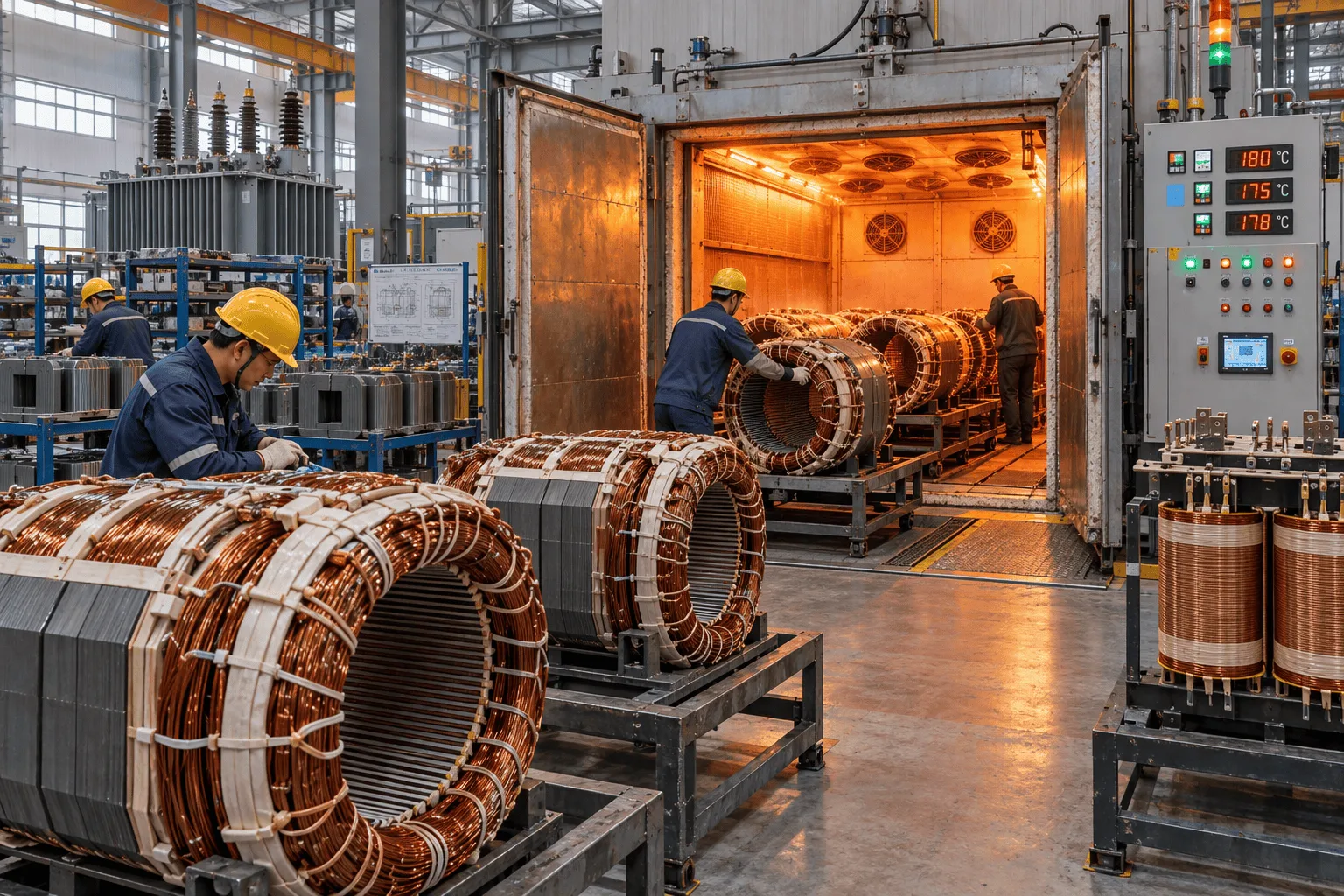
Bay 2 Readings From the First Wet Week
The humidity problem showed up in the first week of July, when the shop floor hygrometer near the loading door moved from about 55 percent to nearly 88 percent over three days. The industrial oven in bay 2 had been running the same loads all season without trouble. That week the same loads took longer to reach their set temperature, and the exhaust duct was visibly wet at the elbow where it leaves the roof. The batch oven in the neighboring bay showed the same pattern, a little less strongly because its door faces the inside of the building and not the yard.
The first cycle of the week took 74 minutes to bring the chamber from ambient to 150 degrees C, against the usual 52 to 55 minutes. The controller display did not show anything abnormal. The heater contactors clicked at the normal interval, so the delay was not coming from the control side. Moisture in the intake air and in the loads themselves was taking energy that normally went into raising the chamber temperature.
Fresh Air Intake Damper Position
The intake damper in bay 2 had been sitting at roughly one third open since the dry season. During the wet week it was moved to a quarter open, and the chamber reached set temperature about six minutes sooner. The exhaust damper was left alone. The chamber's wet bulb reading, taken with a handheld meter through the inspection port, stayed above the dry season value for the first forty minutes of every cycle and then dropped as the load began to release its water.
Thermocouple Reading at the Rear Wall
The rear wall thermocouple of the batch oven read 4 to 5 degrees C lower than a reference probe placed beside it during the first humid cycles. The same two sensors agreed within 1 degree C in March. The sheath had a thin white film near the junction, which looked like mineral residue from condensation. After the film was wiped off and the probe dried out, the difference went back to under 2 degrees C, though it returned slightly on the next two wet days.
Electrode Drying Runs Against Flux Moisture Pickup
Welding electrodes and flux were the loads that showed the moisture problem most clearly. Two racks of low hydrogen electrodes were baked in the batch oven at 300 degrees C for two hours each. Sample packs weighed before and after lost between 0.9 and 1.4 percent of their weight in the wet week, against roughly 0.5 percent in the dry months. Part of that increase is simply more water having been absorbed in storage, because the cartons stayed in the receiving area for two days before being loaded.
Granular flux from the same period behaved differently from the electrodes. It had formed small clumps in the bags, and the clumped portions kept moisture longer than the loose material. A tray of flux at 3 cm depth measured 12 degrees C cooler at the bottom than at the surface after one hour at a 250 degree C set point. A 1.5 cm layer in an adjacent tray evened out within 25 minutes. The difference came from depth and clumping rather than from the oven itself.
Weight Loss on Sample Packs
Sample packs were weighed on a balance reading to 0.1 gram, with three packs pulled from different shelf positions. The top shelf packs lost more than those at the bottom by about 0.3 percent in each of the humid cycles. The airflow fan sits at the rear and top of the chamber, so the top shelf gets the freshest hot air while the lower shelves see air that has already picked up moisture from the load above.
Varnish Baking and Core Baking Loads on Wet Days
The motor stators coming in for varnish baking were also showing the effect. Stators that had stood in the open stores for a week came in with a faint dampness on the windings, and the first ten minutes of the bake produced a light vapor at the door gap that was not visible on dry days. The varnish surface at the end of the cycle was normal on most pieces. Two stators placed near the door showed a slightly dull patch on the outer winding, and the same two positions had given dull patches during a previous wet period.
Core baking in the same batch oven used sand cores that carry binder and moisture. These were loaded on perforated trays and the cycle ran for three hours at 200 degrees C. Cores from the wet week had a surface hardness roughly 10 percent lower than cores from a dry week when tested with the usual scratch method, and a few pieces were still faintly damp in the center when cut open. The cycle time on that load was extended by 40 minutes by the shift supervisor and the center dampness did not appear again.
Panel Cabinet Condition
The control panel on bay 2 had condensation on the inside of the door glass on three mornings. A silica gel sachet kept inside the cabinet had turned from blue to pink. The terminals looked dry, but one neutral terminal showed light surface oxidation. The cabinet's small anti-condensation heater was found with its switch off, which may have been left that way after the previous service.
Heater Current Readings Across Three Phases
Clamp readings taken at the heater bank on the same day gave 21.4 A, 21.1 A and 19.8 A on the three phases of the industrial oven. The earlier spring readings were all within 0.5 A of each other. The lower phase pointed to one element running below its normal output, and a resistance check with the power isolated showed one element about 6 percent higher in resistance than the others. That element had a visible dark mark near the terminal end, which is where moisture had apparently been sitting.
The batch oven showed no such imbalance, with all three phases reading within 0.7 A. Its elements are sheathed and mounted away from the door, which may explain why they stayed unaffected. The industrial oven in bay 2 has open coiled elements placed lower in the chamber, closer to the incoming air.
Insulation Surface Temperature Walk-Around
A surface thermometer was used around the outside of both chambers with the oven running at 200 degrees C. The side panels of the batch oven read 46 to 52 degrees C. The roof of bay 2's oven read 58 degrees C near the exhaust duct, and the door edge at the lower corner read 71 degrees C. In the dry season that same corner had read about 60 degrees C. The mineral wool in the door was found slightly compressed and damp when a corner of the outer skin was opened during a stoppage, so the extra heat loss there matched what the thermometer showed.
Smaller differences appeared on the rear panel, which sits against a wall and gets almost no air movement. It read 5 to 6 degrees C higher than the side panels and has done so since commissioning, so it was not counted as part of the wet week change.
Door Seal Observations After the Last Cycle
The silicone rope seal on the batch oven door had a flat spot about 20 cm long near the latch side and a gap of nearly 3 mm showed at that point when a feeler gauge was passed along it. The seal was old, and the gap probably explains part of the vapor seen at the door during the early cycles. Heat was visibly leaking at that spot with a faint wavering above the door edge when the chamber passed 180 degrees C.
The last cycle of the evening, a light varnish bake on small coils, finished at about 8 pm. The controller read 148 degrees C against a set point of 150, which is within its normal swing, and the chamber was left to cool with the fan running for another ten minutes. The main isolator was switched off after the current clamp read zero, the damper positions were noted on the log sheet, the door was pushed shut until the latch caught, and the bay lights were turned off on the way out.