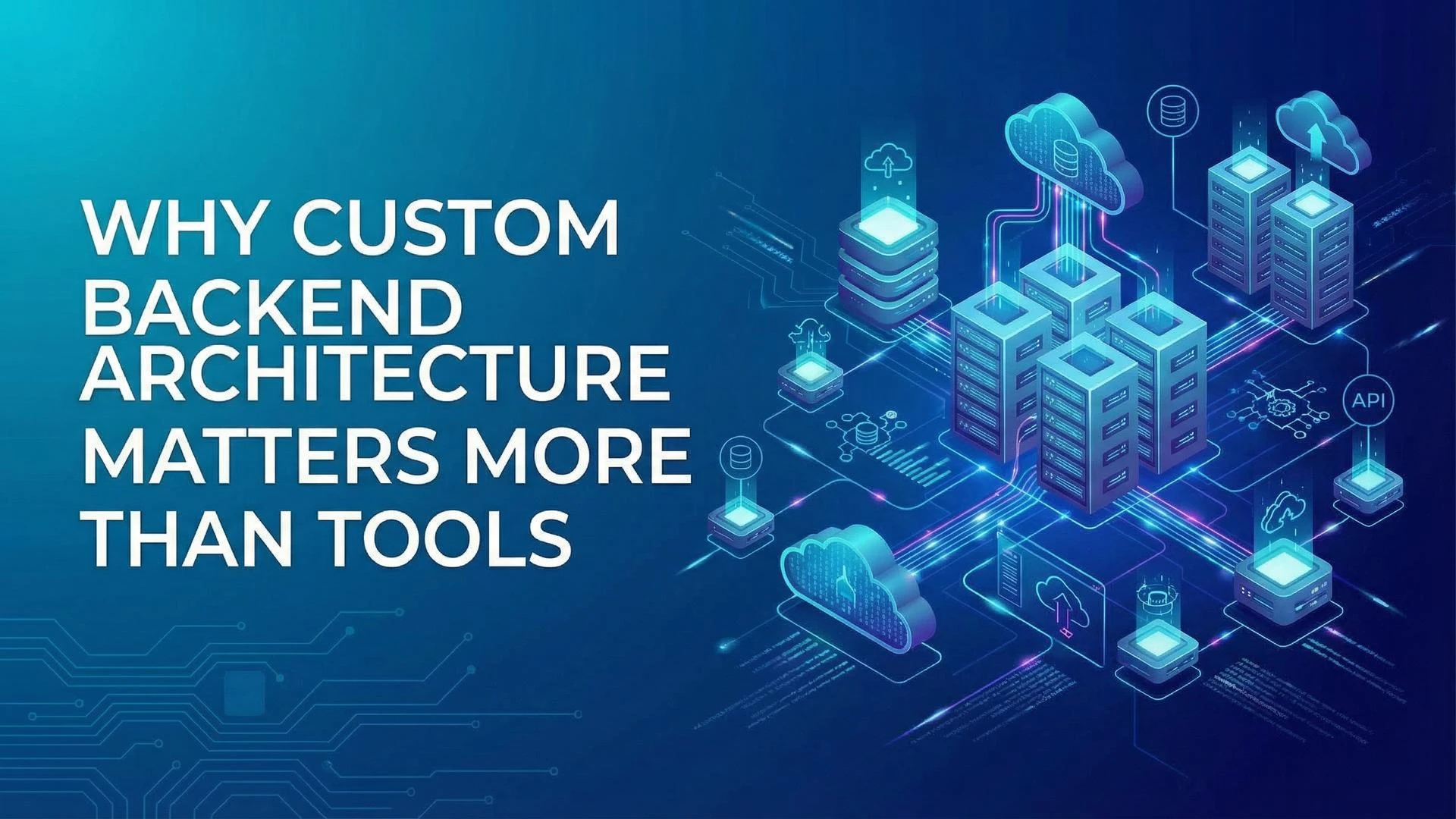
Modern backend discussions often obsess over frameworks, stacks, and tooling, assuming the ‘right’ technology choice guarantees performance and scalability. It doesn’t, as teams often discover only after latency spikes, failed load tests, or production incidents under real traffic. Tools help teams move faster early, but they rarely determine how a system behaves under real load. Backend failures almost always trace back to architectural decisions made long before traffic arrived.
The real difference is between shipping a backend and operating one at scale, where load testing failures, runtime latency spikes, and scaling ceilings expose architectural decisions made long before launch. Issues like load testing failures, runtime latency spikes, and scaling ceilings surface only when growth exposes structural weaknesses. At that stage, no framework upgrade can compensate for poor design.
This is why teams operating multi-tenant SaaS platforms, regulated systems, or high-traffic products partner with a custom backend development company to design systems around behavior, growth, and resilience, not tool defaults. This blog explains why backend architecture, not tools, ultimately determines long-term system success.
1. Tools Solve Speed, Architecture Determines Long-Term Backend Behavior
Tools are designed to accelerate development, not to guarantee how a system behaves under pressure. Frameworks abstract common problems, provide sensible defaults, and help teams ship faster, but they don’t define how your backend will scale, fail, or recover over time.
When architecture is shaped around tool limitations, systems inherit those constraints. Defaults meant for simplicity turn into hidden ceilings as traffic, data volume, and concurrency increase. What worked well for early delivery becomes rigid once real-world usage patterns appear.
Architecture-driven backends start from system behavior, not implementation convenience. They define how services communicate, how data flows, and how failures are isolated, independent of the framework in use. This is why backend longevity depends on intentional design choices, not the tools selected to write the first version.
2. Scalability Is an Architectural Property, Not a Feature
Scalability issues rarely appear when systems are small. Most backends “work fine” until real traffic exposes limits that were never designed around. This is because scalability is not something you toggle later, but a property embedded into the architecture itself.
Poor architectural patterns, such as shared state, tight coupling, and synchronous dependencies, create hard ceilings. Single points of failure, shared state, and tightly coupled services make growth fragile. Teams often try to compensate by scaling infrastructure vertically, but more CPU or memory cannot fix structural bottlenecks.
Horizontal scaling, service isolation, and controlled data access are architectural decisions, not infrastructure upgrades. When these are planned early, systems absorb growth gradually. When they are not, load testing becomes a discovery exercise that forces rewrites instead of tuning.
3. Runtime Latency Is Shaped Long Before Code Is Deployed
Runtime latency is often blamed on slow databases or insufficient infrastructure, but in practice, it is usually baked into the architecture long before production traffic arrives. Even powerful servers cannot compensate for inefficient request flows.
Common architectural causes of latency include synchronous dependencies between services, tightly coupled components that must respond in sequence, and inefficient data access patterns that force repeated queries or excessive joins. Each adds milliseconds that compound under load.
Teams often attempt to fix latency by adding caches or upgrading databases. While these help temporarily, they do not address structural delays. Predictable performance comes from architectures designed with clear boundaries, asynchronous workflows, and controlled data paths. When latency is treated as a design concern, systems remain responsive even as usage scales.
4. Load Testing Exposes Architecture, Not Just Capacity
Load testing is often treated as a way to check whether the infrastructure can handle traffic. In reality, it reveals whether the backend architecture itself can survive concurrency. Systems rarely fail because they lack CPU or memory; they fail because request flows were never designed for parallel usage.
Under load, architectural weaknesses become obvious. Shared resources turn into bottlenecks, synchronous chains amplify delays, and small inefficiencies cascade into widespread failures. This is why systems often pass functional tests yet collapse the moment realistic traffic is introduced.
Effective load testing surfaces how requests move through services, how data stores behave under pressure, and how failures propagate. When testing leads only to tuning servers, problems repeat. When it leads to architectural refinement, scalability becomes sustainable rather than reactive.
5. Backend Patterns Matter More Than Backend Stacks
Frameworks and stacks change every few years. Backend patterns, however, shape systems for a decade or more. When teams prioritize tools over patterns, they inherit limitations that no upgrade can fix.
Patterns define how a system behaves under stress. An API-first backend makes it possible to support new clients without restructuring core logic. Event-driven designs reduce tight coupling and allow systems to absorb spikes gracefully. Stateless services simplify scaling, recovery, and deployment compared to stateful designs that lock data into execution paths.
When patterns are chosen poorly, teams end up with “Frankenstein” systems stitched together with workarounds. Adding features becomes risky, and performance tuning turns into guesswork. Mature teams invest in architectural patterns early, knowing tools can be swapped, but patterns quietly decide whether a backend stays adaptable or collapses under change.
6. Custom Architecture Enables Predictable Scaling
Off-the-shelf backends often scale well in theory but break down when real usage deviates from expected patterns. This is because generic solutions are designed for averages, not for the specific traffic shapes, data access patterns, and failure modes of your product.
Custom backend architecture allows teams to scale selectively instead of globally. High-traffic endpoints can be isolated and scaled independently. Read-heavy and write-heavy workloads can use different storage strategies. Background processing can be separated from user-facing requests, preventing spikes from cascading into outages.
As a result, scalability becomes predictable rather than reactive. Teams don’t scramble to add servers or cache everything blindly. Instead, growth is absorbed by design. This is why custom systems evolve incrementally without breaking dependencies, while tool-driven backends often require disruptive rewrites once scale exposes their limits.
7. Data Ownership, Security, and Compliance Are Architectural Concerns
Data control is not something you can reliably bolt onto a backend after it has already grown. Decisions about where data lives, how it flows, and who can access it are baked into the architecture from the start.
Generic tools often abstract data handling in ways that make fine-grained control difficult. As systems scale, this creates blind spots around access rules, auditability, and compliance obligations. Requirements like data residency, consent tracking, and traceability cannot be retrofitted without major rework.
A custom backend architecture allows teams to design explicit data boundaries, enforce least-privilege access, and build compliance workflows directly into the system. Security becomes predictable rather than reactive. This is especially critical for enterprises operating under regulations such as GDPR or industry-specific standards, where architectural clarity directly reduces risk and long-term operational cost.
8. Integration Complexity Demands Architectural Foresight
Modern backends rarely operate in isolation. As products grow, they must integrate with CRMs, ERPs, analytics platforms, payment gateways, and a growing set of third-party services. These integrations quickly become a major source of complexity.
When integration is treated as an afterthought, teams hard-wire dependencies directly into core services. Over time, this creates tight coupling where changes in one external system ripple through the backend, increasing failure risk and slowing delivery.
Architecture-first backends introduce clear integration layers that isolate external systems from core business logic. This makes it possible to swap vendors, update APIs, or add new partners without destabilizing the system. With the right architectural boundaries, integrations remain flexible instead of becoming long-term constraints on scalability and evolution.
9. Cost Efficiency Emerges From Architecture, Not Licensing
Backend cost discussions often focus on tooling and licensing, but the largest expenses surface later, and they are architectural. Poorly designed backends generate ongoing costs through performance firefighting, emergency scaling, repeated refactors, and engineering time spent maintaining fragile systems.
Tool-first decisions may appear cheaper initially, but they introduce hidden costs as traffic grows. Scaling infrastructure to compensate for architectural inefficiencies increases cloud spend, while tightly coupled systems slow development and inflate operational overhead.
Architecture-led backends control cost by design. Clear service boundaries, efficient data flows, and predictable scaling models reduce waste and prevent unnecessary resource usage. Over time, this leads to a lower total cost of ownership because the system grows in a controlled, intentional way, without constant rewrites or reactive fixes.
Why Teams Regret Tool-First Backend Decisions
Most backend failures don’t happen at launch. They surface months or years later, when growth exposes decisions that were never revisited. Teams that prioritize tools before architecture often discover that early convenience has locked them into rigid systems.
Here’s what teams feel when they make tool-first backend decisions:
- Choosing frameworks before defining system behavior: Tools dictated architecture instead of the product’s real scaling, data, and reliability needs.
- Scaling infrastructure instead of fixing architecture: Adding servers, caches, or databases masks deeper structural flaws without solving them.
- Hitting hard scalability ceilings unexpectedly: Systems worked “fine” until traffic increased, then failed because scaling was never architected.
- Rising runtime latency despite powerful infrastructure: Slow response times caused by synchronous dependencies and tight coupling, not hardware limits.
- Load testing reveals design failures, not capacity limits: Concurrency exposed architectural bottlenecks that tuning could not fix.
- Backend changes becoming risky and slow: Small updates caused cascading failures due to tightly coupled components.
- Accumulating technical debt disguised as feature velocity: Short-term speed created long-term fragility that became expensive to unwind.
- Costly rewrites under live production traffic: Re-architecting later required more time, budget, and operational risk than designing correctly upfront.
- Security and compliance retrofits increasing complexity: Privacy, auditing, and access control added after the fact were harder and more expensive to enforce.
- Realizing the backend was treated as an implementation detail: Instead of a strategic system that should evolve with the business.
The Final Takeaway
Tools help teams ship faster, but architecture determines whether systems survive growth. Scalability, runtime latency, and load handling are not problems you fix later, but are the outcomes of early architectural choices.
When backend design is shaped by short-term tooling decisions, systems eventually hit invisible ceilings that no amount of infrastructure can resolve. Teams that succeed at scale treat backend architecture as a long-term asset, not a setup task. They design for change, isolate complexity, and allow systems to evolve without constant rewrites.
Tools will change over time, but architecture decides whether your backend can grow with your business. Work with a custom backend development company like Quokka Labs to define system behavior, scaling paths, and latency budgets upfront. Our experts make sure growth doesn’t force reactive rewrites later.