Customer relationship management systems are often seen as the foundation of modern sales, marketing, and customer service operations. Businesses invest heavily in CRMs expecting better visibility, stronger customer relationships, and improved performance.
Yet many organizations discover that even after implementing a powerful CRM, the expected results never fully materialize.
The problem isn’t the CRM itself.
It’s the assumption that a CRM can deliver value on its own.
The Modern Business Reality: CRMs Don’t Operate in Isolation
Today’s customer journey spans multiple platforms—websites, marketing tools, payment systems, customer support channels, analytics platforms, and third-party applications. A CRM may sit at the center of this ecosystem, but it rarely owns the full picture.
When CRMs are disconnected from surrounding systems:
- Customer data becomes fragmented
- Teams work with partial information
- Reporting loses accuracy
- Decision-making slows down
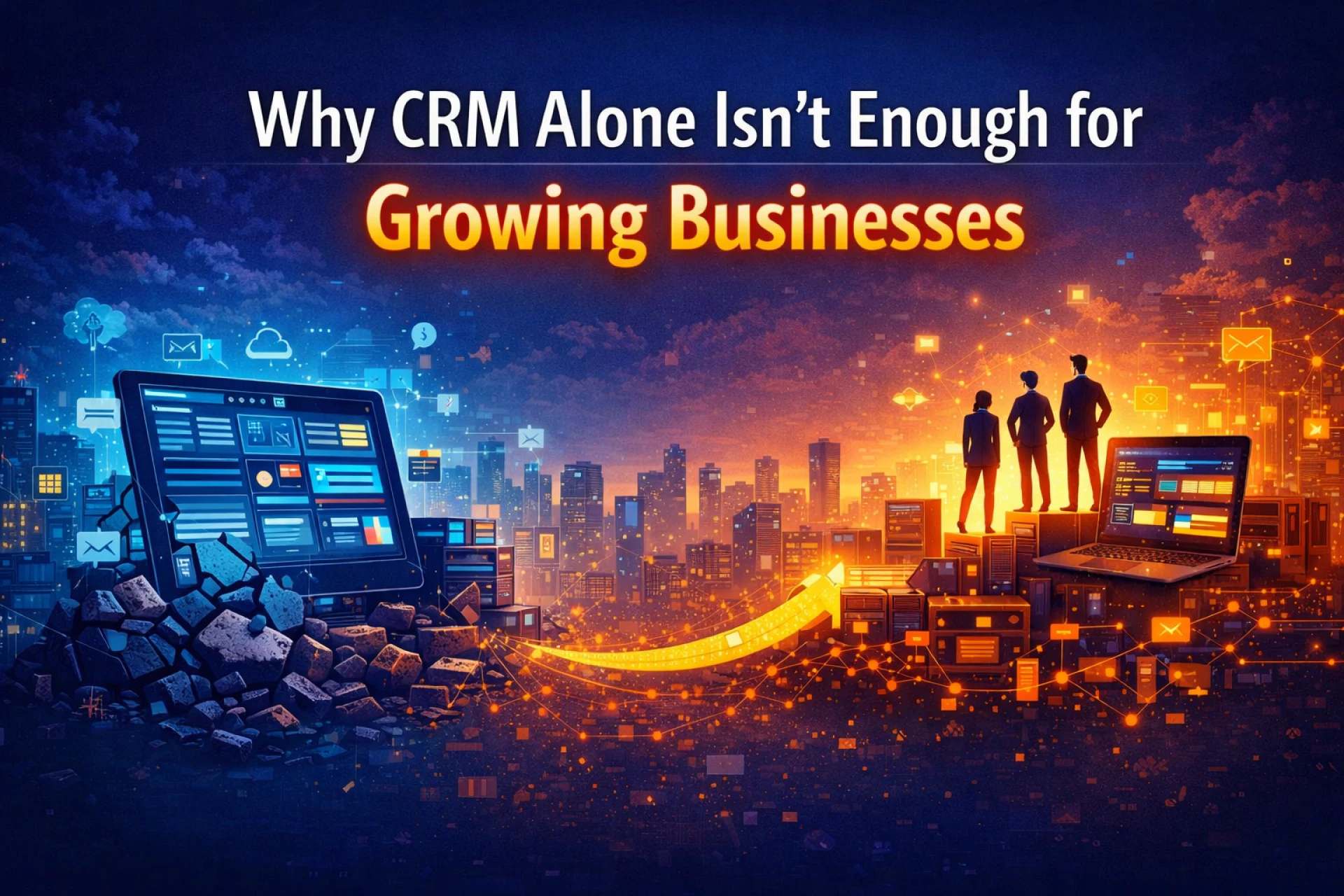
Instead of acting as a single source of truth, the CRM becomes just another silo.
Why Disconnected CRMs Struggle to Deliver Value
Incomplete Customer Visibility
Sales teams may see contact details and deal stages, but lack insight into customer behavior, purchase history, or support interactions. Marketing teams operate without real-time sales feedback. Support teams respond without context.
This fragmentation leads to inconsistent customer experiences and missed opportunities.
Manual Workarounds Replace Automation
Without integration, teams rely on spreadsheets, manual updates, and duplicated data entry. These workarounds increase errors, reduce productivity, and discourage CRM adoption.
Over time, the CRM becomes a reporting tool instead of an operational one.
Growth Amplifies the Problem
As businesses scale, data volume increases and systems multiply. What once felt manageable becomes unworkable. The lack of connectivity begins to slow growth instead of supporting it.
At this stage, improving CRM effectiveness requires more than configuration tweaks.
The Role of Integration in Unlocking CRM Potential
A CRM reaches its full potential only when it is deeply connected to the rest of the business ecosystem.
Effective CRM integration ensures that data flows seamlessly between platforms such as marketing automation tools, ERPs, CMS platforms, billing systems, loyalty programs, and analytics tools. Instead of fragmented records, businesses gain a unified view of each customer.
This connected approach enables:
- Real-time data synchronization
- Consistent reporting across teams
- Automated workflows across departments
- More accurate forecasting and insights
Integration turns the CRM from a static database into a dynamic operational hub.
What Successful CRM Integration Looks Like
Rather than relying on basic plugins or one-off connectors, successful organizations take a strategic approach.
They focus on:
- Business workflows first, not tools
- API-driven, scalable architecture
- Clean and consistent data models
- Flexibility to add or replace systems
This approach allows the CRM to evolve alongside the business, rather than becoming a bottleneck as requirements change.
From Tool to Growth Engine
When CRM systems are properly integrated, the impact is noticeable across the organization.
Sales teams gain full customer context.
Marketing teams align campaigns with real revenue data.
Support teams resolve issues faster with complete histories.
Leadership makes decisions based on reliable, real-time insights.
Instead of managing disconnected tools, teams operate within a unified system that supports growth.
Final Thoughts
CRMs are powerful—but only when they are connected.
Businesses that struggle with CRM adoption, reporting accuracy, or customer experience often don’t need a new platform. They need a better integration strategy. By focusing on how systems communicate and how data flows across the organization, companies can transform their CRM into a true growth enabler.
In a landscape where customer expectations and operational complexity continue to rise, integration isn’t optional—it’s foundational.