
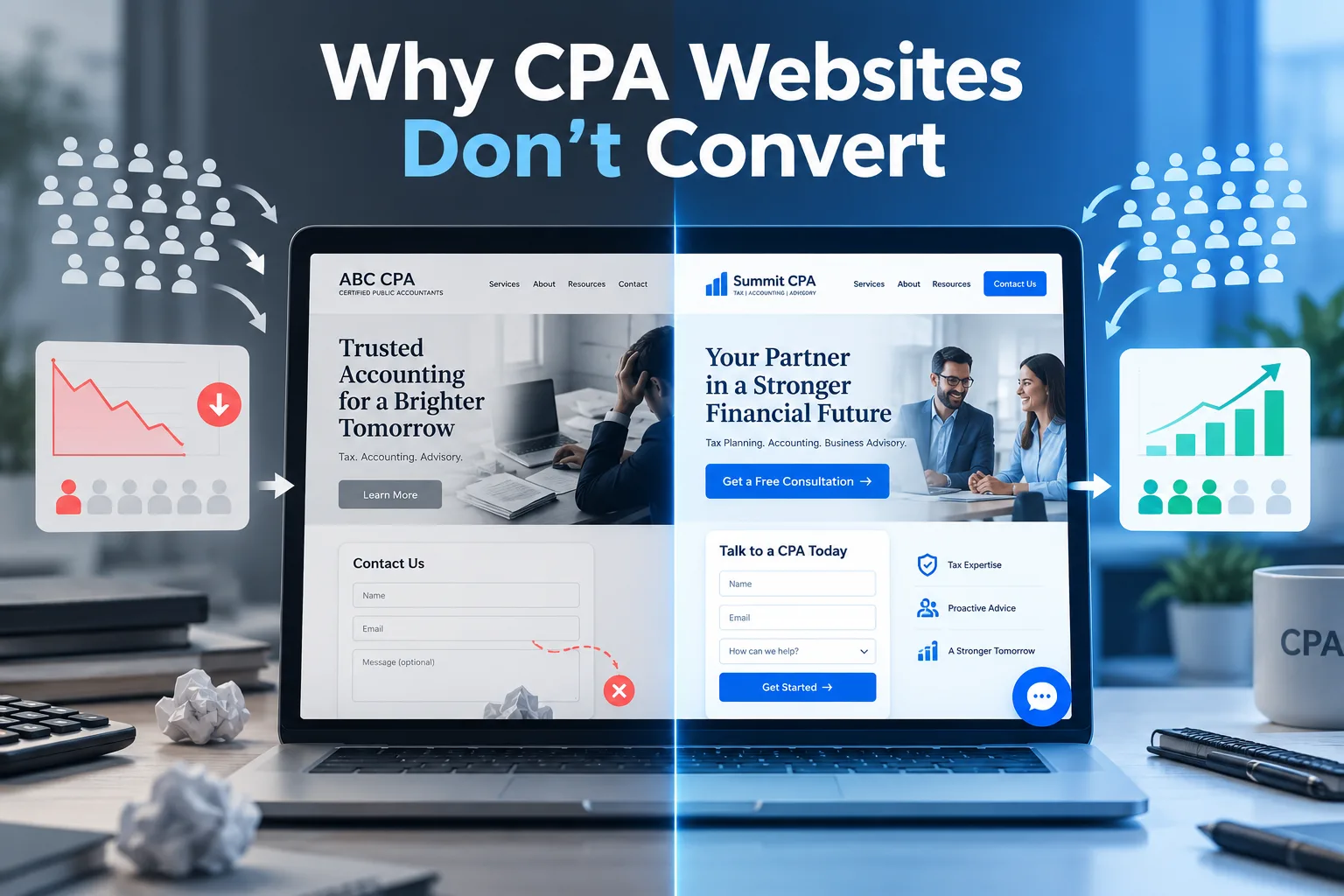
Plenty of CPA firms have a traffic problem. More of them have a conversion problem and don't know it.
Here's a typical scenario. A firm gets 1,500 visits a month, mostly from its Google Business Profile and branded searches. The contact form brings in four or five inquiries. Two of those are tax-season one-offs looking for the cheapest return prep in town. The partners decide "the website doesn't really work for us" and go back to relying on referrals.
CPA firm websites fail to convert visitors into leads mainly because they don't give visitors a clear reason or an easy way to take the next step. The usual causes are vague messaging, a single generic "Contact Us" option, forms that ask too much, no trust signals near the decision point, and slow follow-up after someone does reach out. Each one is fixable, and most fixes don't require a new website.
Key Takeaways
- Traffic without conversions is a messaging and friction problem, not a marketing budget problem.
- Visitors decide in seconds whether your firm is for them. Your headline has to answer that.
- One "Contact Us" page is not a conversion strategy. Offer options for visitors at different stages.
- Trust signals work best right next to the call to action, not on a separate About page.
- Speed of follow-up matters as much as the website itself. A lead that waits a day often goes cold.
What Is a Good Conversion Rate for a CPA Firm Website?
A conversion is any action that turns an anonymous visitor into a contact you can follow up with. That includes a consultation booking, a form submission, a phone call or a resource download.
There's no official benchmark for accounting firms, and published averages vary widely by source and by how "conversion" is defined. A more useful approach is to track your own baseline in Google Analytics 4, then improve against it. Even the math at a modest rate is sobering. At a 2% conversion rate, 98 out of every 100 people who found your firm leave without a trace. Moving that to 3% on the same traffic means 50% more leads with zero extra ad spend.
That's why conversion work often pays back faster than chasing more traffic.
Reason 1: Your Headline Doesn't Tell Visitors They're in the Right Place
Open your homepage and read the first line. If it says something like "Your Trusted Financial Partner" or "Excellence in Accounting Since 1987," you have a problem. Those lines describe you. They don't tell the visitor whether you can solve their problem.
Visitors arrive with a specific question in mind. "Can these people handle my S corp?" "Do they work with physicians?" "Can they clean up two years of messy books?" If the first screen doesn't answer some version of that, they hit the back button.
How to fix it: rewrite the headline around who you serve and what changes for them. Compare these two:
- Before: "Comprehensive Accounting and Tax Solutions"
- After: "Tax Planning and Monthly Accounting for Medical and Dental Practices in Ohio"
The second one will turn away people who aren't a fit. That's the point. It speaks directly to the clients you actually want, and they'll stay.
Reason 2: "Contact Us" Is the Only Call to Action
Most CPA firm websites offer exactly one way forward: a Contact Us button that leads to a generic form. That works for the visitor who's already decided. It does nothing for the much larger group still researching.
Think about buyer stages. Someone comparing firms isn't ready to "contact" anyone. Someone who just got an IRS notice wants to talk today. A CFO evaluating outsourced accounting wants to understand pricing first.
How to fix it: offer calls to action that match where visitors are in their decision.
Visitor stage What they want Call to action that fits Just researching To learn without commitment Download a checklist or guide (email required) Comparing firms To see if you're a fit "See how we work" page, pricing ranges, case examples Ready to talk A fast, easy next step "Book a 15-minute call" with online scheduling Urgent issue Help now Click-to-call number and a same-day response promise
A useful lead magnet for accounting firms is something your clients already ask for. A year-end tax planning checklist, an entity selection guide or a "documents to gather before your first meeting" list all work well. They also start a relationship you can nurture by email.
Reason 3: Your Forms Ask Too Much, Too Soon
A prospect clicks "Get Started" and meets a form asking for annual revenue, number of employees, current software, entity type, how they heard about you and a phone number marked required. Many will close the tab right there.
Every extra field adds a little friction. For a first touch, you need just enough to start a conversation.
How to fix it:
- Keep first-contact forms to four or five fields: name, email, company, and a short "How can we help?" box.
- Make phone number optional unless calling is your only follow-up method.
- Move qualifying questions to the discovery call or a second-step form after submission.
- Change the button text from "Submit" to something specific, like "Request My Consultation."
- Tell people what happens next and when, directly under the button.
If your intake process truly needs detailed information, a two-step form often performs better. Ask the easy questions first, then the detailed ones once the visitor has already committed.
Reason 4: Trust Signals Are Missing at the Moment of Decision
Accounting is a high-trust purchase. A prospect is about to share tax returns, bank access and payroll data. They need reassurance at the exact moment they're deciding whether to reach out.
Many firms do have trust signals. They're just buried on an About page nobody visits.
How to fix it: place proof right beside your calls to action and forms. Good options include:
- A short client testimonial with a name, company type and specific result.
- Credentials like CPA, EA or CFP, and memberships such as the AICPA or your state CPA society.
- A brief note on how you protect client data, such as secure portals, encryption and access controls.
- Your Google review rating, if it's strong.
- Photos of the actual people a new client will work with.
Check your state board rules on testimonials and advertising before you publish. Requirements differ by state, and some are stricter than people expect.
Reason 5: Every Service Lives on One Page
Some firm websites list tax preparation, bookkeeping, payroll, audit, advisory and business valuation on a single Services page with two sentences each. Search engines struggle to rank that page for anything specific, and visitors can't tell whether you go deep on the one thing they need.
How to fix it: give each core service and each target niche its own page. Every page should do three things:
- Describe the client's problem in their language, not accounting jargon.
- Explain your process in plain steps so the engagement feels predictable.
- End with one relevant call to action, not a generic contact link.
Firms rebuilding their site around this structure often find it easier to work with a team that specializes in websites for CPA and accounting firms, since service-page architecture and conversion paths are built in from the start.
Reason 6: The Mobile Experience Gets in the Way
A business owner reading your site on a phone has less patience than one at a desk. On mobile, common conversion killers include tiny phone numbers that aren't tappable, forms that are painful to fill out with a thumb, pop-ups that cover the whole screen, and menus that hide the call to action.
How to fix it: test your own site on your phone. Try to book a call in under a minute. Make your phone number tap-to-call, use a sticky "Book a Call" button, and make sure form fields use the right mobile keyboards for email and phone. Keep pages fast. Google's Core Web Vitals target for Largest Contentful Paint is 2.5 seconds or less.
Reason 7: Slow Follow-Up Wastes the Leads You Do Get
This one isn't technically a website problem, but it's where many conversions die. A prospect submits a form at 2 p.m. on Tuesday. Someone notices it Thursday morning. By then, they've already booked a call with the firm that replied first.
Response time matters. A widely cited Harvard Business Review study of online leads found that companies that responded within an hour were nearly seven times as likely to qualify the lead as those that waited even an hour longer.
How to fix it:
- Route form submissions to a shared inbox or CRM, not one partner's email.
- Send an instant, personal-sounding auto-reply with a booking link.
- Set a clear internal standard, such as replying within four business hours.
- Track every lead through to signed engagement so you know which pages actually produce clients.
If your team is stretched, especially during busy season, a partner focused on lead generation for accounting firms can help set up the capture, routing and nurture steps so inquiries don't slip.
How Do You Measure Whether the Fixes Are Working?
Set up conversion tracking in Google Analytics 4 before you change anything, so you have a baseline. Track these as key events:
- Form submissions, by page
- Booked consultations
- Clicks on phone numbers and email links
- Lead magnet downloads
Then make one change at a time and give it a few weeks. Heatmap tools such as Microsoft Clarity, which is free, show where visitors click, scroll and give up. That's often more revealing than any audit checklist.
Common Mistakes When Fixing Conversion Problems
- Redesigning before diagnosing. A new design with the same weak message and forms converts the same way.
- Adding pop-ups everywhere. One well-timed offer helps. Three aggressive ones drive people away.
- Measuring traffic instead of leads. Sessions are a vanity number. Booked calls pay the bills.
- Treating every lead the same. A tax-season one-off and a $5 million company needing monthly CFO support deserve different follow-up.
The Bottom Line
Your website probably doesn't need more visitors first. It needs to do a better job with the ones it already gets. Start with the headline, the forms and your follow-up speed. Those three fixes cost little, and they usually show you quickly how many leads your site was quietly leaving on the table.
Frequently Asked Questions
Why is my accounting firm website getting traffic but no leads?
Usually because visitors can't quickly tell whether you serve someone like them, or because the next step feels like too much commitment. Clarify your headline around your ideal client, add a low-commitment offer such as a checklist, and shorten your forms.
How can a CPA firm get more leads from its website?
Match calls to action to visitor intent, create dedicated service and niche pages, place trust signals near forms, make booking easy on mobile, and respond to every inquiry within hours, not days.
What should a CPA firm put on its contact form?
For a first contact, ask only for name, email, company and a brief description of what the visitor needs. Collect detailed qualifying information later in the process.
Do lead magnets work for accounting firms?
Yes, when they solve a real, specific problem. Tax planning checklists, entity comparison guides and year-end preparation lists give researching visitors a reason to share their email before they're ready to talk.
How long does it take to see results from conversion fixes?
Simple changes like a clearer headline or a shorter form can show an effect within a few weeks, depending on traffic volume. Firms with lower traffic need longer to judge results reliably.