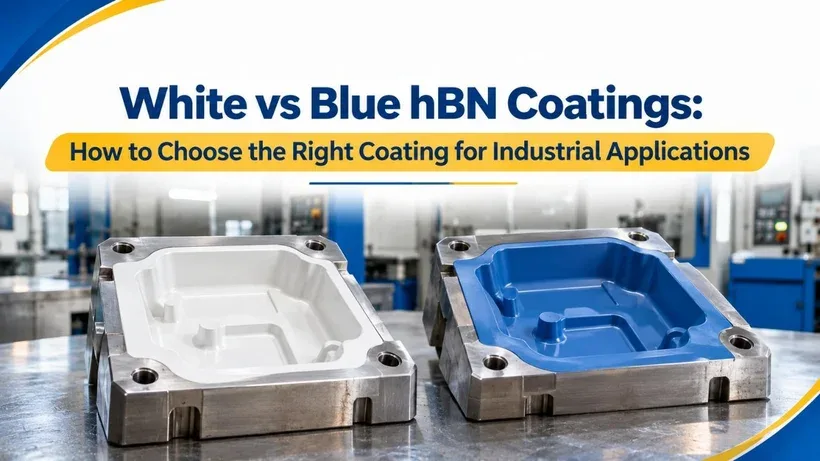
Industrial manufacturing processes often involve high temperatures, repeated material contact and continuous equipment operation. In industries such as aluminium extrusion, die casting and glass manufacturing, moulds and dies require suitable surface protection to support consistent production.
One of the common challenges in these environments is unwanted material sticking. When processed materials adhere to tooling surfaces, manufacturers may experience additional cleaning requirements, production interruptions and inconsistent release performance.
Hexagonal Boron Nitride (hBN) coatings are used in selected industrial applications because of their dry lubrication, thermal stability and anti-stick properties. However, selecting the correct coating is not only about its protective characteristics. Application visibility can also influence how operators prepare and inspect industrial tooling.
Understanding the Role of hBN Coatings
Hexagonal Boron Nitride is a ceramic material commonly known as white graphite. Its layered structure gives it useful low-friction properties, making it suitable for certain dry lubrication and industrial coating applications.
When applied through an appropriate coating formulation, hBN can form a protective layer on compatible surfaces. This layer may help reduce unwanted material adhesion and support mould release under suitable operating conditions.
Industrial hBN coatings are available in different formulations, including white and blue variants.
Although both options may deliver similar lubrication and anti-stick performance, the difference in colour can affect how easily operators identify coated surfaces.
Why White hBN Coatings Are Used
White hBN coatings have the natural appearance associated with Hexagonal Boron Nitride. They are used in selected industrial applications requiring dry lubrication and surface protection.
In aluminium extrusion, suitable hBN coatings may help manage unwanted contact between processed aluminium and tooling surfaces. In glass manufacturing, certain moulds and forming components may also benefit from specialised release coatings.
White coatings can be a practical choice when their appearance is suitable for the application and operators can inspect coverage adequately.
However, proper surface preparation remains important. Dust, oil, moisture and existing deposits can interfere with coating consistency.
The coating should be applied and dried according to the manufacturer's recommendations before equipment returns to production.
How Blue hBN Coatings Improve Application Visibility
Blue hBN coatings are designed to provide similar intended protective properties while incorporating a pigment that makes treated areas easier to identify.
This additional colour can be useful when applying coatings to complex industrial moulds or dies.
For example, tooling may contain grooves, corners and recessed sections that require consistent coating coverage. A contrasting blue coating can help operators visually identify areas that appear untreated.
This can be helpful during routine maintenance and preparation before production begins.
However, the blue colour does not automatically indicate better lubrication or higher temperature resistance. The coating's actual performance depends on the complete formulation and operating conditions.
Choosing Between White and Blue Coatings
Manufacturers should evaluate several factors before selecting an hBN coating.
- Tooling Material: Confirm that the coating is compatible with the mould or die surface.
- Operating Temperature: Review the recommended working conditions of the coating.
- Application Visibility: Consider whether colour contrast would help operators inspect treated areas.
- Surface Geometry: Complex tooling may require additional attention during coating application.
- Maintenance Requirements: Follow appropriate cleaning, application and inspection procedures.
Neither coating should be selected based on appearance alone. The most suitable option depends on the manufacturing process and the intended application.
hBN Coatings for Industrial Applications from Jade Chemicals
Jade Chemicals supplies specialty industrial lubrication and coating solutions in India, including JD Nano-BNC80 White Coating and JD Nano-BNC80 Blue Coating.
Both formulations are intended to provide comparable dry lubrication, thermal protection and anti-stick performance. The blue variant includes a pigment that helps operators recognise coating coverage during application.
Manufacturers interested in understanding these differences can read Jade Chemicals' detailed guide on White vs Blue hBN Coatings for Industrial Applications.
For industrial buyers, the selection process should begin with understanding the tooling material, operating temperature, application method and expected coating performance.
Proper surface preparation and consistent application practices remain essential for both variants. Selecting an appropriate hBN coating can help manufacturers manage material sticking, improve tooling preparation and maintain more reliable industrial production processes.