
Most coverage of a new AI model focuses on benchmark scores. For finance operations teams, the architectural question matters more: does this change how we design our automation pipelines?
With Claude Opus 4.8, it does, and not because of reasoning improvements alone.
The Feature Getting Overlooked
When Anthropic shipped Opus 4.8 on May 28th, headlines centered on honesty gains and coding performance. Fair points. But the feature with the most direct impact on finance ops is effort control: the ability to configure reasoning depth per task and per agent.
Five levels: Low and medium for speed. High (default) for standard work. Extra for complex multi-step reasoning. Max for frontier problems.
On the surface, this sounds like cost optimization. Actually, it's an architecture feature.
Why This Solves a Real Month-End Problem
Here's the tension effort control breaks.
AR reconciliation, cash application, and variance analysis don't all require the same reasoning depth. A routine cash match running 500 times against fixed ledger rules needs speed and consistency. Throwing maximum reasoning at each one is wasteful—expensive and unnecessary.
But when an outlier surfaces, a complex multi-party transaction, an unmatched variance, an invoice with no PO, you want the model reasoning as hard as possible before anything writes to your general ledger.
In our pilot work on month-end close automation, we saw exactly where this mattered most.
Before effort control, you picked one path: a model strong enough for worst-case exceptions (and you pay that cost on routine work), or a cheaper option (and you risk it failing on complexity). Neither is right.
Effort control lets you architect for both inside a single pipeline.
How We're Building This at Engini
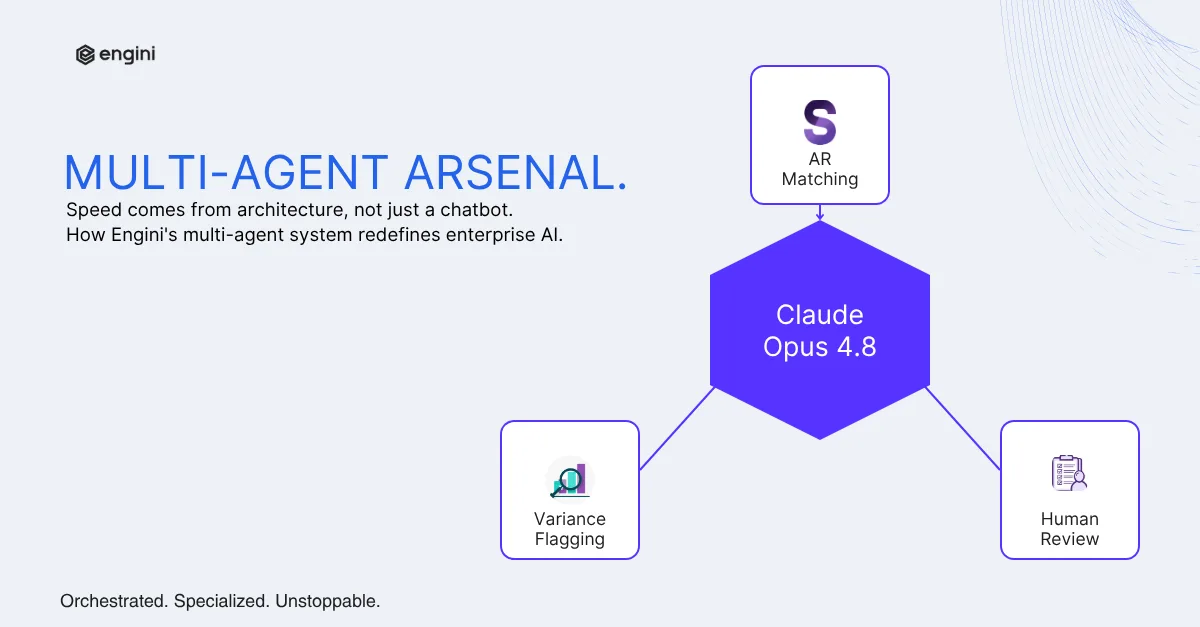
This is the subagent architecture we've been designing toward.
In a governed multi-agent finance workflow, different subagents handle different stages, data retrieval, matching, exception flagging, reporting, each with scoped permissions that lock them to their specific role.
With Opus 4.8's effort control, you assign reasoning depth per agent role, not per model deployment:
- Routine subagents running high-volume matching against established rules operate at lower effort. Faster, cheaper, consistent.
- Exception subagents triggered only when an anomaly flags scale up to extra or max effort. Full reasoning depth applied only where complexity actually requires it.
Your engineering team doesn't need custom API routing logic or manual threshold configuration. The orchestration layer handles it.
In pilots, Engini-governed workflows reduced manual process handling by 71% while maintaining 100% audit trail coverage across all connected platforms. Efficiency and compliance moved together, not in trade-off.
The Governance Layer Is Non-Negotiable
Opus 4.8 being four times less likely to let flawed logic pass unremarked is meaningful. Production agentic workflows should care about that.
But better models don't replace governance. In banking environments especially, "better" isn't the same as "sufficient."
Three controls must live in the orchestration layer, not patched on afterward:
- Human-in-the-loop gates. High-impact anomalies, general ledger modifications, payment triggers, vendor relationship changes, these need human review before execution. Not because the model might fail, but because it's structural control architecture.
- Immutable audit trails. Every action logged with full context: model, agent, effort level, permission scope, authorization event. SOX and GDPR don't ask if your AI is trustworthy. They ask if you can prove exactly what it did and when.
- Scoped permissions per agent. An AR subagent should be architecturally incapable of writing outside its assignment, not restricted by a policy that could misconfigure, structurally blocked at the connector so the access doesn't exist.
Better models raise the baseline. Governance sets the ceiling.
Build vs. Buy
If you're evaluating internal build, here's the actual scope:
Agent routing logic. Effort level configuration per task type. Error handling for failed subagents. Permission scoping per connector. Audit logging at compliance granularity. Ongoing maintenance as Anthropic ships updates.
That's months of ML engineering with zero connection to your core business process.
Engini provides the orchestration layer out of the box, effort control per agent role via visual interface, 200+ pre-built enterprise connectors including SAP, NetSuite, Salesforce, and Workday, compliance-grade audit logging at the connector level, and human-in-the-loop gates per action type. No code required.
The competitive edge in enterprise finance right now isn't which model you run. It's how well you govern the architecture around it.
What's Next
Anthropic's Dynamic Workflows, currently in research preview, lets a single orchestrator spin up hundreds of parallel workers in one session. For large financial operations, that's a significant shift: full-portfolio reconciliation or multi-entity close processes running parallel instead of sequential.
Governance scales with capability. More parallel agents mean more simultaneous access, more intermediate outputs needing validation, more audit events in real time.
That's the architecture problem we're focused on now.
Are your finance teams experimenting with Opus 4.8's effort controls? Curious whether you're building the routing logic internally or looking at an orchestration layer to handle the infrastructure. Let's talk in the comments.