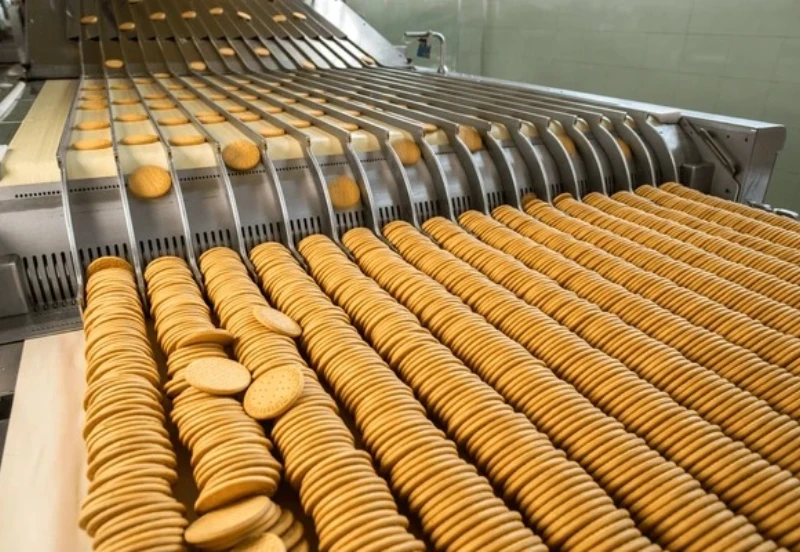
The global demand for bakery and confectionery products is rising rapidly, and biscuits remain one of the most consumed snacks across markets. With competition growing stronger and customer expectations shifting towards consistent quality, faster delivery, and hygienic production, manufacturers are looking for smarter ways to scale.
This is exactly why more businesses today are moving towards Biscuit Making Machines — a technology-driven upgrade that transforms traditional manual production into a streamlined, high-output process.
Automated Biscuit Making Machines bring precision, efficiency, and repeatability into biscuit production. Instead of depending on manual labor for mixing, shaping, baking, and cutting, machines manage every stage with controlled accuracy. As a result, production increases, wastage decreases, and quality stays uniform batch after batch.
What Makes Biscuit Making Machines a Game-Changer for the Industry?
Automation in food processing isn’t just about technology — it’s about speed, hygiene, and profit sustainability. Here’s why so many manufacturers are choosing automation over traditional setups:
1. Faster Output with Higher Productivity
Manual biscuit production is slow and inconsistent, especially when demand increases. Automated Biscuit Making Machines can run for long hours with uniform speed, delivering thousands of biscuits in a single production cycle. High-speed rollers, cutters, and baking conveyors ensure that output stays steady even during peak requirements.
When demand rises, the machine keeps pace — without compromising quality.
2. Consistent Quality in Every Batch
Customers expect biscuits to look and taste the same every time. Variations in dough thickness, baking temperature, or shaping can lead to inconsistency — which directly affects brand value. Modern Biscuit Making Machines maintain uniform dough feeding, shaping accuracy, and temperature control. Whether you produce 500 packets or 50,000 packets, quality and size remain identical.
Consistency builds customer trust — and trust builds strong brands.
3. Better Hygiene & Food Safety
The food industry is strictly regulated with global hygiene standards. Manual handling increases risk of contamination, bacteria exposure, and inconsistent storage conditions. Automated Biscuit Making Machines minimize human touch, ensuring the dough and baked biscuits remain clean, safe, and fully compliant with FSSAI and industrial guidelines.
In a world that values cleanliness more than ever, this is a high-value advantage.
4. Reduced Labor Costs & Operational Expenses
Businesses often struggle with labor shortages, training gaps, human errors, and rising costs. Automation solves this challenge by taking over repetitive tasks like dough feeding, cutting, and baking. Instead of hiring large labor teams, manufacturers can operate with fewer skilled workers who control machines rather than perform manual tasks.
A one-time machine investment leads to long-term savings — a financially smarter choice.
5. Scalability & Future-Ready Manufacturing
Small bakeries as well as large biscuit factories need flexibility in production capacity. Biscuit Making Machines come in multiple models — from semi-automatic lines to fully industrial conveyors capable of producing tons per day. Manufacturers can start small and scale up as business grows, without redesigning their entire infrastructure.
Businesses evolve — and a scalable production setup grows with them.
Industries Benefiting from Biscuit Making Machines
These machines are widely used across:
• Commercial biscuit factories
• Bakery chains & confectionery brands
• FMCG snack production units
• Food startups planning mass manufacturing
• Private label product manufacturers
Whether producing glucose biscuits, cream biscuits, cookies, or custom shapes — automation supports all formats with speed and precision.
Direct Benefits That Drive Conversion
BenefitBusiness ImpactHigher daily outputMeets large order demandsUniform biscuit size & qualityStrong brand positioningLower production costHigher profit marginsSafety and hygiene complianceMarket trust and approvalsContinuous 24/7 operationFaster delivery timelines
Switching to automated production doesn't just improve operations — it directly strengthens market competitiveness.
Why Businesses Can’t Ignore Automation Anymore
Customer expectations are rising, retailers demand consistency, and competition keeps growing. To survive and scale, manufacturers need speed, reliability, and quality. Biscuit Making Machines offer exactly that — at a cost that pays back quickly through increased profit and productivity.
Companies that upgrade now get an early advantage. Those who delay risk falling behind.
Automation is no longer a future plan — it is today’s requirement.