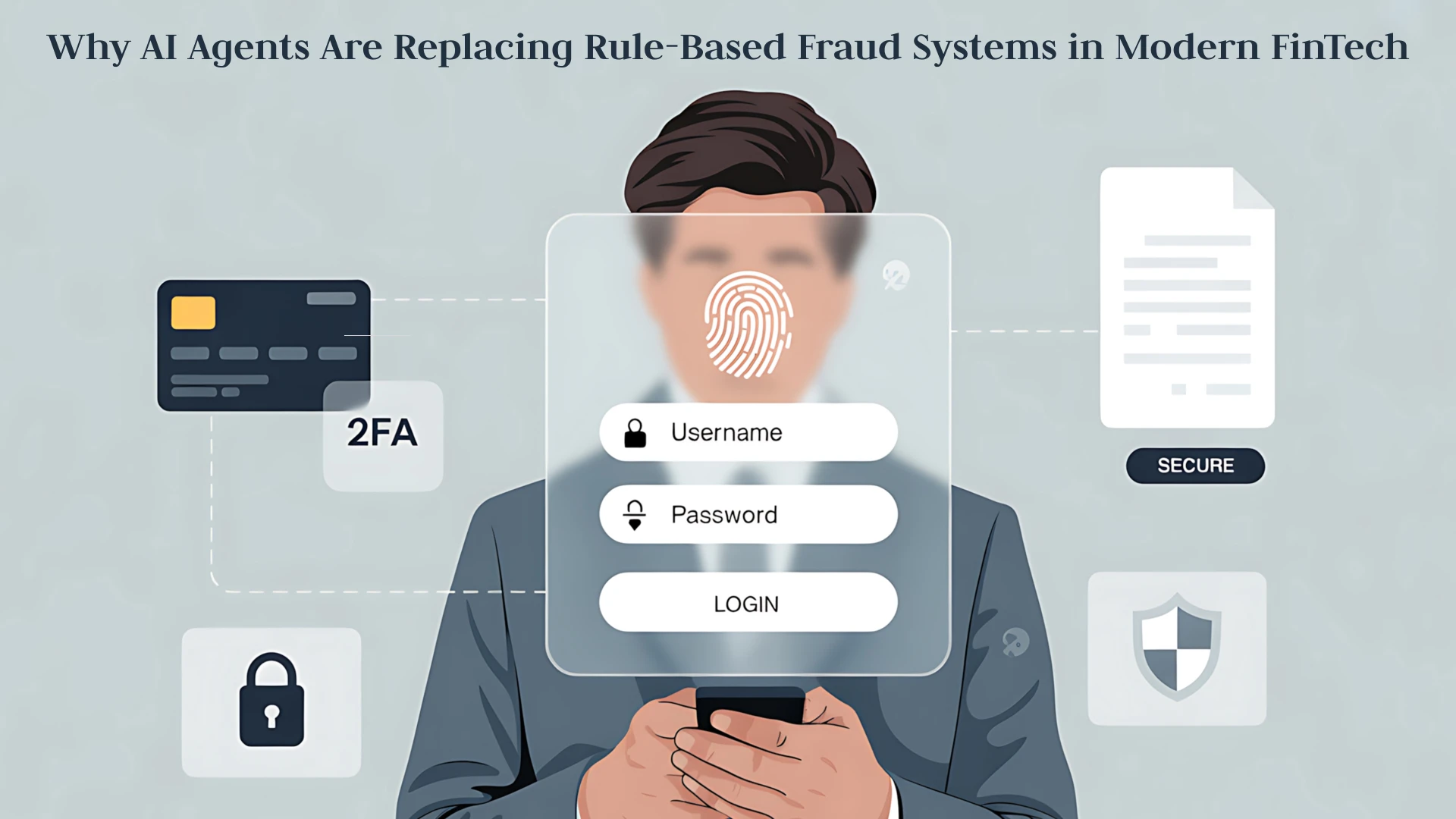
Fraud remains one of the most urgent issues in modern financial technology. The use of traditional rule-based systems, which have long been regarded as the foundation of fraud detection, is also failing to keep up with more advanced attacks.
In the current hectic digital world, FinTech companies require systems which are not only for detecting fraud but also adaptable. This is where AI and ML development solutions are becoming a technology to revolutionize the industry.
The Limitations of Rule-Based Fraud Systems
Rule-based fraud systems are based on predestined rules and thresholds. As an illustration, a transaction can be marked when it is above a specific threshold, or represents a new geographic area, or contains similar previously known suspicious activities. Although suitable for some simple situations, these systems have some major limitations:
- Static and reactive: Rule-based systems are unable to predict new tactics and must be updated manually all the time.
- High false positives: Real customers are usually flagged, and it becomes a burden and destroys trust.
- Limited scalability: It is difficult to support hundreds or thousands of rules as the number of transactions increases.
- Inability to analyze complex patterns: Fraudsters take advantage of the connection between accounts, devices, and networks, which cannot be identified by inert rules.
The new digital banking, payments, and e-commerce environment does not allow the use of rule-based systems only.
How AI Agents Transform Fraud Prevention
In comparison to rigid rules, AI agents utilise advanced machine learning solutions for specific enterprises to identify anomalies in real-time. They constantly learn new data and evolve new threats and provide a smart and agile method of trying to thwart fraud.
Key Advantages of AI Agents
- Real-Time Learning: AI agents look at actions and transactions automatically and as they go, taking immediate action against suspicious activity.
- Behavioral Analysis: AIs detect minor anomalies that a rule cannot detect by considering user behavior patterns in many channels, through mobile apps, web platforms, and APIs.
- Predictive Intelligence: The AI models prevent fraud before it takes place, allowing for mitigation instead of reacting to it.
- Generative AI Capabilities: Compared to traditional AI, generative AI is capable of simulating possible fraud cases and enhances the effectiveness of detection mechanisms.
Using a combination of these capabilities, AI agents offer an amount of accuracy and agility that is impossible to achieve with rule-based systems.
FinTech companies can use custom machine learning solutions and AI development solutions to enhance the AI models to suit their transactional data, regulatory requirements, and customer behaviors.
Why AI Agents Are Replacing Rules
There are multiple reasons as to why contemporary FinTech organizations are replacing rules with AI agents:
Reduced False Positives
False positive rates can be exasperating to the legitimate customers because the rule-based systems have high false positives. Predictive modelling and behavioral analytics allow the AI agents to eliminate unnecessary alerts drastically, enhancing the user experience, yet preserving the high level of security.
Scalability and Speed
The services of AI software development allow scalable systems that can handle millions of transactions daily. Contrary to the slow performance of the rule-based systems during high volume, AI agents do not lose their performance at the expense of accuracy.
Adaptive Protection
The methods of fraud develop at a very fast pace. Artificial intelligence agents learn continuously from new patterns and are able to react much quicker than manually managed sets of regulations. This will make sure that secure fintech functions will continue working in the face of new threats.
Regulatory Compliance
Financial regulations in Europe, such as the GDPR, PSD2, and the future EU AI act, are enforced to have transparency, explainability, and auditability in automated systems. In order to ensure that institutions remain in compliance, AI agents will be capable of giving out detailed decision trails and explainable outputs.
Generative AI vs Traditional AI in Fraud Detection
Although the development of both the traditional and the generative AI is based on machine learning, there are some distinctions in their approaches:
- Traditional AI: Is concerned with the detection of patterns and anomalies based on past data.
- Generative AI: Generates possible fraudulent cases and creates artificial data to provide training for the models to enhance prediction accuracy and system resilience.
Generative AI is able to actively discover vulnerabilities and change fraud detection processes, which makes it an essential instrument of tailored deep learning applications and corporate-wide security infrastructures.
Implementing AI & ML Development Solutions in FinTech
Implementing AI agents within the financial systems needs to be planned:
- Data Integration: Collect transactional, behavioral, and contextual data securely.
- Custom Machine Learning Solutions: Build models tailored to the environment in which the bank or the FinTech is operating.
- Scalable Architecture: Capitalize on the cloud platform and be very available and processing.
- Continuous Training: AI agents require training and learning in order to remain useful.
- Explainability and Compliance: Ensure AI decisions can be audited and explained to regulators.
The steps are included in overall AI software development services and AI development solutions taken by contemporary FinTech companies to stay on the frontline against fraud risks.
Business Benefits of AI Agents
The practical benefits of investing in AI agents to prevent fraud are:
- Enhanced User Trust: False positives are minimized as well as the speed of detecting fraud will result in increased customer satisfaction.
- Cost Savings: Preventive detection saves costs and operational expenses incurred in the management of fraud.
- Regulatory Alignment: Explainable AI models have the capacity to be applied to adhere to the high compliance requirements of the European and global regulatory requirements.
- Agility: Flexibility in implementing new tactics of fraud is an assurance of continuous protection.
Lastly, AI agents enable FinTech firms to make fraud management a response process instead of a business capability.
The Future of Fraud Prevention in FinTech
With the rise of digital financial services, AI agents will be the focus of secure, scalable, and intelligent platforms. Enterprise-level machine learning solutions, machine learning solutions, Custom solutions and generative AI vs traditional AI comparisons are the reflectors of the changing industry landscape with proactive, adaptive, and generative intelligence playing a major role.
The need to have rule-based systems will not go away completely, but will be used to establish a foundation, which will be complemented with AI-powered systems that will learn, predict and evolve as the threat of landscape changes.
Frequently Asked Questions (FAQs)
What are AI & ML development solutions for FinTech?
They are personalized systems with artificial intelligence and machine learning to identify fraud, automate risks, and deliver secure and adaptive financial services.
Why are rule-based systems no longer sufficient?
Systems that operate based on rules are unchanging, easily prone to false positives, and not able to keep up with the changing tactics of fraud because they are not dynamic.
How do AI agents reduce false positives?
Through user behavior, transaction, and other contextual data analysis, AI agents can effectively identify the presence of legitimate activity and fraud, thereby enhancing customer experience.
What is the difference between generative AI and traditional AI?
The classic AI identifies familiar patterns, whereas the generative AI models the possible situations of fraud and generates artificial data to increase predictive quality and strength.