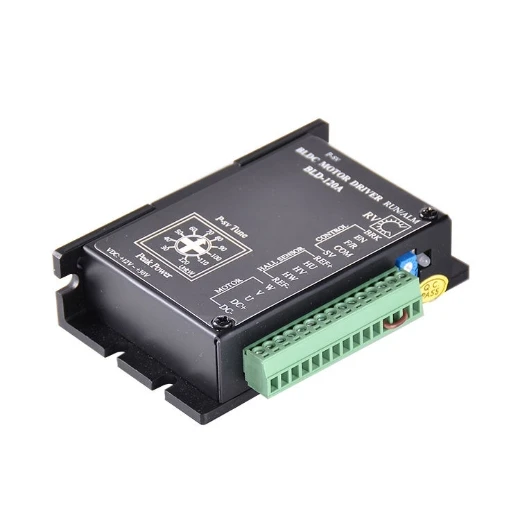
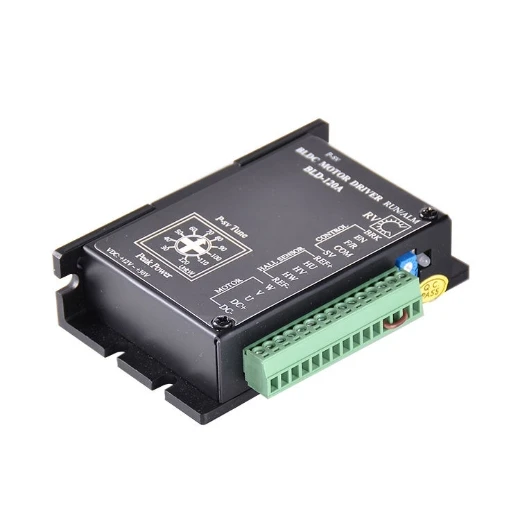
You’ve got a brushless DC motor, maybe powering a robot, a lightweight EV, or a CNC system. It’s efficient, quiet, durable—but without the right controller, you’re flying blind. That’s where a 24V BLDC motor controller steps in, giving you precision over speed, torque, and direction… and keeping everything running safely.
So what exactly does a BLDC controller do? Why is 24V such a sweet spot for so many systems? Let’s dig in.
First: What Is a 24V Brushless Motor Controller?
In simple terms, it’s the brain between your power source and motor. A BLDC motor doesn’t have brushes to handle commutation—it needs electronic timing to decide which coil to energize and when. That’s the controller’s job.
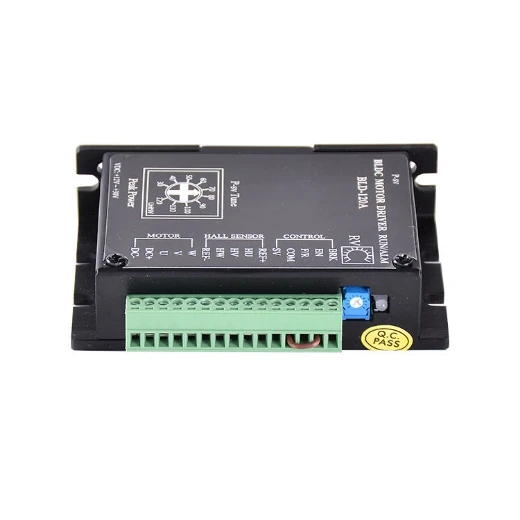
A 24V BLDC controller handles this switching electronically. Using Hall sensors (or going sensorless), it knows the rotor’s position and fires the right motor phases. It adjusts speed via PWM, keeps torque consistent under load, and often includes built-in safety protections—like overcurrent, short circuit, and thermal shutdown.
And 24 volts? It’s ideal for mobile and industrial-grade applications that need power efficiency without stepping into high-voltage territory.
Why Not Just Use a 12V or 48V System?
Sure, they exist. But 24V is something of a “Goldilocks” zone.
- 12V may not give you enough torque for mid-range motors.
- 48V can deliver power, but requires heavier wiring and more safety overhead.
- 24V, on the other hand, plays nicely with battery packs, solar systems, and standard industrial DC supplies—especially for systems drawing 100–1000W.
So if you’re working with robotics, light electric vehicles, or motion systems in automation, chances are 24V hits the sweet spot.
Where You’ll Actually Use One
Let’s skip the brochure language. Here’s where 24V brushless motor controllers actually show up in the real world:
- A self-driving robot that needs millimeter-accurate turns
- A portable CNC machine cutting plywood in a workshop
- An autonomous guided vehicle (AGV) moving packages across a warehouse
- A compact EV drivetrain that’s all torque and no drama
- A solar-powered fan or pump that needs variable speed
Whether you’re controlling speed, position, or just need reliable directional switching, the controller is what makes it all programmable and repeatable.
What to Look For Before You Buy
Not all BLDC controllers are made equal. When comparing options, ask:
- Can it handle your motor’s voltage and peak current?
- Does it support Hall sensor input or work sensorless?
- Do you need forward/reverse, braking, or a soft start?
- Will it integrate easily—with PWM, analog input, or even CAN/RS485?
- Is there short-circuit, overheating, or overload protection?
And let’s be honest: If you’re building something that might hit a wall (literally or figuratively), you’ll want those protections built-in.
Why Look at Brushless.com’s Controllers?
The team at Brushless.com isn’t trying to overcomplicate things. Their 24V BLDC motor controllers are straightforward, reliable, and ready for real-world applications. Whether you’re:
- Building a robot
- Controlling a mobility device
- Automating a tool or machine
...these controllers offer quiet operation, precise control, and enough flexibility to grow with your project. They come with adjustable input, forward/reverse control, and short-circuit protection—all in a compact, efficient package.
Final Thought: The Controller Makes the Motor Work
A BLDC motor is just potential energy. Without the right controller, it’s like having a great car with no steering wheel. Whether you're designing something mobile, stationary, smart, or simple, a 24V BLDC motor controller gives you the power to tune, automate, and protect your motion system.