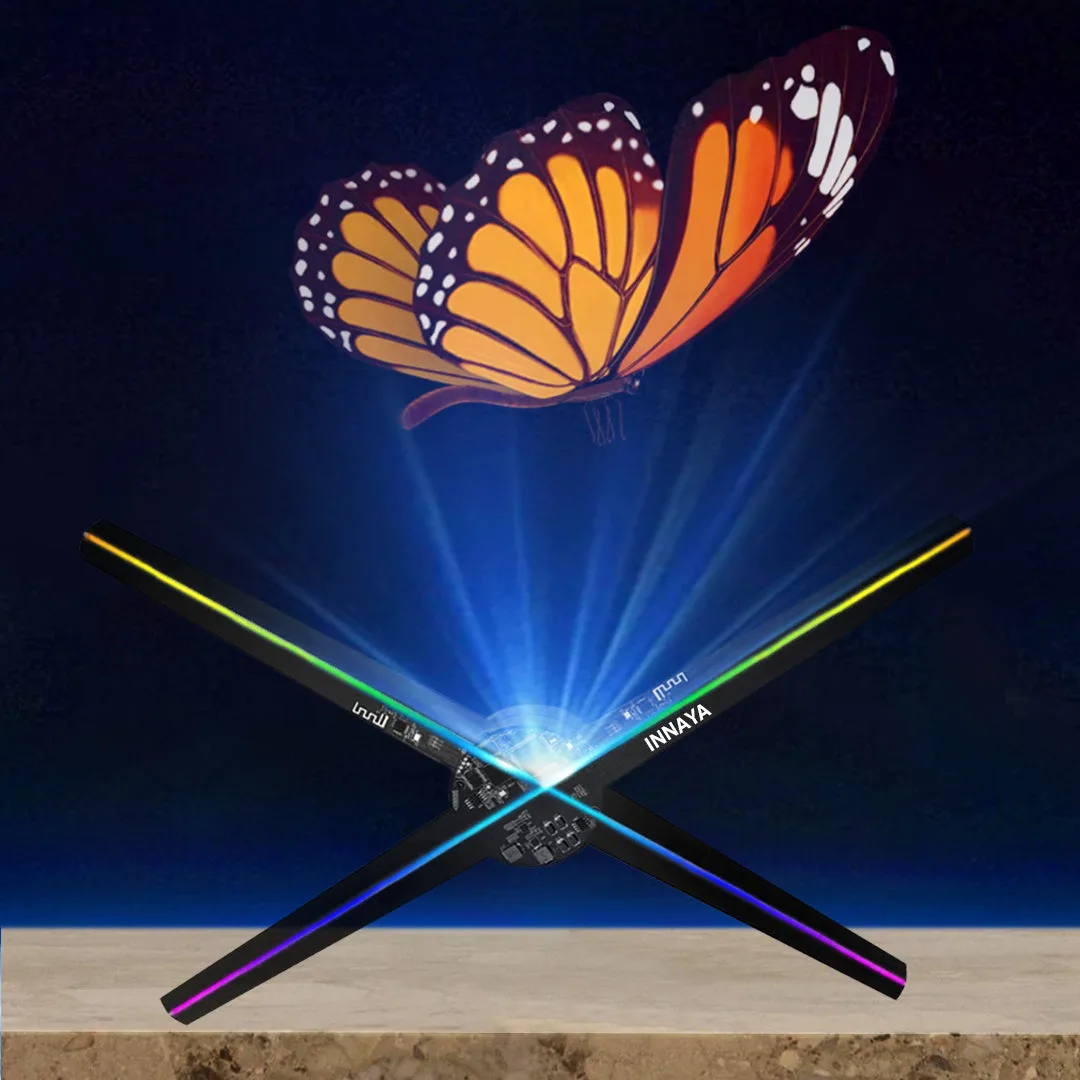
Walk into any forward-thinking retail space or trade show floor today and something will stop you cold. Floating mid-air, rotating slowly, glowing with an almost impossible clarity — it's not a screen, not a projection onto glass, and certainly not a trick of the light. It's a 3D hologram fan, and if you haven't encountered one yet, that's about to change. These devices have quietly moved from novelty items to genuine business tools, and the brands adopting them earliest are already seeing the results.
For entrepreneurs, marketers, and retail operators asking themselves how to cut through the noise in an increasingly saturated visual landscape, holographic LED fan technology offers something that flat screens simply cannot: depth. Real, perceived depth that draws the eye, holds attention, and converts curious glances into genuine engagement.
The Technology Behind the Magic
The mechanics, once you understand them, are surprisingly elegant. A hologram fan works by spinning LED-laden blades at high speed while synchronized light pulses fire at precise intervals. The result is a persistence-of-vision effect — your brain fills in the gaps and perceives a fully three-dimensional object hanging in open air. No special glasses. No headset. No darkened room required.
Modern units have pushed this concept far beyond its early, blurry iterations. Today's premium hologram fans use high-definition LED arrays with resolutions capable of rendering logos, animated characters, product visuals, and even text with striking clarity. WiFi and app connectivity mean that a business owner can update what's displayed on a unit in their storefront from their phone in minutes. The days of printing new signage every promotional cycle feel genuinely antiquated by comparison.
Some manufacturers have also introduced Tensor Holography Technology — an approach that delivers improved depth, color accuracy, and image fidelity compared to standard LED array methods. For brands where visual quality directly ties to brand perception, this distinction matters considerably.
Real-World Use Cases That Are Driving Adoption
The businesses leading the charge on hologram fan adoption tend to fall into a few clear categories, and what they share is a need for display solutions that work harder than a poster or a flat-panel screen.
Retailers — particularly those in fashion, cosmetics, electronics, and luxury goods — have found that placing a hologram fan near an entrance or at a point of sale creates an immediate attention anchor. Customers who might otherwise walk past a static display stop, look, and often ask questions. That pause is marketing gold. It creates a micro-conversation, and micro-conversations lead to purchases.
Event producers and trade show exhibitors have embraced hologram fans for a different reason: portability combined with impact. A compact 16-inch unit fits in a carry-on bag and can transform a modest booth into something that draws a crowd from across the hall. Larger 39-inch models and full lifesize rigs take that further, turning an ordinary event space into something genuinely immersive.
Restaurants and hospitality venues have started using them at host stands and bar areas to display specials, seasonal menus, and brand visuals with a style that printed menus and chalkboard signs cannot match. The effect on perceived brand quality is immediate.
Choosing the Right Model for Your Needs
This is where many buyers get stuck, and understandably so. The range of hologram fan products on the market now spans compact desk units all the way to lifesize multi-fan installations, and the price points vary accordingly. Picking the wrong size for your space — or the wrong resolution for your content type — means spending money on something that underperforms.
A good rule of thumb: for countertop or desk use, a 16-inch unit is sufficient and highly cost-effective. For mid-floor retail displays or window installations, something in the 23-to-39-inch range will fill the space properly and remain legible from a distance. For events, trade shows, or high-traffic public spaces where scale matters, lifesize setups involving synchronized multi-fan rigs create experiences that people photograph and share — free marketing that compounds over time.
For a well-curated selection spanning all these tiers, best 3d hologram fan options from INNAYA cover the full spectrum — from their highly-rated H16" compact unit (currently rated 4.9 stars across 57 reviews) to their H-PRO Lifesize rig designed for large venues. Every model ships with WiFi app control, a free 16GB memory card, a 12-month warranty, and free worldwide shipping. Their current 50% launch discount makes this an unusually affordable entry point for businesses testing holographic display for the first time.
What Makes a Hologram Fan Worth the Investment
The ROI question is legitimate. Any new piece of display hardware represents a capital outlay, and business owners are right to ask what they're getting back. The honest answer involves a few factors that compound on each other.
First, dwell time. Studies on in-store marketing consistently show that the longer a customer engages with a display, the more likely they are to convert. A hologram fan doesn't just attract a glance — it holds attention in a way that static imagery rarely does. That additional dwell time translates directly into purchase likelihood.
Second, content flexibility. Unlike printed signage, a hologram fan's content can be updated wirelessly in minutes. Seasonal campaigns, flash promotions, new product launches — all of it can be pushed to the display without reprinting anything. The ongoing cost is dramatically lower than traditional signage once the hardware is in place.
Third, social sharing. Holographic displays are inherently photogenic and novel enough that customers still stop to record them and post what they see. A single viral video of your storefront display reaching even a few thousand local viewers is worth multiples of the device's cost in organic awareness.
Environmental Considerations
One aspect of hologram fan technology that tends to get overlooked in the excitement about the visual effects is the environmental angle. LED-based displays are dramatically more energy-efficient than traditional illuminated signage. Some manufacturers have also begun pairing their products with sustainability commitments — for instance, INNAYA contributes a percentage of each purchase to Plastic Bank, which builds recycling ecosystems in coastal communities and has recovered over 10 million kilograms of ocean-bound plastic since 2013. For brands with ESG commitments or sustainability-conscious customer bases, this kind of alignment adds a layer of value to the purchase that goes beyond the product itself.
Getting Started
If you've been on the fence about holographic display technology, 2026 is genuinely the right moment to move. The products have matured. The price points have dropped significantly. The content creation tools are accessible to non-technical users. And the competitive advantage for brands that adopt early — before hologram fans become standard fixtures in every retail environment — is real.
The Innaya Store is a strong starting point for anyone ready to explore the range. Their lineup is clearly organized by size and use case, the reviews are genuine, and the support structure — including 24/7 customer service and a comprehensive warranty — removes much of the risk from a first purchase.
Visual commerce is evolving fast. The businesses that figure out how to make their displays stop people in their tracks will continue to hold the attention advantage. 3D hologram fans, at this stage of their development and price trajectory, represent one of the clearest opportunities to do exactly that.