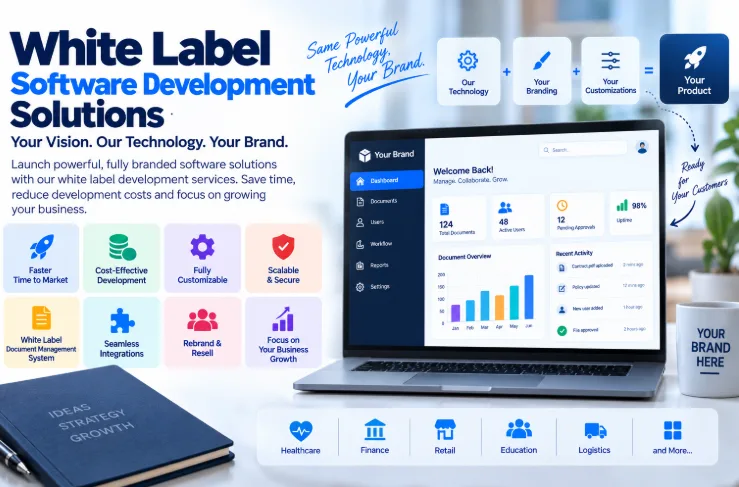
Businesses looking to expand their digital services often need reliable software without investing years in developing products from scratch. White label software development solutions provide a practical approach, allowing companies to use customizable, ready-made software under their own brand. This helps businesses launch products faster, reduce development effort, and focus on customer relationships and growth.
From healthcare platforms and customer relationship management systems to document management tools, white label software can support a wide range of business needs. The right solution combines customization, scalability, security, and seamless integration with existing systems.
What Are White Label Software Solutions?
White label software solutions are applications developed by one company that another business can rebrand and offer to its customers as its own product. The underlying technology is provided by the software developer, while the reseller or business partner can customize supported features, branding, and user interfaces.
These solutions are useful for software companies, healthcare organizations, consulting firms, and businesses that want to expand their product portfolios without building every application independently.
Benefits of White Label Software Development
1. Faster Time to Market
Developing software from the ground up can require significant planning, engineering, and testing. White label products provide an existing foundation that can be customized and deployed more quickly, helping businesses introduce new digital services sooner.
2. Lower Development Costs
White label development can reduce the resources required for initial product creation. Businesses can use an established software foundation instead of funding every component from scratch, although licensing, customization, integration, and maintenance costs still need to be considered.
3. Brand Customization
Companies can often customize logos, colors, interfaces, and selected features to match their brand identity. This creates a consistent customer experience across their digital products and services.
4. Scalability and Flexibility
Well-designed white label applications can support additional users, features, and integrations as business requirements evolve. Organizations should evaluate the architecture and customization options before selecting a platform.
What Do White Label Software Development Services Include?
White label software development services typically cover product configuration, branding, integration, testing, deployment, and ongoing technical support.
Common services include:
- Product customization: Adapt supported features and interfaces to business requirements.
- Branding and user experience: Apply brand elements and create a consistent application experience.
- Third-party integrations: Connect the software with CRM, ERP, payment, or other business systems.
- Security configuration: Implement suitable access controls, authentication, and data protection measures.
- Testing and deployment: Validate functionality, performance, and compatibility before launch.
- Maintenance and upgrades: Address technical issues and keep the application aligned with evolving requirements.
Businesses should clarify ownership rights, licensing terms, customization limits, and support responsibilities before entering a development agreement.
White Label Document Management System
A white label document management system allows businesses to provide document storage, organization, sharing, and workflow capabilities under their own brand.
Depending on the platform, key features may include:
- Centralized document storage: Organize files in a searchable digital repository.
- Access permissions: Control who can view, edit, download, or share documents.
- Version control: Track document changes and maintain previous versions.
- Workflow automation: Support document approvals, review processes, and notifications.
- Search and retrieval: Find documents using metadata, categories, and keywords.
- Audit trails: Record relevant activities to improve accountability.
Healthcare, legal, financial, and professional services organizations may benefit from document management tools tailored to their operational workflows. Organizations handling sensitive information should evaluate encryption, retention policies, audit capabilities, and applicable regulatory requirements.
How to Choose the Right White Label Software Development Partner
Selecting a suitable development partner requires more than comparing features and pricing. Businesses should evaluate the provider's technical expertise, customization capabilities, integration experience, security practices, and ongoing support model.
Consider the following factors:
- Business requirements: Confirm that the product supports your target market and essential workflows.
- Customization options: Check which branding and functional changes are possible.
- Integration capabilities: Verify compatibility with your existing applications and data systems.
- Security and compliance: Assess access controls, data protection, and relevant regulatory obligations.
- Scalability: Determine whether the platform can support future growth.
- Total cost of ownership: Include licensing, setup, customization, maintenance, and upgrade costs.
A pilot implementation can help validate the solution before a full-scale rollout.
Conclusion
White label software development enables businesses to expand their digital offerings using customizable applications without building every component from scratch. With the right white label software solutions, organizations can accelerate product launches, strengthen brand consistency, and support changing customer needs. Choosing an experienced development partner and evaluating security, scalability, integration, and long-term costs can help businesses build a sustainable software offering.