Introduction
There's one question almost every job seeker in the Oracle Fusion space eventually gets around to asking: which modules should I actually prioritize if I want to get hired quickly? Soft Online Training keeps a close eye on hiring trends by staying connected with recruiters across multiple industries, and the pattern in job postings has stayed remarkably consistent for a while now. This piece lays out exactly which modules employers are actively hiring for, and why some are clearly outpacing others in today's market.
Demand isn't evenly distributed across the platform. Certain modules show up in nearly every listing as a baseline requirement, while others surface mainly within specialized, industry-specific roles. Recognizing that difference makes a real difference in how someone plans their learning sequence and where they should focus early on.
Why General Ledger Never Falls Out of Demand
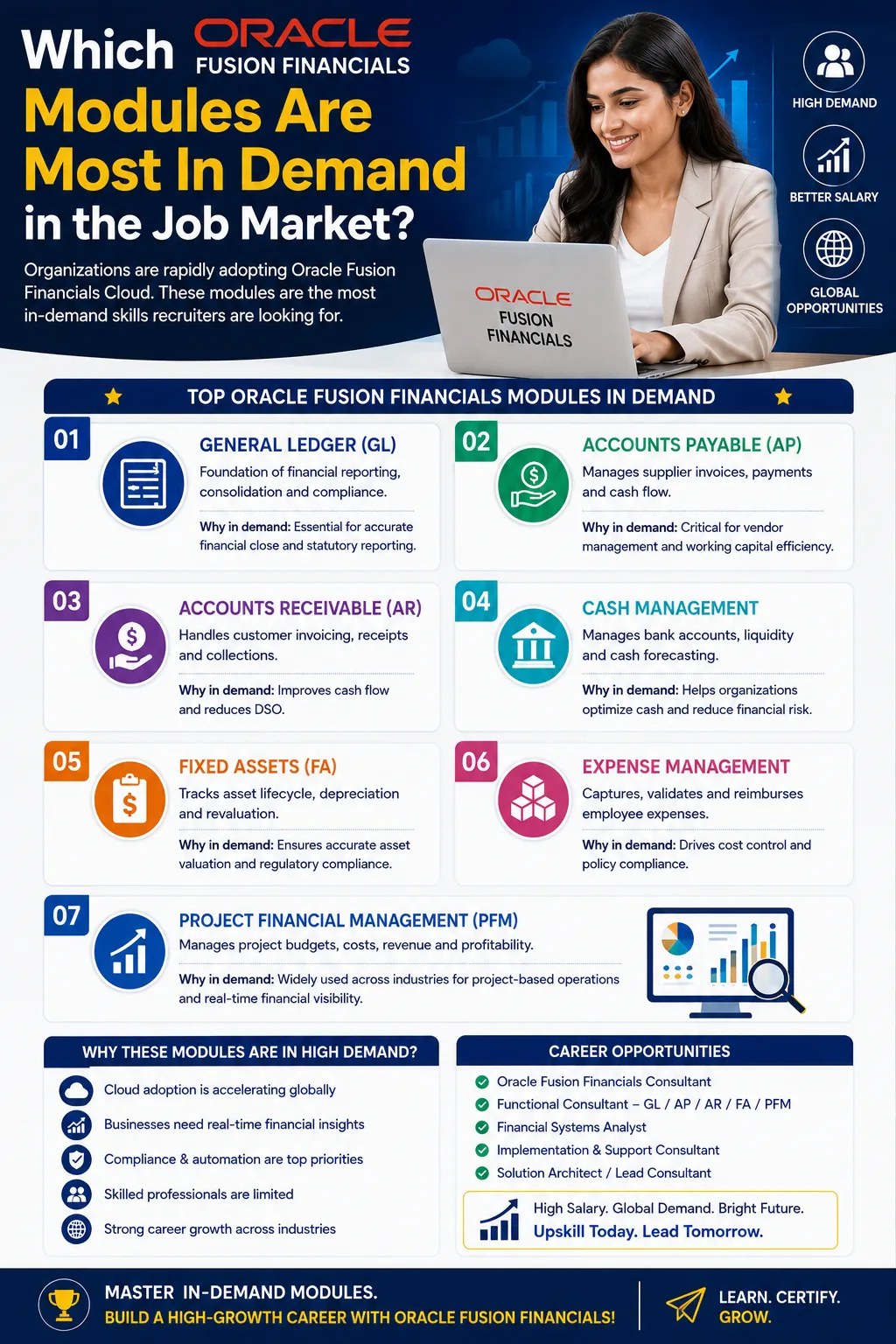
General Ledger consistently tops the list of skills employers ask for, and honestly, that's not surprising given how central GL is to financial reporting across essentially every industry. Recruiters don't treat this as a specialization at all it's a baseline expectation. Whether the posting is for a functional consultant, a financial analyst, or a support engineer, GL knowledge almost always appears as a core requirement rather than an optional extra.
Because this demand holds so steady, most solid Oracle Fusion Financials Course programs build their entire structure around GL as the natural starting point. Candidates able to speak confidently about chart of accounts design, journal entry processing, and multi-currency reporting tend to get through initial screening rounds far more easily than those who treat these fundamentals as background noise.
AP and AR: Two Modules That Rarely Get Separated
Accounts Payable and Accounts Receivable trail closely behind General Ledger in terms of frequency across job postings, particularly for roles in shared services, finance operations, and support desks. Companies handling meaningful AP or AR volume genuinely need professionals who understand invoice processing, vendor and customer relationships, payment cycles, and reconciliation at a real, working level.
What makes these two modules especially appealing to employers is their direct tie to daily cash flow. Someone comfortable across both AP and AR tends to be noticeably more hireable than someone who's only gone deep into one, since many mid-sized companies expect consultants to handle both sides of the transaction cycle without needing separate specialists. This is exactly the kind of dual-module comfort that strong Oracle Fusion Financials Online Training programs deliberately build toward, since it reflects how these roles are actually structured in most real organizations.
Fixed Assets: A Module That Rewards Targeting the Right Industry
Fixed Assets follows a noticeably different demand curve compared to GL, AP, or AR. Rather than appearing across nearly every posting, it spikes sharply within industries carrying heavy physical infrastructure manufacturing, construction, energy, and logistics. Organizations in these sectors need people who genuinely understand depreciation schedules, asset transfers, and capitalization rules in real depth.
For job seekers deliberately targeting these industries, strong Fixed Assets knowledge can act as a genuine differentiator. It's far less universal than GL or AP/AR, but wherever it's actually required, employers often struggle to find qualified candidates a gap that tends to work in favor of anyone who's built this specific expertise.
Cash Management's Quiet Climb Up the Priority List
Cash Management has been showing up in noticeably more job postings recently, largely driven by companies wanting sharper visibility into liquidity and cash positioning following a stretch of economic uncertainty. Roles pairing Cash Management with GL or AP knowledge have become increasingly common in corporate finance and treasury-adjacent positions.
This rising demand is easy for beginners to miss entirely, since Cash Management rarely comes up in early, general conversations about Oracle Fusion Financials. Including it as part of a broader Oracle Fusion Financials Course gives candidates a genuine edge over plenty of applicants who never got around to covering it.
The Shift Toward Multi-Module Candidates
One trend running clearly through recent job postings is a move away from narrow, single-module specialists. Employers are increasingly looking for candidates who can move comfortably across GL, AP, AR, and increasingly Cash Management, since real implementation and support work rarely stays confined to just one isolated area.
This is a major reason well-structured Oracle Fusion Financials Online Training has become significantly more valuable than piecing together disconnected tutorials one module at a time. Candidates who can speak clearly about how these modules interact tend to stand out almost immediately in technical interviews, since interviewers frequently probe for exactly this kind of cross-module understanding.
A Practical Order for Prioritizing What to Learn
Given these hiring patterns, a sensible learning order looks like this: General Ledger first, since it's expected in nearly every role; Accounts Payable and Receivable together next, given how often both appear side by side; Cash Management after that, particularly for anyone targeting corporate finance roles specifically; and Fixed Assets last, mainly for those aiming at asset-heavy industries.
A properly built Oracle Fusion Financials Course typically mirrors this exact sequence, ensuring learners lock in the most universally demanded skills before branching into more specialized, industry-specific territory.
Final Thoughts
Job market demand across Oracle Fusion Financials modules isn't evenly spread. General Ledger remains the clear, non-negotiable foundation every employer expects, AP and AR stay consistently strong across nearly every industry, Cash Management is quietly gaining real momentum, and Fixed Assets pays off specifically for those targeting asset-heavy sectors. For anyone genuinely serious about aligning their learning with real hiring trends, investing in a structured Oracle Fusion Financials Course, paired with flexible Oracle Fusion Financials Online Training, remains one of the smarter ways to build a skill set that actually matches what employers are hiring for right now.