Introduction
Almost every beginner hits the same wall right after deciding to learn Oracle Fusion Financials, staring at a list of nine different modules and having genuinely no idea which one to open first. It's a fair place to get stuck. The platform is genuinely made up of several interconnected pieces, and picking the right starting point changes how smoothly the rest of your learning actually goes.
Tech Leads IT built its Oracle Fusion Financials Training to walk both beginners and working professionals through this exact sequence, real practical learning, genuine projects, and expert guidance that removes the guesswork.
Here's why the first module matters so much, each one builds on core accounting logic and supports a different slice of the business. Nail the starting point, and everything that follows becomes noticeably easier to absorb instead of confusing.
A Fast Refresher on What This Platform Actually Does
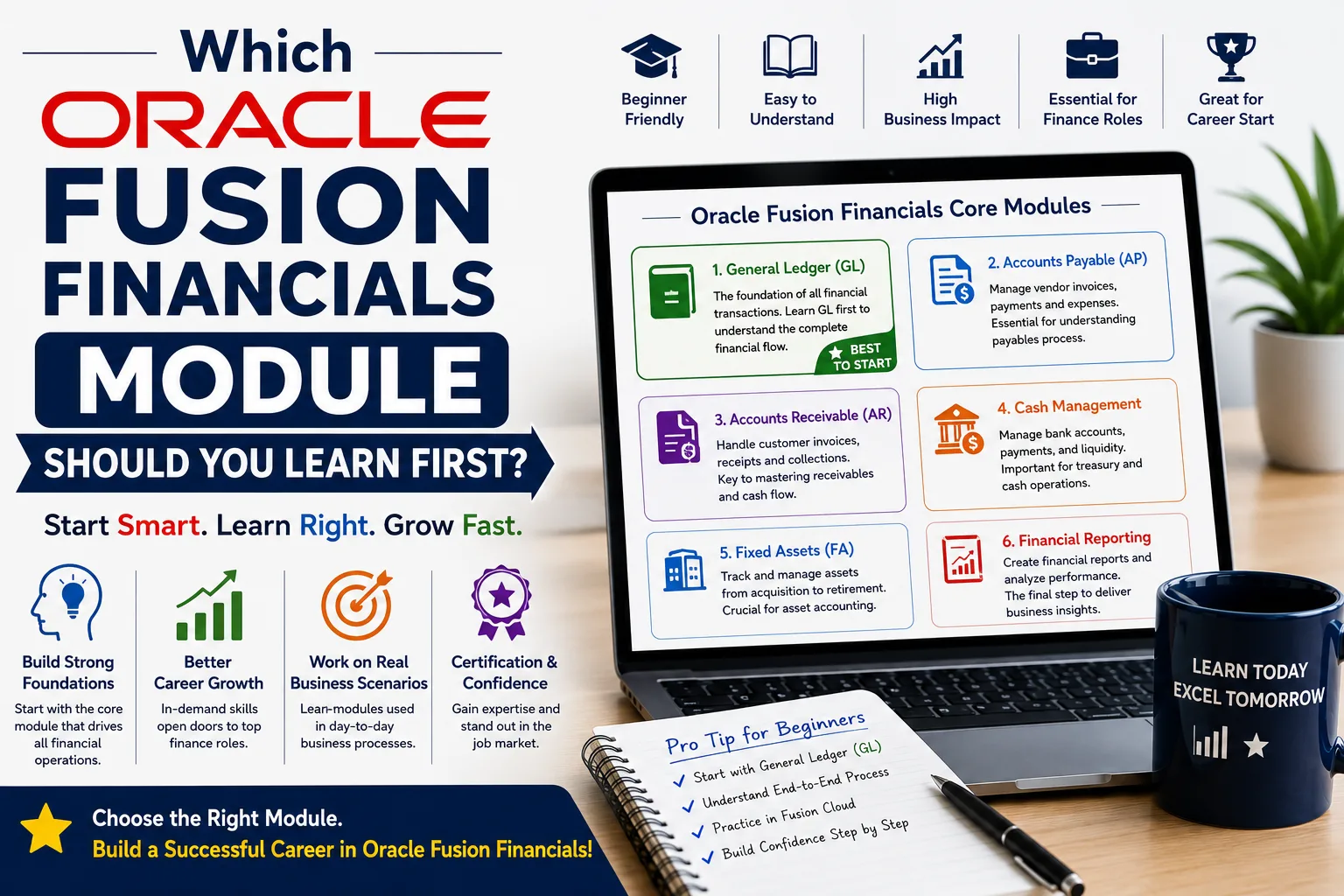
Oracle Fusion Financials manages accounting, reporting, payments, receivables, assets, and cash flow through one connected system, General Ledger, Accounts Payable, Accounts Receivable, Cash Management, Fixed Assets, Expense Management, Financial Reporting, Budgeting, and Subledger Accounting. Each module handles something distinct, but under the hood, they're all quietly talking to each other.
The Module You Should Genuinely Start With
For anyone new to this, General Ledger (GL) is the obvious starting point. It's the foundation of Oracle Fusion Financials, since nearly every financial transaction eventually flows into the ledger one way or another. Learning GL first makes everything downstream, chart of accounts, accounting calendars, journals, posting, financial statements, period closing, click into place a lot faster, since they're all ultimately feeding the same core system.
Why GL Genuinely Deserves to Come First
It builds real accounting muscle. Journal entries, debits and credits, trial balance, balance sheets, profit and loss statements, financial reporting, this is the foundation everything else in the platform rests on.
It's the meeting point for every other module. Supplier invoices from Accounts Payable, customer payments from Accounts Receivable, depreciation from Fixed Assets, expense reimbursements from Expense Management, all of it eventually lands in the General Ledger. Understanding GL is genuinely how you see the whole system working together instead of a bunch of disconnected screens.
It's what interviewers ask about first. Expect questions like what is a Ledger, what's the Chart of Accounts, what's an Accounting Calendar, how are journals created, how does posting actually work? Solid Oracle Fusion Financials Training prepares you to answer all of this without freezing up.
Once GL Feels Solid, Here's What Comes Next
Accounts Payable supplier creation, invoice processing, payments, approvals, and validation, the backbone of procurement-related finance.
Accounts Receivable customer creation, invoicing, receipts, credit management, and collections, showing how revenue actually gets recorded.
Cash Management bank account setup, reconciliation, cash positioning, and forecasting, giving you genuine cash flow visibility.
Fixed Assets asset creation, capitalization, depreciation, transfers, and retirement, especially relevant for organizations with major capital investments.
Expense Management expense reports, policy validation, approvals, and reimbursement, tightening tracking and compliance.
Learn the Business Cycles, Not Just Each Module in Isolation
Rather than treating each module as its own island, it helps to see how they work together across real business processes. Procure-to-Pay runs from purchase requisition through purchase order, invoice, and payment, with Accounts Payable at its core. Order-to-Cash covers customer orders through invoicing, receipts, and revenue collection, driven by Accounts Receivable. Record-to-Report covers journal entries, posting, reconciliation, and reporting, with General Ledger as the backbone throughout. Understanding these full cycles makes applying Oracle Fusion Financials to actual projects feel a lot more intuitive.
Skills Worth Building Alongside the Modules Themselves
Employers want more than module familiarity. Real accounting fundamentals, journal entries, trial balance, balance sheets, reconciliation, remain essential. Analytical thinking helps you actually interpret reports rather than just generate them. Communication matters since functional consultants constantly talk with finance teams, business users, clients, and technical staff. And genuine problem-solving, understanding requirements, resolving functional issues, improving processes, rounds out a profile that actually gets hired.
Why Structured Training Genuinely Speeds This Up
Self-teaching has its place, but it's slower, and easy to get lost in without a clear path. A comprehensive Oracle Fusion Financials Course brings expert-led sessions, hands-on Oracle Cloud practice, an industry-relevant curriculum, real implementation scenarios, practical assignments, mock interviews, resume help, and placement support, giving you both the theory and the practical implementation skill employers genuinely look for.
Where This Learning Path Can Actually Lead
Once you've built solid command of the core modules, roles worth aiming for include Oracle Fusion Financial Functional Consultant, Oracle Cloud ERP Consultant, Financial Systems Analyst, Oracle Financial Support Consultant, Finance Transformation Consultant, and Business Process Consultant, all available across banking, manufacturing, healthcare, retail, IT, logistics, and consulting.
Conclusion
For beginners, General Ledger is genuinely the right place to start, it's the foundation of Oracle Fusion Financials and the connective tissue between every major financial process on the platform. Once GL feels genuinely comfortable, moving into Accounts Payable, Accounts Receivable, Cash Management, Fixed Assets, and the rest becomes a lot more natural, especially once you understand how they all interact through real business cycles. Enrolling in Oracle Fusion Financials Training builds this foundation the right way, and a well-designed Oracle Fusion Financials Course gives you the hands-on experience and industry-relevant knowledge to become a genuinely confident Oracle Fusion Financials professional in this fast-growing cloud ERP field.