
Picking a CMS is a multi-year commitment. Pick wrong, and you spend the next three budget cycles patching around limitations. Pick right, and the platform fades into the background while your team ships features.
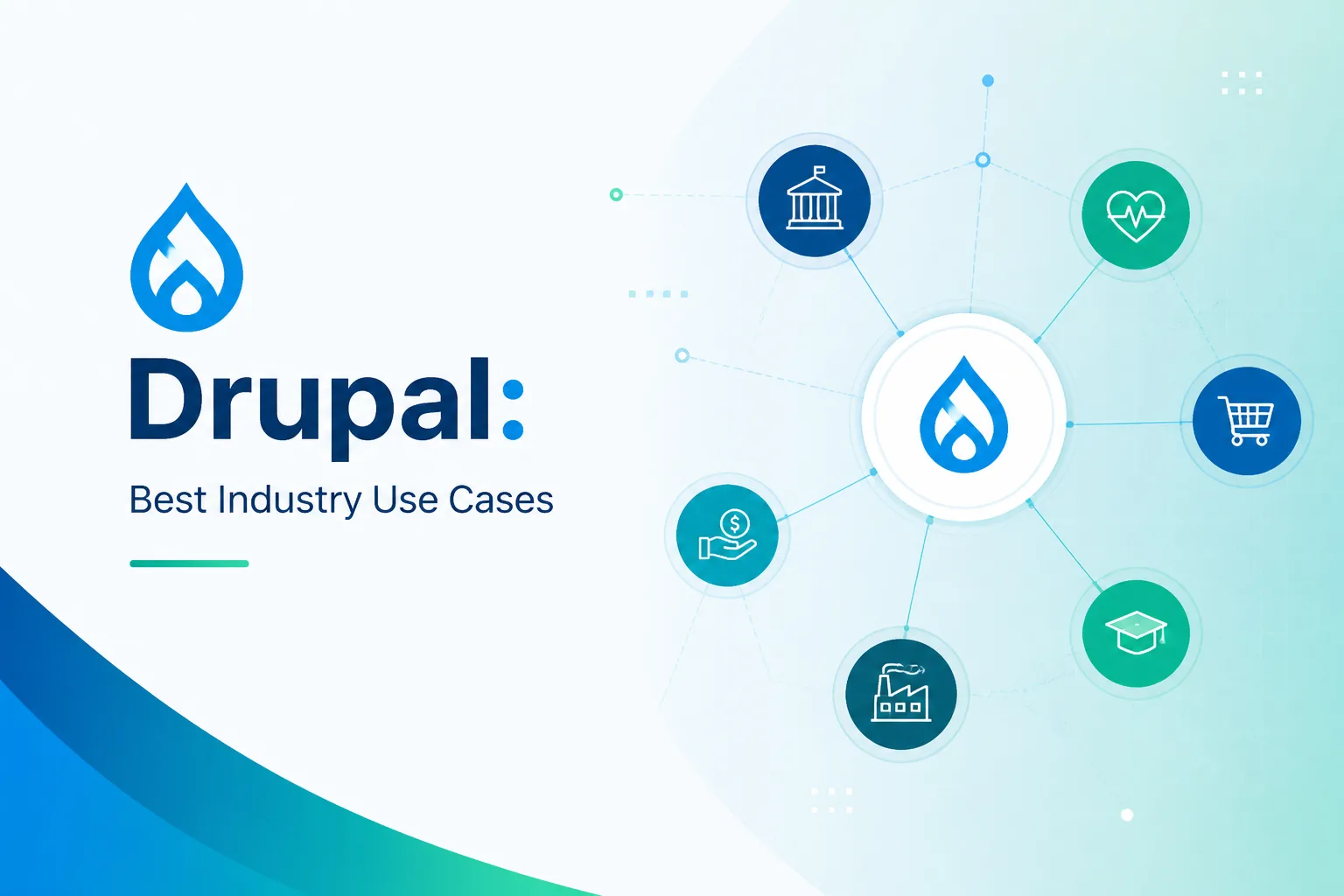
Drupal sits in a specific zone. It's overkill for a 10-page brochure site, and it's the default answer when content models get complex, security requirements get audited, or one editorial team needs to run 40 sites from a single codebase. This guide covers the industries where a Drupal Website Developer earns their rate, and the situations where another platform makes more sense.
What Drupal Actually Solves
Three things, mainly:
- Structured content at scale. Content types, taxonomies, fields, and references that map to real-world data models, not just blog posts.
- Granular access control. Role-based permissions down to the field level, audit logs, and workflow states.
- Multi-site, multi-language, multi-channel publishing. One editorial team feeding websites, mobile apps, kiosks, and partner APIs from a single source.
If your problem doesn't involve at least one of these, hire a WordPress shop and save money.
Industries Where Drupal Wins
Government and Public Sector
Federal, state, and local agencies sit on Drupal mainly for its security track record. The Drupal security team publishes advisories on a fixed schedule, and the platform powers a long list of .gov properties across the US, UK, Australia, and France. (Specific named sites change platforms over time, so verify current implementations before citing them publicly.)
What matters for agencies:
- FedRAMP-aligned hosting options (Acquia, Pantheon)
- Section 508 and WCAG 2.1 AA compliance baked into core themes
- Audit logs and content moderation workflows for FOIA-sensitive material
- Multi-site architecture for departments under one parent agency
A Drupal Development Company working with public-sector clients should have direct references in this space. Ask for them.
Higher Education
Universities run on Drupal because each department needs autonomy without each department needing its own CMS. A central IT team maintains the codebase. The business school, athletics department, and admissions office each get their own site, theme, and editorial team, all from one install.
The draw is multi-site management, deep integration with student information systems (Banner, PeopleSoft), and the ability to handle 50+ sub-sites without 50+ contracts. This is where Custom Drupal Development Company work shows up most often: integrating Drupal with legacy systems that won't be replaced for another decade.
Healthcare and Life Sciences
Healthcare publishers and provider networks pick Drupal when they need:
- HIPAA-compliant hosting and audit trails
- Patient portals with role-based access (clinicians vs. patients vs. billing)
- Multi-language publishing for patient education
- Integration with EHR systems through custom modules
Hospital networks running dozens of facility sites use Drupal's multi-site features the same way universities do. One codebase, many brands.
Media and Publishing
High-volume publishers gravitate to Drupal when WordPress starts breaking under content scale. Sites with hundreds of thousands of articles, complex taxonomy, syndication to third parties, and live editorial workflows benefit from Drupal's content architecture and caching layer.
The relevant features:
- Workbench-style editorial workflows (draft, review, publish, archive)
- Headless Drupal feeding mobile apps and partner APIs
- Performance under heavy read traffic through Varnish and CDN integration
Nonprofits and Advocacy
Nonprofits with donor management, event registration, grant programs, and chapter networks need a CMS that handles members, donations, and content from one platform. Drupal Web Development Company shops often pair Drupal with CiviCRM for the donor and CRM side, giving organizations a single stack instead of three disconnected SaaS tools.
Enterprise and Financial Services
Banks, insurance carriers, and large B2B companies use Drupal when:
- Marketing sites need 20+ language variants
- Customer portals require SSO with Active Directory or Okta
- Content needs SOX or PCI compliance trails
- Internal and external sites share a content backbone
This is where you Hire Drupal Developers with enterprise integration experience, not generalists. Look for portfolios showing SAP, Salesforce, or Adobe Experience Manager integrations.
E-commerce (Specific Cases)
Drupal Commerce isn't Shopify. Don't choose it for a 50-SKU DTC brand. Choose it when:
- Your catalog has complex product configurations (B2B parts, made-to-order industrial goods)
- Content marketing and commerce share the same backend
- You need custom pricing logic, tiered customer accounts, or quote workflows
- Integration with ERP systems like NetSuite or SAP is non-negotiable
When Drupal Is the Wrong Choice
Be honest with yourself:
- Simple brochure site, no complex permissions: WordPress
- DTC e-commerce, fast launch: Shopify
- Content-only marketing site, headless preferred: Sanity, Contentful, or Next.js with a lightweight CMS
- Team without developer support: anything but Drupal
Drupal's flexibility is also its tax. Without engineering capacity, the platform becomes a liability.
What to Look for in Drupal Development Services
Whether you're hiring an agency or building in-house, these signals separate Drupal Development Services that ship from ones that don't:
- Active drupal.org contributions (modules, patches, core commits)
- Acquia or Pantheon partnership status
- Case studies with named clients in your industry
- A clear Drupal 7 to 10/11 migration story (Drupal 7 reached end-of-life in January 2025, per the official Drupal Association timeline; confirm the current support status before publication, since extended commercial support options exist.)
- DevOps maturity: CI/CD, automated testing, configuration management
Cheap Drupal work tends to mean stitched-together contributed modules without security review. Expensive work tends to mean custom modules where contributed ones would have done the job. The right partner explains the trade-off.
Conclusion
Drupal is a specialist's tool. If your project involves complex content models, strict security, multi-site management, or deep system integrations, the platform pays back the learning curve. If it doesn't, you're paying for capability you'll never use.
The decision usually comes down to three questions: How structured is your content? How tightly regulated is your industry? How many properties will share a backend? Answer those honestly, and the choice gets simple.
Ready to Talk About Your Project?
If you're weighing Drupal against alternatives, or planning a Drupal 7 migration, get a no-pitch technical assessment from our team. We'll tell you when Drupal makes sense, and when it doesn't.
Frequently Asked Questions
1. Is Drupal still relevant in 2026?
Yes, particularly for government, education, healthcare, and enterprise use cases. Drupal 11 added modern developer experience features. Market share in the simple-site segment has dropped, but in complex enterprise and public-sector work, Drupal remains a default choice. (Verify current adoption data from W3Techs or BuiltWith before publication.)
2. What's the difference between Drupal and WordPress for enterprise use?
WordPress optimizes for ease of use. Drupal optimizes for complexity management. WordPress can scale, but Drupal handles structured content, granular permissions, and multi-site setups natively. For a marketing blog, WordPress wins on cost. For a regulated multi-site operation, Drupal wins on architecture.
3. How long does a typical Drupal project take?
A standard corporate site runs 12 to 20 weeks. Enterprise multi-site or migration projects run 6 to 12 months. Discovery alone often takes 4 to 6 weeks for complex integrations.
4. What does it cost to Hire Drupal Developers?
Rates vary by region. US-based senior Drupal developers typically charge between $125 and $200 per hour. Offshore senior rates run $35 to $75 per hour. Agency project costs depend on scope. (Verify current market rates before publication; these shift annually.)
5. Is Drupal secure enough for healthcare and finance?
Yes, when configured correctly. Drupal's security team coordinates advisories on a published schedule. HIPAA and PCI compliance is achievable with proper hosting (Acquia Cloud, Pantheon) and module choices. The platform itself isn't the risk; misconfiguration is.
6. Should we migrate from Drupal 7 to Drupal 10 or 11?
If you're still on Drupal 7, you're running software that has passed its community end-of-life date (verify current extended support status). Migrate to Drupal 10 for stability, or Drupal 11 if you want the latest features and have engineering bandwidth.
7. Can Drupal work as a headless CMS?
Yes. Drupal's JSON:API and GraphQL support is mature. Many enterprises run Drupal as a content backend with React, Next.js, or native mobile apps consuming the API. This is increasingly common for media and retail clients.
8. What's the difference between Drupal Commerce and Shopify?
Shopify is a hosted DTC platform with fixed patterns. Drupal Commerce is a framework for building custom e-commerce. Choose Shopify for speed. Choose Drupal Commerce for complex catalogs, B2B workflows, or tight content-commerce integration.
9. Do we need an agency or can we hire freelance Drupal developers?
Depends on scope. For a single-site launch, a strong freelancer or small agency works. For multi-site enterprise builds or regulated industries, an agency with DevOps maturity and team depth is safer. Solo developers struggle with on-call coverage and continuity.
10. What modules are essential for a new Drupal site?
The core distribution covers most needs. Common additions include Pathauto (URL aliases), Webform (forms), Metatag (SEO), Paragraphs (flexible content layouts), and Search API (advanced search). Avoid module sprawl; every contributed module is an attack surface.