Software-as-a-Service (SaaS) has transformed how businesses adopt technology. It lowered entry barriers, accelerated digital transformation, and enabled organizations to scale faster than ever before. For startups and growing companies, SaaS platforms often provide the speed and flexibility needed to move quickly.
But what happens when growth reaches a point where SaaS tools start holding the business back instead of pushing it forward?
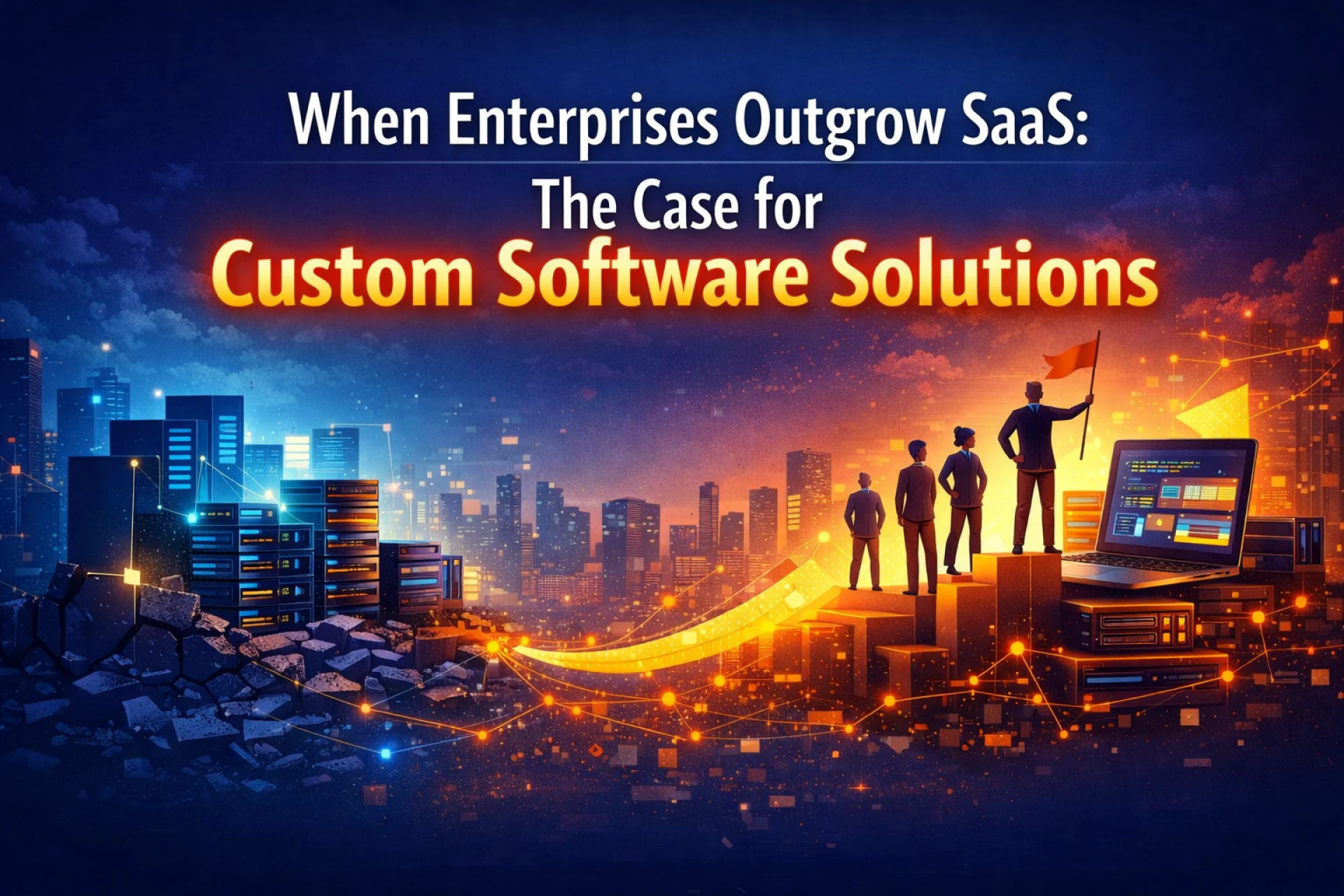
Many enterprises eventually discover that the very tools that once enabled growth now introduce friction, inefficiency, and limitations. At that stage, continuing to stack more SaaS products becomes a short-term fix for a long-term problem. This is when organizations begin to outgrow SaaS—and when custom software solutions become not just viable, but necessary.
Why SaaS Works—Until It Doesn’t
SaaS platforms are designed for scale, but not for differentiation. They aim to serve thousands of businesses with common needs, using standardized workflows and predefined features.
In the early and mid-growth stages, this works well:
- Fast deployment
- Lower upfront costs
- Minimal maintenance
- Predictable pricing models
However, as enterprises expand operations, customer bases, and internal processes, the limitations of SaaS begin to surface.
What once felt flexible starts to feel restrictive.
The Tipping Point: Signs an Enterprise Has Outgrown SaaS
Outgrowing SaaS doesn’t happen overnight. It’s usually a gradual realization driven by recurring challenges.
1. Forced Workflows Replace Efficient Processes
SaaS platforms require businesses to adapt to their structure. As enterprises grow more complex, teams begin to rely on workarounds:
- Manual steps between systems
- Custom fields used for unintended purposes
- External tools to compensate for missing features
Instead of software supporting operations, operations bend to accommodate the software. At this stage, many enterprises turn to custom software solutions to regain control over workflows, data, and system scalability as they move beyond the limitations of SaaS platforms.
2. Integration Complexity Spirals Out of Control
Enterprises rely on dozens of systems—CRMs, ERPs, CMS platforms, analytics tools, loyalty systems, billing software, and more.
With SaaS-heavy stacks:
- Integrations become brittle
- Data synchronization breaks under scale
- Vendor limitations restrict flexibility
- Performance issues emerge as data volume grows
The cost of maintaining integrations quietly increases over time.
3. Data Lives in Silos
SaaS platforms often control their own data structures, making it difficult to unify information across tools.
This leads to:
- Conflicting reports
- Incomplete customer views
- Delayed insights
- Decision-making based on partial data
At enterprise scale, data fragmentation becomes a strategic risk.
4. Customization Hits a Ceiling
Most SaaS tools offer customization—but only within predefined limits. Once enterprises need:
- Unique workflows
- Industry-specific logic
- Complex business rules
- Advanced automation
They run into hard constraints that cannot be solved without external tools or costly compromises.
5. Costs Increase Faster Than Value
SaaS pricing scales with:
- Number of users
- Data volume
- Feature tiers
- Add-ons and integrations
As enterprises grow, subscription costs multiply—often without a corresponding increase in efficiency or performance. Over time, SaaS becomes expensive not because of licensing alone, but because of the inefficiencies it creates.
Why Custom Software Becomes the Logical Next Step
When SaaS limitations begin to slow progress, custom software solutions offer an alternative approach—one designed around the business rather than generic use cases.
Custom software doesn’t replace every SaaS tool. Instead, it fills the gaps SaaS cannot address.
Aligning Technology With Business Strategy
The most powerful advantage of custom software is alignment.
Instead of forcing teams into predefined workflows, custom platforms are built to:
- Match real operational processes
- Support unique business models
- Enable strategic differentiation
- Evolve alongside the organization
Technology becomes a strategic asset, not a constraint.
Centralizing Data for Better Intelligence
Custom software allows enterprises to define their own data architecture.
This enables:
- A single source of truth across systems
- Clean, consistent data models
- Real-time data visibility
- Advanced analytics and reporting
When data is unified, decision-making improves across the organization.
Simplifying Integration at Scale
Rather than relying on fragile, third-party connectors, custom software can act as an integration hub.
Benefits include:
- API-first architecture
- Controlled data flow between systems
- Easier system replacement or expansion
- Improved performance and reliability
This flexibility is critical for long-term growth.
Supporting True Scalability
Custom platforms are designed with scale in mind from the start.
They can be built to:
- Handle increasing data volumes
- Support high transaction loads
- Adapt to new markets or regions
- Maintain performance under growth
Unlike SaaS, scalability isn’t retrofitted—it’s foundational.
Enhancing Security and Compliance
As enterprises grow, security and compliance requirements become more complex.
Custom software provides:
- Granular access control
- Custom security protocols
- Industry-specific compliance alignment
- Faster adaptation to regulatory changes
This level of control is difficult to achieve with standardized SaaS tools.
Cost Efficiency Beyond the Surface
While custom software requires upfront investment, it often reduces long-term costs by:
- Eliminating redundant tools
- Reducing integration maintenance
- Improving productivity
- Lowering vendor dependency
Instead of paying recurring fees for partial solutions, enterprises invest in systems that deliver compounding value.
When SaaS and Custom Software Work Together
Outgrowing SaaS doesn’t mean abandoning it entirely.
Many enterprises adopt a hybrid approach:
- SaaS tools for standardized functions
- Custom software for core operations, integration, and differentiation
This strategy combines speed with control—maximizing flexibility without sacrificing efficiency.
Making the Transition Successfully
Moving from SaaS dependency to custom software requires careful planning.
Successful enterprises:
- Identify critical pain points
- Prioritize high-impact processes
- Start with modular development
- Ensure scalability and integration readiness
- Align stakeholders across departments
Custom software is most effective when treated as a strategic initiative, not just an IT project.
The Competitive Advantage of Going Custom
At enterprise scale, competitive advantage rarely comes from features competitors can easily replicate. It comes from:
- Operational efficiency
- Data-driven decision-making
- Personalized customer experiences
- Faster innovation cycles
Custom software enables all of these.
Enterprises that continue relying solely on SaaS eventually face the same constraints. Those who invest in custom solutions gain flexibility, control, and resilience that competitors struggle to match.
Final Thoughts
SaaS is an excellent starting point—but it’s not always the destination.
As enterprises grow, complexity increases. Systems multiply. Data expands. Differentiation becomes critical. At this stage, generic software begins to limit what’s possible.
Custom software solutions offer a way forward—one where technology evolves with the business instead of holding it back.
For enterprises that have outgrown SaaS, going custom isn’t about building software for the sake of it. It’s about regaining control, unlocking scalability, and turning technology into a long-term competitive advantage.