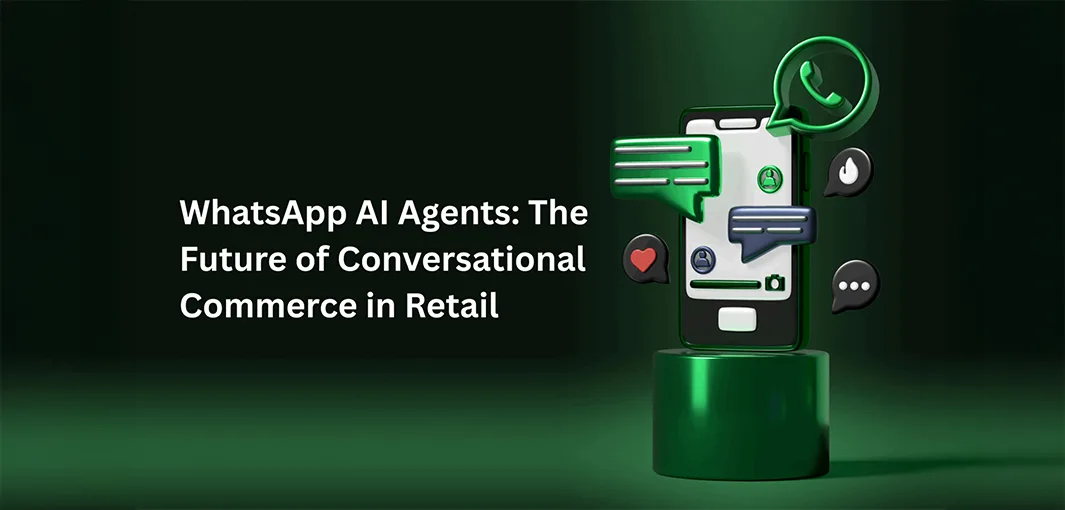
How WhatsApp AI Agents are transforming the way D2C brands sell, support, and retain customers — at scale.
The way people shop has changed forever. Consumers no longer want to browse faceless websites, fill out long forms, or wait 48 hours for a support email. They want answers now, on the apps they already use — and for over 2 billion people worldwide, that app is WhatsApp.
For retail and direct-to-consumer (D2C) brands, this shift is not a trend to watch. It is an opportunity to act on. Enter the WhatsApp AI Agent: a new breed of intelligent, conversational commerce engine that turns a messaging app into a full-stack shopping experience.
In this blog, we explore what a WhatsApp AI Agent is, why it matters for D2C brands, how it works, and why 2025 is the year conversational commerce becomes mainstream retail infrastructure.
What Is a WhatsApp AI Agent?
A WhatsApp AI Agent is an AI-powered system that operates within WhatsApp to autonomously handle conversations, answer product questions, process orders, send proactive notifications, and complete transactions — all without requiring a human agent for routine tasks.
Unlike a traditional chatbot that follows rigid scripts, an AI Agent for WhatsApp understands natural language, remembers context across a conversation, and takes goal-directed actions. It can access your product catalogue, check inventory, apply discount codes, initiate payments, and even follow up with customers who abandoned their carts — all inside a single WhatsApp thread.
Think of it as giving every customer their own personal shopping assistant, available 24/7, who never loses patience, never forgets context, and never has a bad day.
Why WhatsApp? The Channel Advantage
Before diving into the capabilities of an AI Agent for WhatsApp, it is worth understanding why WhatsApp is the right channel for conversational commerce.
Reach at scale. WhatsApp has over 500 million users in India alone, making it the default messaging platform for the majority of online shoppers. In Southeast Asia, Latin America, and Europe, the numbers are similarly dominant.
Unmatched open rates. Email open rates hover around 20–25%. WhatsApp messages see open rates of 90%+, often within minutes of delivery. When you send a customer a cart recovery message or a shipping update on WhatsApp, they actually read it.
Trust and familiarity. People use WhatsApp to talk to family and friends. A brand that communicates through WhatsApp enters a trusted, personal space — which drives higher engagement and lower drop-off compared to any other channel.
Native commerce features. With WhatsApp Business API, brands can now send product catalogues, receive payments (in supported markets), share order confirmations, and collect feedback — all natively within the app.
When you layer an AI Agent on top of this infrastructure, the result is a commerce channel that is more powerful than email, more personal than a website, and more scalable than a human support team.
The Rise of WhatsApp AI Agents for D2C Brands
D2C brands have a unique set of challenges that make WhatsApp AI Agents for D2C brands particularly valuable.
1. Customer Acquisition Costs Are Rising
Performance marketing is becoming more expensive every year. D2C brands that relied on Facebook and Google ads to acquire customers are facing margin compression. Retaining existing customers and maximising lifetime value (LTV) is now the primary growth lever. A WhatsApp AI Agent enables D2C brands to build a direct, owned communication channel with their customer base — reducing dependence on paid platforms.
2. Post-Purchase Experience Is Often Neglected
Most D2C brands invest heavily in the pre-purchase journey (ads, landing pages, checkout) but leave the post-purchase experience to automated emails that customers rarely read. Shipping delays, return requests, refund queries, and reorder reminders are all handled reactively, if at all.
A WhatsApp AI Agent transforms post-purchase from a cost centre into a loyalty driver. It proactively sends order updates, handles return requests conversationally, triggers reorder nudges when a replenishable product is running low, and collects reviews — all in the same thread where the customer originally purchased.
3. Support Costs Are Unsustainable at Scale
As a D2C brand scales from 1,000 to 10,000 to 100,000 orders per month, customer support scales linearly with volume — unless you have intelligent automation. A WhatsApp AI Agent handles 80–90% of routine queries (order status, return policy, product information, size guides) without human intervention, freeing your team to focus on high-value interactions.
4. Personalisation Is a Competitive Advantage
Large retail brands win on price and selection. D2C brands win on relationship and personalisation. A WhatsApp AI Agent can be trained on your product catalogue, brand voice, and customer data to deliver hyper-personalised recommendations, birthday offers, loyalty rewards, and contextual upsells — at a level of personal touch that no email automation tool can replicate.
How a WhatsApp AI Agent Works: The Architecture
A modern AI Agent for WhatsApp is not a single piece of software. It is an orchestrated system of components working together in real time.
Natural Language Understanding (NLU). The agent parses what a customer says — regardless of typos, abbreviations, or regional language — and identifies intent. “Where’s my order?” and “kahan hai mera parcel?” are both understood as a tracking query.
Context Management. Unlike a stateless chatbot, an AI Agent maintains conversation memory. If a customer mentions their size in message three, the agent remembers it when making a recommendation in message ten.
Tool Use and Action Execution. The agent connects to your backend systems — OMS (order management), CRM, product catalogue, payment gateway, and returns platform — and takes actions on behalf of the customer. It doesn’t just answer questions; it resolves them.
Guardrails and Escalation. When a query is outside the agent’s competence — a complex complaint, a sensitive refund dispute, a PR situation — the agent recognises this and escalates to a human agent with full conversation context pre-loaded.
Proactive Outreach. Beyond reactive support, the agent initiates conversations: abandoned cart recovery, back-in-stock alerts, loyalty point expiry reminders, personalised product drops. These are not broadcast blasts — they are personalised, contextual messages with two-way engagement built in.
Use Cases: WhatsApp AI Agents for D2C Brands in Action
Discovery and Consideration
A customer sees a skincare brand’s Instagram ad and clicks to WhatsApp. Instead of landing on a generic website, they are greeted by the AI Agent, which asks a few quick questions about their skin type and concerns, then recommends three products from the catalogue with ingredient highlights and real customer reviews. The entire discovery-to-consideration journey happens inside WhatsApp in under three minutes.
Cart Recovery
A customer adds a product to cart but does not complete checkout. Forty-five minutes later, the WhatsApp AI Agent sends a personalised message: “Hey Priya, you left something behind! Your cart is waiting — and we’d love to offer you free shipping if you complete your order in the next 2 hours.” One click. Order placed. No email campaign needed.
Order Tracking and Proactive Updates
The moment an order ships, the AI Agent sends a tracking update. If there is a delay, it proactively messages the customer before they have a chance to worry — not with a generic “your order is delayed” notification, but with a personalised message acknowledging the delay and offering a discount on their next order as a goodwill gesture.
Returns and Exchanges
The customer wants to return a product. They message the AI Agent, which walks them through the return process conversationally: confirms the order, captures the reason, generates a return label, and initiates the refund — all without the customer ever visiting a returns portal or speaking to a human. The entire interaction takes two minutes.
Reorder and Subscription
For replenish able products — supplements, skincare, pet food, coffee — the WhatsApp AI Agent tracks average consumption patterns and sends a reorder nudge at the right time. “Running low on your protein powder? You usually reorder every 28 days — it’s been 25 days. Want to place your next order?” One-tap reorder, no friction.
Loyalty and Community
The agent becomes the brand’s relationship layer. It sends personalised birthday offers, celebrates customer milestones, invites loyal customers to product launches, and gathers zero-party data through conversational surveys — building a proprietary data asset that no third-party platform can take away.
WhatsApp AI Agents vs. Traditional Chatbots: What’s Different?
The term “chatbot” has earned a bad reputation — and rightly so. Legacy chatbots are frustrating because they are brittle, scripted, and fail the moment a customer goes off-script. The comparison between a traditional chatbot and a WhatsApp AI Agent is important for brands evaluating the technology.
Dimension Traditional Chatbot WhatsApp AI Agent Language understanding Keyword matching Natural language (any phrasing) Conversation memory None (stateless) Full context retained Action capability FAQ responses only Backend integrations, transactions Personalisation Generic Customer-data driven Escalation Rarely, poorly Intelligent, with context handoff Proactive outreach Not capable Core capability Learning over time Static Improves with feedback
The difference is not incremental. It is categorical. A WhatsApp AI Agent is not a smarter chatbot — it is a new category of retail infrastructure.
The Business Case: What the Numbers Say
Brands deploying WhatsApp AI Agents for D2C are reporting results that are difficult to ignore.
Cart recovery rates via WhatsApp AI agents are running at 3–5x the rate of email cart recovery, primarily because of the channel’s higher open rates and the conversational, non-pushy nature of the interaction.
Customer support costs are falling by 40–60% as AI agents handle the majority of routine queries, reducing the need to scale support headcount linearly with order volume.
First-response time — a key driver of customer satisfaction — drops from hours to seconds, even at 2 AM on a Sunday.
Repeat purchase rates are improving by 20–35% for brands running proactive WhatsApp AI Agent programmes (reorder nudges, loyalty interactions, personalised recommendations), because the brand stays top-of-mind between purchases in a channel the customer checks every day.
Return on WhatsApp marketing spend, when measured across the full funnel (acquisition, conversion, retention), is increasingly outperforming email and SMS for D2C brands that have invested in the channel properly.
Choosing the Right WhatsApp AI Agent Platform
Not all AI Agents for WhatsApp are created equal. When evaluating platforms for your D2C brand, consider these criteria:
WhatsApp Business API compliance. The platform must operate through Meta’s official Business API. Any platform offering WhatsApp automation outside the official API is violating Meta’s terms of service and risks your business being banned.
Integration depth. The agent is only as powerful as the systems it can access. Look for native integrations with your OMS (Shopify, WooCommerce, Unicommerce), CRM, payment gateway, and returns management platform.
AI quality and customisation. The agent should be trainable on your product catalogue, brand voice, and domain-specific knowledge — not just a generic language model pointed at WhatsApp.
Analytics and observability. You need visibility into conversation volumes, resolution rates, escalation rates, and conversion attribution to measure ROI and improve over time.
Human handoff quality. The mark of a mature platform is not how many queries the AI resolves — it is how gracefully it escalates the ones it cannot, with full context preserved for the human agent.
The Road Ahead: WhatsApp as the New Retail OS
The trajectory is clear. As AI models become more capable, as WhatsApp’s native commerce features expand, and as consumer expectations for instant, personalised, conversational service become the norm rather than the exception, WhatsApp AI Agents will evolve from a competitive advantage into a baseline requirement for D2C retail.
Brands that build their WhatsApp AI Agent capability today are building a proprietary, owned channel with a compounding advantage: richer customer data, stronger relationships, higher LTV, and lower acquisition costs over time.
The brands that wait are not just missing a feature. They are ceding the most important customer relationship surface of the next decade to competitors who moved faster.
Conclusion
The future of conversational commerce is not a website with a chat widget. It is a WhatsApp AI Agent that meets customers where they already are, speaks to them like a knowledgeable friend, and makes every interaction — from discovery to delivery to re-order — feel effortless.
For D2C brands, the question is no longer whether to invest in WhatsApp AI Agents. The question is how quickly you can deploy one that truly represents your brand, integrates with your stack, and starts compounding returns from day one.
The conversation has already started. Your customers are waiting on WhatsApp. The only question is: who’s answering?
Want to explore how a WhatsApp AI Agent can be built for your D2C brand? The best time to start was yesterday. The second best time is right now.