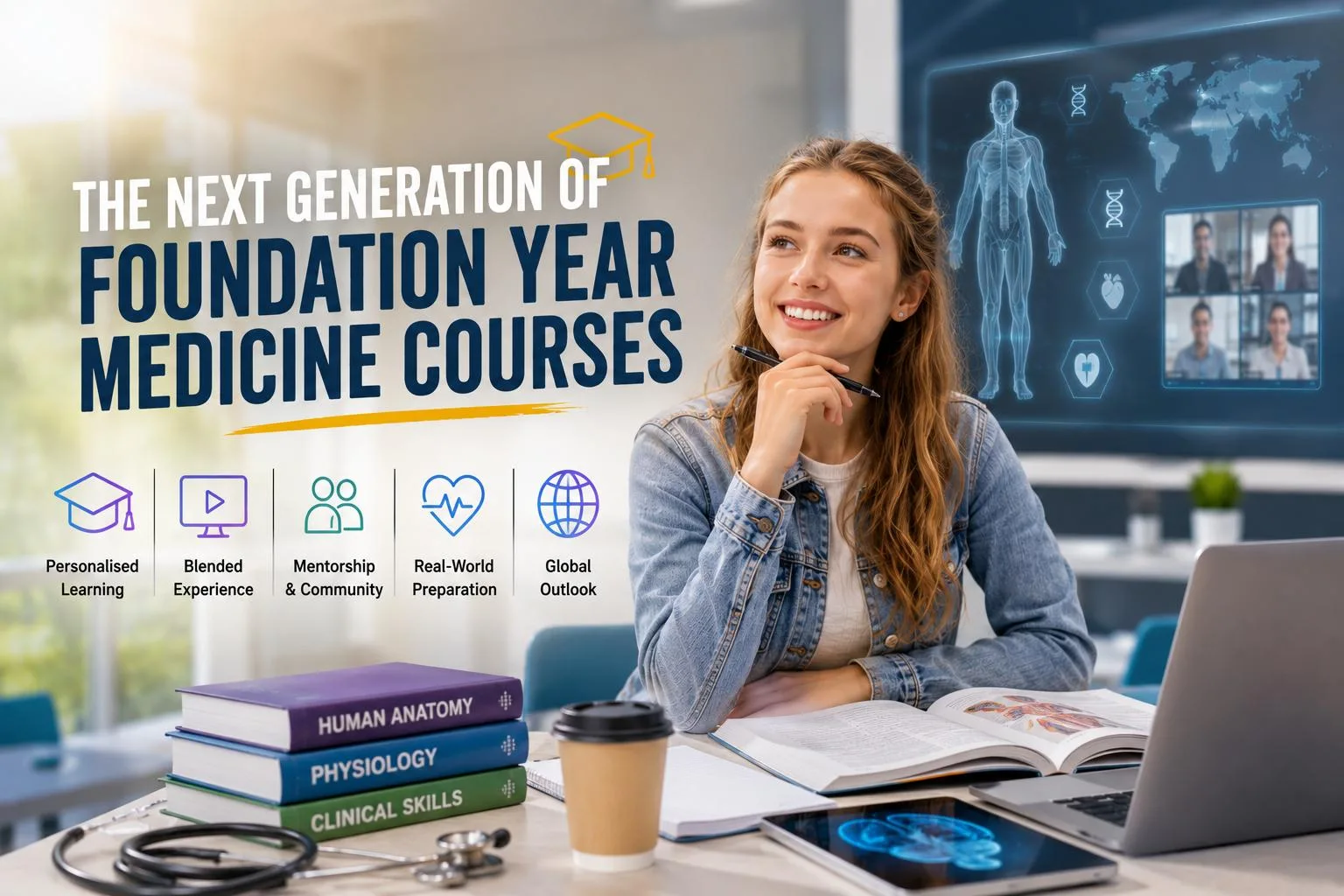
Foundation year medicine is moving beyond its old role as an extra academic year before medical school. Future courses could become a full preparation stage for medical training. Students may still build their biology, chemistry, maths, and study skills. Yet they could also meet patients earlier, practise in simulation rooms, learn how healthcare uses AI, and receive support based on their own academic needs.
A medicine with foundation year course may therefore become less about filling gaps and more about getting students ready for the demands of medical school. Current UK policy already places greater focus on widening access to medicine, local workforce needs, simulation, and blended teaching. Medical education is also giving more attention to digital skills and the safe use of AI.
The result could be a new type of foundation year. It would prepare students for science exams, but it would also teach them how doctors think, communicate, learn, and work with patients.
Why Foundation Year Medicine Is Likely to Change
Foundation programmes already play a clear role in widening access to medicine. Leicester's current programme links its foundation route to widening participation. Edge Hill also uses its programme as a route for students who have the ability to study medicine but may not have had the same opportunities as other applicants.
That role may grow in the coming years. England's 10 Year Health Plan says expansion of medical school places should focus in part on institutions with a strong record of widening participation. Government guidance has also asked medical schools to think about local NHS workforce needs when expanding places.
Future foundation courses may therefore have two jobs. They may open medical education to a wider group of capable students and give those students stronger preparation for the years ahead.
The Foundation Year Could Become a Medical Readiness Year
People sometimes see a foundation year as a year for students who need to catch up before starting medicine. That view may become outdated.
Future programmes could ask a different question: What does this student need to succeed once medical school starts?
That changes the purpose of the course. Science would still matter, but it would sit beside communication, teamwork, academic writing, professional conduct, digital skills, and clinical thinking.
A future programme might look more like this:
Current focusPossible future focusScience preparationScience linked to patient careGeneral study skillsMedical learning skillsStandard teaching pathwayPersonal learning supportMainly classroom workClassroom, simulation, and community learningEnd-of-module marksRegular feedback on progressPreparation for Year OnePreparation for the full medical degreeThis model would not lower the standard. It would give students more ways to reach it.
Learning Could Become More Personal
Students enter foundation medicine with different strengths. One student may have strong biology knowledge but struggle with chemistry. Another may achieve good science grades but have little experience with academic writing or group discussion.
Future courses could test these areas near the start of the year. Tutors could then build a learning plan around each student's needs.
A student who finds chemistry difficult might receive extra workshops and practice questions. Someone who needs help with communication might spend more time in simulated patient sessions. A student who has not studied in a university setting before could get added help with research, referencing, note-taking, and exam planning.
Technology could make this system easier to manage. Online learning systems can already track question performance and identify repeated mistakes. Future tools may give tutors a clearer picture of where a student needs help, without replacing the tutor's judgement.
The goal would be simple. Students would not receive easier work. They would receive support that better matches the work they need to do.
Students May Meet Patients Earlier
Future foundation medicine may feel more connected to real healthcare from the start.
Some courses have already moved in this direction. Edge Hill includes clinical and community learning, work placements, science practicals, clinical skills sessions, and experience in local healthcare settings during its foundation programme.
Future courses could build on this approach. Foundation students might observe GP consultations, visit community health services, speak with patient groups, or follow a patient's journey through different NHS services.
This would not mean giving students clinical responsibility before they are ready. The aim would be exposure, not independent practice.
Early contact can also give science more meaning. Respiratory physiology may feel more useful after meeting someone who lives with asthma. Public health becomes easier to understand when students see how housing, income, transport, and local services affect a person's health.
Simulation May Become Part of the Normal Week
Simulation could become one of the biggest changes in the medicine with foundation year course.
UK medical education policy has already named simulation and blended learning as possible ways to update course delivery. NHS England's medical training work has also reported support for putting simulation, digital literacy, and AI skills closer to the centre of medical training.
Foundation students do not need advanced emergency simulations. Their sessions could start with basic but useful situations.
They might practise introducing themselves to a patient. They could learn how to ask clear questions, respond to an anxious person, work with a small healthcare team, or recognise when they need help from someone more experienced.
Simulation has one major benefit for beginners. Students can make mistakes in a controlled setting, receive feedback, and try again. That can build confidence before later clinical placements carry greater pressure.
Virtual patients may add another option. Students could practise the same communication task several times with different patient profiles, symptoms, and responses. A real tutor could then discuss what worked and what needs improvement.
AI Literacy Could Become a Basic Medical Skill
AI is likely to appear in foundation medicine, but not simply as a study shortcut.
Future doctors will work in health systems that use digital records, clinical software, data tools, remote care, and growing forms of AI support. NHS England's 2025 Medical Training Review found strong calls for better training in digital systems, safe AI use, and critical review of technology.
That means foundation students may need to learn how to question AI output instead of simply accepting it.
Teaching could cover:
- Checking accuracy: Students may compare AI-generated medical information with trusted teaching material and explain where an answer goes wrong.
- Patient privacy: Courses could teach why sensitive health information should not be placed into unapproved tools.
- Bias: Students may learn how poor training data can lead to unfair or inaccurate results for some patient groups.
- Human responsibility: Students should know that software support does not remove professional responsibility from the healthcare worker using it.
Assessment may also change. Instead of trying to ban every AI tool from every task, tutors may test whether students can find errors, defend their own reasoning, and prove that they understand the subject without digital help.
Clinical Reasoning Could Start Before Year One
Foundation students do not need to diagnose patients. They can still start learning the thinking habits used in medicine.
A tutor might present a simple case about a person who feels short of breath. Students could study respiratory biology, oxygen transport, possible lifestyle factors, and the questions a doctor might ask. The task would connect science with human health without expecting students to act like qualified clinicians.
This approach could help solve a common problem in pre-medical study. Students sometimes learn large amounts of science without seeing why it matters in patient care.
Future courses may link more teaching to simple cases. Students would still learn the science in full, but patient situations would give that knowledge a clear purpose.
The MLA May Influence Learning Habits Earlier
The Medical Licensing Assessment, or MLA, now provides a common framework for the core knowledge, clinical skills, and professional behaviour expected from doctors entering UK practice. UK medical students take the MLA as part of their medical degree. The GMC's updated content map applying from September 2026 covers both applied knowledge and clinical and professional skills.
Foundation students would not need to prepare directly for a final medical licensing assessment. That would be far too early.
Yet foundation courses may start building the habits that matter later. Students could practise applying knowledge rather than memorising facts alone. They could learn patient-centred communication, professional behaviour, safe decision-making, and how to deal with uncertainty.
The pathway would then feel more connected:
Foundation preparation → medical degree → MLA → medical practice
That gives the foundation year a clearer place within the student's full training journey.
Exams May Become Only One Part of Assessment
Written exams will probably remain part of foundation medicine. Medical students need strong knowledge, and universities need clear progression standards.
The change may come from how much weight courses place on a single exam.
Future programmes could collect evidence across the year. Students might complete science tests, laboratory work, communication tasks, case discussions, portfolios, group projects, and simulated patient sessions.
Tutors could then give feedback across several areas. A student might be strong in scientific knowledge but need more work on communication. Another might communicate well but need stronger data interpretation.
This kind of feedback gives students time to improve before progression decisions arrive. The standard remains firm, but the path towards that standard becomes clearer.
Mentoring May Become Part of Teaching
Academic support offices already exist across universities, but future foundation medicine programmes may make mentoring a normal part of the course.
A useful model could involve three forms of support. Each student could have an academic tutor, a senior medical student as a near-peer mentor, and a small foundation-year peer group.
The academic tutor would focus on progress and study needs. The medical student could explain what the next stage of the degree feels like. The peer group could help students discuss problems with people going through the same transition.
This matters because entry is only the first stage. A widening-access programme works best when students also receive the academic and social support needed to progress through medical school.
Community Learning Could Take a Bigger Role
The future doctor will not work only in hospitals. Foundation medicine may reflect that fact much earlier.
Students could spend time learning about GP practices, community pharmacies, care homes, mental health services, public health teams, rehabilitation services, and local support groups. Current policy on medical school expansion already asks providers to consider local NHS workforce needs and priority areas.
This could lead to courses that feel more connected to their region. A programme serving a rural area may give more attention to distance, access to care, and general practice. A programme based in a large city may spend more time on language barriers, housing, public health, and access to community services.
Such teaching can also help students understand that good medicine depends on more than knowing diseases. Doctors work with people whose health is affected by their jobs, homes, families, income, and local services.
Wider Access Does Not Mean Lower Standards
Future entry routes may become more inclusive, but that does not mean medical school will become easier.
Foundation programmes can look at academic potential alongside a student's educational and social background. Current Leicester entry rules, for example, combine academic requirements with widening-participation criteria for its foundation route.
Future admissions systems may get better at spotting students whose grades do not tell the full story. School performance, local disadvantage, care experience, family education history, or other contextual information may help universities judge opportunity as well as attainment.
The key point is that access and progression are different issues. Universities can admit students from a broader range of backgrounds and still require every student to meet the same standard needed to move into the medical degree.
Blended Teaching Will Grow, but Medicine Will Stay Human
Future foundation courses may put more learning online. Students could watch science lessons before class, complete practice questions at home, review digital anatomy material, and prepare for cases through an online platform.
That does not mean foundation medicine is likely to turn into a remote course.
Laboratory work, communication training, patient contact, teamwork, practical skills, and professional behaviour all benefit from direct human contact. Government guidance that mentions blended learning also places simulation and practical training within the wider direction of medical education reform.
A sensible future model would use technology where it saves time or improves practice. Human teaching would remain central where judgement, communication, teamwork, and patient care matter most.
Health Inequality May Sit Beside Medical Science
Public health may become much more closely linked with the science students learn.
An asthma lesson could cover the lungs and also discuss air quality and poor housing. A diabetes lesson could cover metabolism and then look at food access, prevention, and local health services. Cardiovascular teaching could link circulation with smoking, income, diet, and access to early care.
This approach could teach students to think about both disease and the person's situation.
That skill matters in real medical work. Two patients can have the same condition yet face very different barriers to treatment. Starting this type of thinking during the foundation year could give students a stronger base for later clinical learning.
What a Future Foundation Medicine Week Could Look Like
A future timetable may mix science, practical work, technology, and patient contact instead of placing them in separate parts of the year.
Monday might start with human physiology, followed by a personalised online practice session. Tuesday could include a community healthcare visit and a group discussion about why some patients find it harder to access care.
Wednesday could involve a virtual patient session and feedback from a clinical tutor. Thursday might combine laboratory work with a team project involving students from another healthcare course. Friday could finish with a case discussion, a mentor meeting, and a review of progress.
That timetable is only an example, not an announced university model. Yet each part follows changes already visible across medical education: more simulation, stronger digital skills, community learning, widening access, and closer links between study and patient care.
What Students Should Look for in a Future Course
Students comparing foundation medicine programmes should look beyond the course title. Two programmes can use similar names but have very different entry rules, progression terms, and teaching methods.
A good medicine with foundation year course should clearly explain how students move into the main medical degree. Applicants should also check the amount of science teaching, clinical or community contact, academic support, mentoring, simulation, and professional skills training.
Pay close attention to entry rules as well. Some foundation medicine routes target specific widening-participation groups, regions, or home-fee students. Eligibility should therefore be one of the first things an applicant checks rather than something left until the application deadline. Current Leicester requirements are one example of a programme with specific academic and widening-access conditions.
What Is Unlikely to Change
Technology may change the classroom, but the core purpose of medical education will stay firm.
Students will still need strong scientific knowledge. They will need to communicate well, behave professionally, work safely, pass assessments, and show that they are ready to progress.
The GMC continues to set the knowledge, skills, and behaviours expected from UK medical graduates through its Outcomes for Graduates framework. A foundation year may change how students prepare for those demands, but it cannot remove them.
That is why future courses are more likely to add better preparation than make medicine easier.
The Biggest Change Could Be How Students View the Foundation Year
The strongest change may not involve a new piece of software or a new assessment. It may involve the reputation of the foundation year itself.
Students may stop seeing it as a sign that they were not ready for medicine. Instead, it could become a planned transition year that gives students more time to build the skills needed for a demanding degree.
Its purpose could follow a simple path:
Access → preparation → belonging → capability → progression
That model gives foundation medicine a much bigger role. It supports entry into medical school, but it also aims to improve what happens after entry.
Could Foundation Courses Influence Standard Medical Degrees?
Foundation programmes may become useful testing grounds for new teaching methods.
Personal learning plans, early simulation, near-peer mentoring, community teaching, digital literacy, and case-based science could work just as well for standard-entry medical students. A successful idea introduced in a foundation programme does not need to stay there forever.
That creates an interesting possibility. The next generation of foundation courses may not simply copy changes made elsewhere in medical education. Some of their best teaching methods could later become normal across undergraduate medicine.
Final Outlook: Foundation Medicine in the Years Ahead
The next generation of foundation year medicine courses will probably keep their core purpose: helping capable students progress into medical training. What changes is the amount of preparation built around that goal.
Students may receive more personal academic support, earlier contact with healthcare, regular simulation, stronger mentoring, and better teaching about digital medicine and AI. Courses may also connect more closely with local communities and the workforce needs of the NHS.
The foundation year could therefore become less like an extra year added before medicine and more like the first stage of medical development. The strongest programmes will not only ask whether a student can gain entry to medical school. They will ask whether that student has the knowledge, confidence, learning habits, communication skills, and support needed to succeed once medical training begins.
For students, that could make the medicine with foundation year course a much more valuable route than its old “bridging year” label suggests.
Frequently Asked Questions
Will medicine with foundation year courses still exist in the future?
They are likely to remain useful because UK policy continues to support wider access to medical education. The exact number and design of courses can change between universities. Future programmes may also use new teaching methods rather than following one national foundation-year model.
Will AI be used in foundation year medicine?
AI could become part of teaching, revision, simulation, and digital-health education. Students are also likely to learn about its limits, errors, bias, and patient privacy. Human tutors should still make academic and professional judgements.
Will foundation medicine students get clinical experience?
Some current courses already include clinical or community learning. Future programmes may give students more early contact with patients and health services. Foundation students would observe and learn rather than take on the responsibilities of qualified clinicians.
Will foundation medicine become easier to enter?
Wider access does not automatically mean easier entry. Universities may use more contextual information when judging applicants, but students will still need to meet academic, admissions, and progression rules.
Do foundation students take the UK MLA?
The MLA forms part of the UK medical degree rather than the pre-medical foundation year itself. Students who later progress through a UK medical degree must meet the MLA requirements that apply to their medical programme.
Is a medicine foundation year the same as Foundation Year One?
No. A medicine foundation year is an additional university stage before Year One of the main medical degree. Foundation Year One, commonly called F1, comes after medical school and forms part of postgraduate medical training.