Introduction
Before diving into another list of interview questions, it's worth pausing on something most candidates skip entirely: figuring out which side of the interview you're actually weak on. Soft Online Training has noticed that candidates rarely fail interviews from lacking knowledge altogether they fail from being lopsided, strong in one dimension and quietly shaky in the other, without realizing it until they're already in the room.
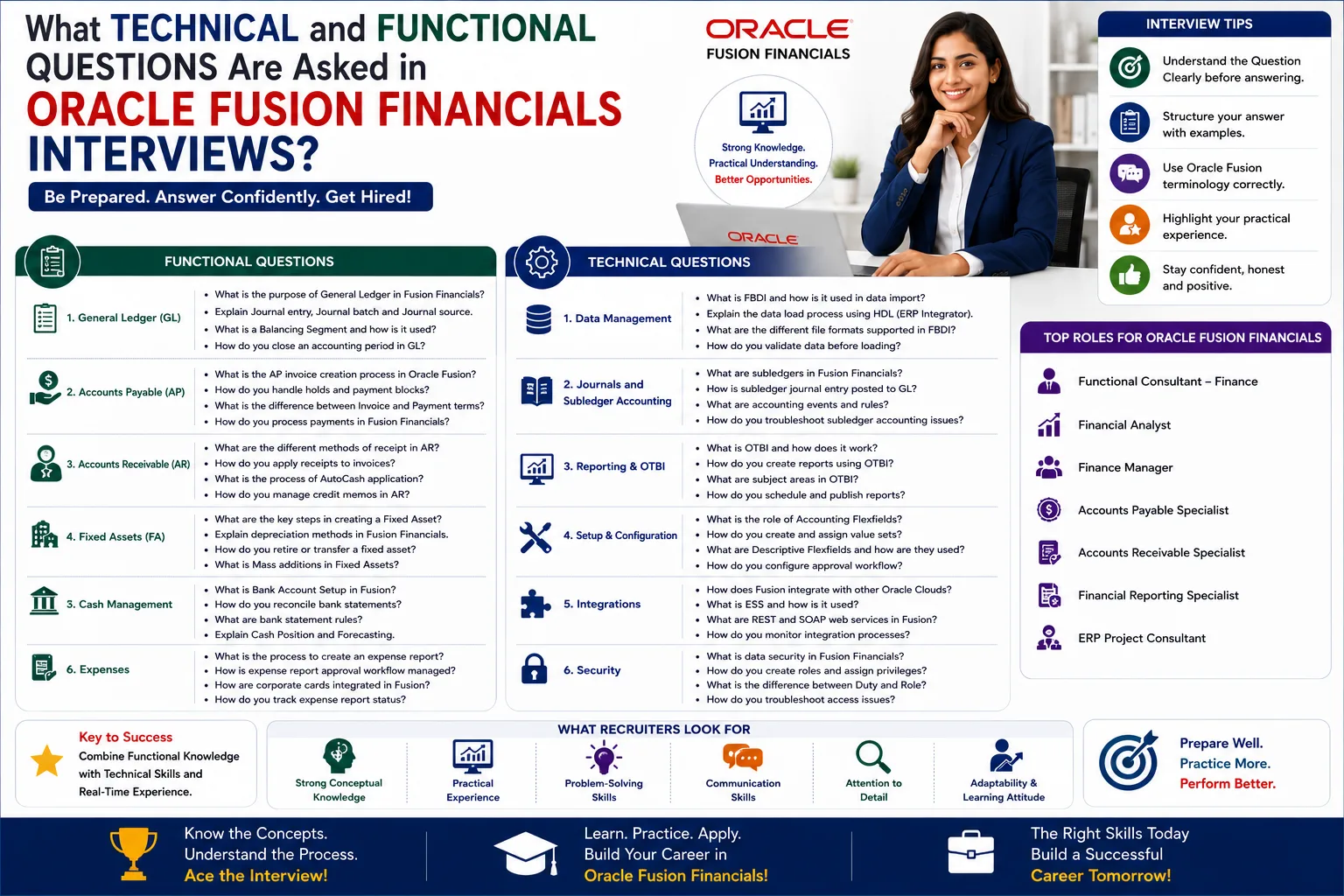
Oracle Fusion Financials interviews genuinely split into two distinct categories functional questions about business logic, and technical questions about the platform itself. Rather than another undifferentiated question list, here's a way to actually diagnose where your gaps are, paired with real examples from both sides, and how structured Oracle Fusion Financials Online Training closes whichever gap you find.
Quick Self-Check: Which Side Are You Actually Weaker On?
Ask yourself honestly: can you explain why a Chart of Accounts is structured a certain way, or only what it technically is? Can you actually configure an approval workflow in Oracle Cloud, or only describe what one does in theory? If the first question felt easier than the second, you're likely functional-strong and technical-light. If it's reversed, you probably know your way around the software but haven't fully connected it to business reasoning yet. Most candidates lean one way without noticing this quick check is worth doing honestly before you assume you're evenly prepared.
If You're Functional-Strong: Test Yourself Here
Functional questions probe business logic and accounting reasoning rather than software mechanics. If this is your strength, you should be able to comfortably answer: What is a Chart of Accounts, and why does its structure actually matter to an organization? Walk me through the full supplier-to-payment cycle in Accounts Payable. How does a credit memo affect a customer's account balance? What causes most bank reconciliation mismatches in real practice? Can you explain Procure-to-Pay, Order-to-Cash, and Record-to-Report as connected cycles rather than isolated definitions?
If these feel easy, functional isn't where you need to focus your remaining prep time technical is.
If You're Technical-Strong: Test Yourself Here
Technical questions, in this context, mean comfort with the platform's mechanics configuration, navigation, reporting, and data handling not coding. If this is your strength, you should be comfortable with: How do you actually set up a new ledger in Oracle Cloud? What's involved in configuring a supplier invoice approval workflow? What reporting tools generate a trial balance or balance sheet directly from the system? How would you troubleshoot a report pulling incorrect figures? What does functional testing and User Acceptance Testing typically involve after a configuration change?
If these feel comfortable, technical isn't your gap functional reasoning likely is.
Why This Split Exists in the First Place
Interviewers deliberately test both because real project work demands both simultaneously. Someone who understands accounting deeply but can't configure the system struggles the moment theory needs to become a working setup. Someone who navigates Oracle Cloud confidently without grasping why a client's business needs a specific configuration ends up making technically correct but functionally wrong decisions. Neither half alone reflects what the job actually requires.
Why Most Candidates Never Notice Their Own Gap
It's genuinely hard to self-assess accurately, because whichever side you're stronger on feels effortless, and effortless things don't register as "things I know" they just feel like common sense. That's exactly why candidates walk into interviews assuming they're broadly prepared, only to freeze on the category they've been unconsciously avoiding in their own study sessions.
Closing the Gap Once You've Found It
If you're functional-light, spend deliberate time actually navigating Oracle Cloud setting up ledgers, configuring workflows, running reports yourself rather than just reading about these processes. If you're technical-light, practice explaining business logic out loud, as if teaching someone with zero ERP background, until the reasoning comes without hesitation.
Why Hands-On Practice Naturally Closes Both Gaps
This is exactly where a genuinely practical Oracle Fusion Financials Course earns its value working through real implementation exercises forces both dimensions together, since correctly processing an invoice requires understanding the accounting logic and the actual system steps at the same time, not one in isolation.
Rehearsing the Side You're Weaker On
Once you've identified your gap, weight your mock interview practice toward that category specifically, rather than splitting time evenly. If technical is your weak spot, physically walk through the steps in Oracle Cloud rather than just describing them. If functional is your weak spot, practice narrating the "why" behind configurations, not just the "how."
Why Structured Online Training Builds Both Deliberately
A well-designed Oracle Fusion Financials Online Training program develops functional and technical fluency together by design business process teaching alongside real Oracle Cloud labs which naturally surfaces and corrects whichever gap you'd otherwise have carried into an interview unnoticed.
Why Soft Online Training
The program pairs live instructor-led classes with hands-on Oracle Cloud practice, real implementation scenarios, mock interviews, resume support, and placement guidance built specifically to develop both functional and technical strength rather than letting either one quietly lag.
Conclusion
The candidates who perform best in Oracle Fusion Financials interviews aren't necessarily the ones who know the most they're the ones who've honestly identified which half of the interview they're weaker on and deliberately closed that gap. Enrolling in Oracle Fusion Financials Online Training builds both dimensions together, and a comprehensive Oracle Fusion Financials Course like the one offered through Soft Online Training gives you a structured way to find your actual gap and close it before it costs you an offer.