A workplace should help a team get work done, not create another list of problems to manage.
Yet many businesses discover that running an office involves far more than paying rent. Internet interruptions, air-conditioning issues, housekeeping, furniture, meeting-room management and vendor coordination can quickly become part of someone’s daily workload.
For founders, HR teams and operations managers, every hour spent resolving these issues is time taken away from employees, customers and business priorities.
That is where the idea of a managed office becomes valuable.
But a modern managed office should offer more than furnished desks. It should reduce everyday operational friction, give teams a dependable environment and provide enough flexibility to adapt as the business changes.
A Managed Office Should Reduce Setup Work
Setting up a traditional office usually involves several moving parts.
Businesses may need to coordinate:
- Furniture and interiors
- Internet connectivity
- Electricity and utilities
- Housekeeping
- Facility maintenance
- Security
- Meeting-room infrastructure
- Vendor management
Each element may involve a different service provider, contract or internal point of contact.
A managed office brings many of these requirements together under one workspace arrangement. Depending on the provider and agreement, furniture, internet, housekeeping and facility support may already be available when the team moves in.
This can reduce the amount of time required to make an office operational.
The real benefit is not simply convenience. It is giving internal teams fewer non-core responsibilities to manage.
Reliability Matters More Than a Good-Looking Office
An attractive workspace can create a strong first impression.
But employees experience the office for hours every day.
That means reliability eventually matters more than appearance.
Fast internet needs to remain dependable during an important client presentation. Meeting rooms should be available when required. Air-conditioning and essential facilities should work consistently.
When these basic elements function smoothly, employees rarely think about them.
That is exactly the point.
A well-managed workspace should allow the infrastructure to operate quietly in the background while the team concentrates on its actual work.
Location Is Part of the Workspace Experience
Businesses sometimes evaluate an office based almost entirely on the building.
But the workspace experience starts before employees enter the office.
Commute time, metro access and connectivity to other parts of the city can significantly influence how practical a location feels over time.
For growing teams that value employee accessibility and an active commercial neighbourhood, a managed office in Indiranagar can be worth considering.
Indiranagar can work particularly well for startups, product teams, hybrid companies and businesses that want employees to have access to restaurants, cafés and everyday conveniences around the workplace.
The right location ultimately depends on where employees travel from and how frequently the team uses the office.
Central Accessibility Can Matter for Client-Facing Teams
Not every business evaluates location primarily around employee commute.
Some companies regularly host clients, senior leaders, consultants, investors or external partners.
For these organisations, having an office in a central business area can become more important.
Teams exploring managed office space MG Road may be prioritising access to Central Bangalore along with a professional environment for meetings and business interactions.
This can be particularly relevant for:
- Consulting companies
- Professional services firms
- Enterprise teams
- Satellite offices
- Business development teams
- Leadership functions
- Client-facing organisations
The important point is to match the location with how the business actually operates rather than choosing an address only because it is well known.
Privacy Should Grow With the Business
Open workspaces can work well for smaller teams.
As organisations grow, their privacy requirements usually increase.
HR discussions may need enclosed rooms. Leadership conversations cannot always happen in shared areas. Sales teams need places to make calls. Client presentations require dedicated meeting spaces.
This means a modern managed office should provide a sensible mix of:
- Dedicated work areas
- Private cabins
- Meeting rooms
- Phone booths
- Collaborative areas
- Quiet spaces
Companies should assess these facilities based on their team's actual working patterns.
A business that conducts frequent confidential conversations may need a very different setup from one whose employees mainly work collaboratively.
Flexibility Should Be Part of the Agreement
Office requirements rarely remain unchanged.
A company may have 25 employees today and 50 a year later.
Another business may add a project team for six months and then reduce its space requirement.
This is why flexibility can be one of the most important factors when evaluating a managed office.
Before signing an agreement, businesses should understand:
- Whether additional seats can be added
- Whether larger office configurations are available
- Minimum commitment periods
- Deposit requirements
- Notice periods
- Included amenities
- Meeting-room terms
- Expansion possibilities
The word “managed” does not automatically mean every agreement is flexible.
Commercial terms vary between providers, so they should be compared carefully.
A Managed Office Should Take Operational Pressure Off the Team
One of the biggest benefits of a well-run office is difficult to measure directly: management attention.
Consider how many small workplace issues appear during a normal month.
An internet problem needs escalation.
A meeting room needs attention before an important presentation.
Furniture needs to be moved for a new employee.
A maintenance issue requires a follow-up.
Housekeeping needs coordination.
None of these tasks is particularly large on its own.
Together, they can consume significant time.
In a smaller company, these responsibilities often reach founders, HR teams or operations managers.
A managed office can reduce this burden by giving the workplace a dedicated support structure.
That allows internal teams to spend more time on people, customers and business operations.
Don't Compare Managed Offices Only on Price
The lowest quoted rent may not always represent the lowest overall cost.
Businesses should understand what is included before comparing two workspace options.
For example, one office may include internet, housekeeping, furniture and maintenance in the commercial arrangement.
Another may offer a lower headline price while requiring the company to manage several of these costs separately.
A useful comparison should therefore consider:
Workspace cost + operational cost + internal management effort
This gives businesses a clearer idea of the real value of each option.
Employee Experience Still Matters
Facilities and commercial terms are important, but employees are the people who experience the workspace every day.
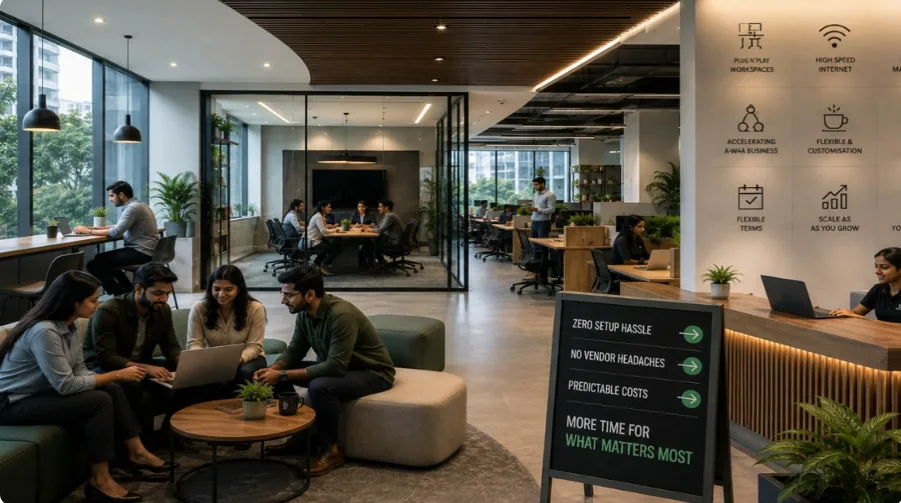
Natural light, comfortable work areas, reliable infrastructure, meeting-room access and spaces for informal conversations can all influence how employees use the office.
A workspace should support different kinds of work.
Some employees need quiet environments for focused tasks.
Others spend much of their day collaborating.
Managers need private areas.
Teams need places where short conversations can happen without booking a formal meeting.
A good managed office balances these requirements rather than designing the entire workplace around one style of working.
What Should Businesses Check Before Choosing a Managed Office?
Before making a decision, companies can ask a few practical questions.
What exactly is included?
Clarify internet, furniture, utilities, housekeeping, security and facilities support.
How reliable is the infrastructure?
Understand internet backup and how maintenance issues are handled.
Does the location work for employees?
Map employee commute patterns and public-transport access.
Are there enough meeting spaces?
Check availability, booking procedures and additional costs.
Can the workspace expand with the team?
Understand what happens if headcount increases significantly.
How much privacy does the business need?
Consider client meetings, HR conversations, leadership discussions and confidential work.
What are the commercial terms?
Review deposits, notice periods, minimum commitments and other conditions carefully.
These questions help businesses compare managed offices based on their operating requirements rather than simply the appearance of the workspace.
A Modern Managed Office Should Make Work Simpler
Bengaluru recorded 15.1 million sq. ft. of office leasing between January and September 2025, according to a CBRE India report.
For an individual business, however, the most important question is not how much office space the city is leasing.
It is whether the workspace supports the way its people need to work.
A good managed office should reduce setup effort, handle everyday facility requirements and provide the privacy and flexibility a growing organisation needs.
Whether a company chooses Indiranagar, MG Road or another Bangalore business location, the objective should remain the same:
The office should make running the business easier, not become another business to run.