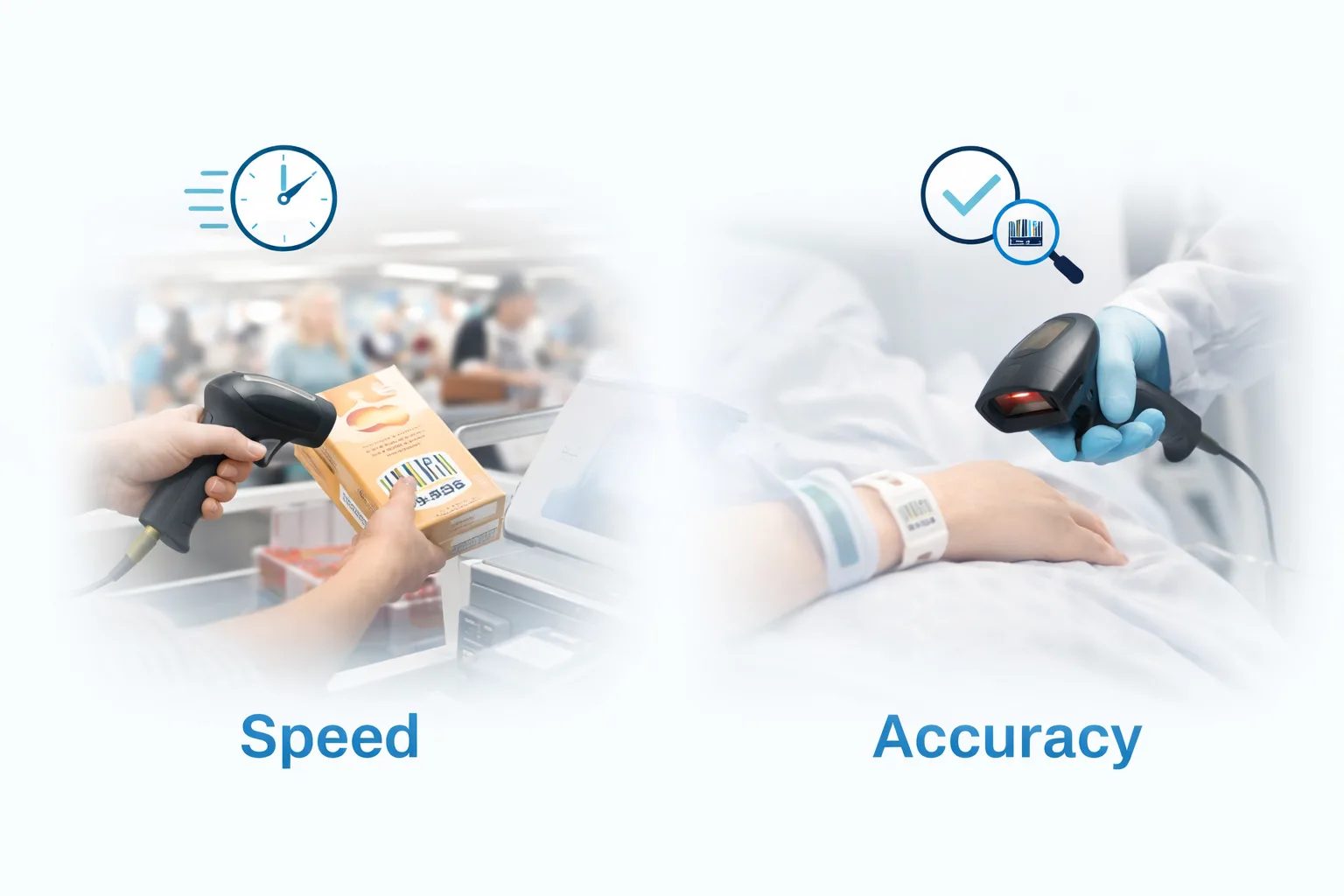
Efficiency and precision remain at the core of the debate over data capture in modern enterprise workflows.
Since the 1970s, barcodes have revolutionized supply chains, retail, and healthcare. According to GS1, over 6 billion barcode scans occur daily. Given this scale, businesses must regularly evaluate their data-capture systems. The central question is whether to prioritize scan speed or lookup accuracy, which depends on your operational environment and the costs of inefficiency.
Key Takeaways for Evaluating Scanning Priorities
The following points can help guide your evaluation.
- Scan speed is essential in high-volume workflows to reduce bottlenecks and lower labor costs.
- Lookup accuracy prevents errors, safeguards inventory integrity, and is mandatory in critical sectors such as healthcare.
- False positives, or misreads, often result in greater financial losses than minor delays in scanning speed.
- Environmental factors such as poor lighting, damaged labels, and awkward angles can compromise both speed and accuracy.
- Modern enterprises address these challenges by using commercial-grade barcode scanner SDKs with advanced algorithms for rapid processing and accurate decoding.
The Need for Speed: When Milliseconds Matter
In high-volume environments, barcode scanning speed directly determines productivity and throughput.
In large logistics centers during peak season, even a delay of a few hundred milliseconds per scan can accumulate quickly. Slow hardware or inefficient software leads to bottlenecks, missed deadlines, and increased labor costs.
Speed is also crucial in consumer-facing environments. In retail, efficient checkouts improve customer satisfaction, while delays from repeated scans can cause long lines, cart abandonment, and harm brand reputation. Speed includes code registration, barcode detection, data decoding, and database lookup. Fast scanning supports seamless workflows and operational efficiency.
The Demand for Accuracy: When Errors Cost More Than Time
While speed maintains workflow, accuracy is vital for reliable data management and enterprise trust.
Speed without accuracy increases errors. In many industries, scanning errors, especially misreads, can have serious consequences. For example, in healthcare, a misread during patient or medication scanning poses a critical risk to patient safety. In these settings, absolute accuracy is both a regulatory and ethical requirement.
In warehousing and inventory management, accuracy directly affects profitability. Retail inventory distortion, including shrinkage, stockouts, and overstock, costs the global industry billions each year. If a scanner misreads a digit due to a damaged label or poor decoding, the system logs the wrong item, creating phantom inventory. This leads to unfulfilled orders or unnecessary replenishments. The time spent auditing inventory, correcting errors, and processing returns far exceeds any time saved by a faster but less accurate scan. Accuracy ensures your digital records match physical inventory.
The Hidden Challenges in Real-World Scanning
The effectiveness of scanning technology is best evaluated in real-world environments, where theoretical performance often falls short.
In controlled settings, most scanners achieve both speed and accuracy. However, field operations introduce challenges like reflective materials, curved surfaces, shrink wrap, damage, smudges, fading, and inconsistent lighting.
These environmental factors often force trade-offs in legacy systems. A system optimized for speed may quickly reject a damaged code, requiring manual entry of a 13-digit number and negating any speed advantage. Conversely, a system that struggles with accuracy may freeze or take several seconds to process a faded code, frustrating users.
Speed vs. Accuracy: A Comparative Analysis
To better understand these trade-offs, consider a direct comparison of how speed and accuracy affect various business areas.
Operational Metric Prioritizing Scan Speed Prioritizing Lookup Accuracy Throughput Volume Extremely high; ideal for rapid sorting. Moderate; requires precise targeting. Error Rate Higher risk of misreads or skipped items. Near-zero risk of data corruption. Cost of Failure High downstream costs (returns, inventory audits). Low downstream costs, but higher upfront time cost. User Experience Frictionless when it works, frustrating when codes are rejected. Consistent and reliable, building worker confidence. Ideal Use Case Retail checkout, parcel sorting, ticketing. Healthcare, asset tracking, high-value manufacturing.Bridging the Gap: The Role of a Robust Barcode Scanner SDK
Modern businesses no longer need to choose between speed and accuracy if they use the right technology.
The traditional divide between speed and accuracy is fading as advances in mobile computing and computer vision blur the distinction. Enterprises are moving away from costly, purpose-built hardware scanners and adopting consumer-grade smart devices, such as smartphones and tablets, equipped with robust barcode-scanning SDKs.
A high-quality barcode scanner SDK bridges this gap by leveraging advanced image processing. Before decoding, the software can automatically enhance the camera feed by adjusting contrast, sharpening edges, and compensating for glare or low light. Modern SDKs use predictive algorithms to instantly locate multiple barcodes in a single frame, even at extreme angles or from a distance.
These software solutions also feature robust error-correction capabilities, allowing accurate reconstruction and reading of barcodes that are ripped, wrinkled, or partially obscured. By leveraging optimized software that uses the device’s CPU and GPU, businesses achieve enterprise-grade accuracy without sacrificing rapid, point-and-shoot speed. This ensures a seamless workflow in which workers do not need to pause, precisely align the camera, or manually enter data, while maintaining both operational speed and data integrity.
Conclusion: Achieving the Perfect Balance
Ultimately, the debate between speed and accuracy is about finding the right balance for your specific workflow.
While speed drives throughput and accuracy, prioritizing one over the other creates operational challenges. Enterprises must assess their unique pain points, such as slow checkouts or inventory discrepancies. By investing in advanced software that intelligently processes visual data, companies can equip their teams with tools that are both fast and precise, transforming data capture into a competitive advantage.