Introduction
The charitable giving sector has spent years focused on donor acquisition — optimizing landing pages, simplifying checkout flows, and expanding payment options. What received far less attention was the question sitting underneath all of it: how does a donor actually know the organization they’re giving to is legitimate?
That question has become harder to answer as donation platforms scale and the volume of nonprofits registered across jurisdictions grows. The IRS alone maintains records for over 1.8 million tax-exempt organizations in the United States. Add international charity registries, state-level solicitation filings, and the informal giving infrastructure that emerged during COVID-era fundraising surges, and the verification landscape becomes genuinely complicated. Platform operators are no longer dealing with a manageable list — they’re dealing with a data problem.
The response, slowly but visibly, has been to treat trust verification not as a compliance checkbox but as infrastructure.
Why Trust Systems Are Becoming Infrastructure
The shift is partly practical and partly driven by liability exposure. Fundraising platforms that host third-party campaigns have learned, sometimes painfully, that their brand absorbs the reputational damage when a fraudulent or misrepresented campaign gains traction. When GoFundMe or a workplace giving tool facilitates a donation to an organization that turns out to be defunct or ineligible, the platform is the visible party — not the data gap that enabled the transaction.
This is pushing a quiet but significant architectural change. Rather than displaying a nonprofit’s status as a static label sourced from a one-time data import, platforms are beginning to treat charitable eligibility as a live, queryable signal. The model looks less like a database field and more like a financial compliance check — a continuous state that can change and needs to be validated at or near the point of transaction.
The analogy to payment infrastructure is instructive. Fraud detection in payments doesn’t run once during account creation and then trust the result forever. It runs continuously, drawing on signals that can shift in real time. Nonprofit verification is heading toward a similar posture, at least among platforms serious about the problem.
The Manual Verification Problem
For most of the past decade, nonprofit verification on donation platforms worked like this: an organization submits documentation, a staff member reviews it, a determination is made, and the organization is approved. This works reasonably well when the platform serves a bounded, relatively stable set of nonprofits. It falls apart at scale, and it fails in a specific way — it creates a gap between the moment a nonprofit’s status changes and the moment that change is reflected in the platform.
That gap has real consequences. An organization can lose its 501(c)(3) status for failure to file annual returns, engage in prohibited political activity, or dissolve entirely — and remain listed as an active, donatable entity on platforms that haven’t refreshed their data. Donors who give to these entities may lose tax deductibility without knowing it. Platforms face potential regulatory scrutiny for facilitating charitable contributions to ineligible organizations.
The manual approach also doesn’t scale horizontally. Workplace giving platforms that list hundreds of thousands of organizations, or international platforms that span multiple charity registries, cannot reasonably staff verification at that volume. The only way to manage it is automation — and automation requires reliable, structured data sources with defined freshness guarantees.
API Architecture and the Data Freshness Problem
Building automated nonprofit verification is, at its core, a data pipeline problem. The primary sources — IRS Publication 78, the IRS Business Master File, state charity registrations, Charity Commission records in the UK, and similar registries globally — are maintained on different schedules, expose data in different formats, and have their own update cadences and access patterns.
The IRS updates its exempt organization data with some regularity, but the cadence isn’t real-time, and the raw files require non-trivial parsing. State-level data is more fragmented still — some states publish structured data via APIs, others offer CSV downloads, and a handful still require screen scraping or manual retrieval. Any platform building on top of this has to manage heterogeneous sources, handle inconsistencies, and make explicit decisions about how stale is too stale.
Several third-party services have emerged to address this by aggregating and normalizing the underlying registries behind a unified API layer. The model is similar to how credit reporting aggregators work — they assume the complexity of source data management and expose a cleaner interface to downstream consumers. Pactman’s NonprofitCheck Plus API is one example of this pattern, providing structured verification data to platform developers without requiring each one to independently manage registry integrations.
The architecture question for platforms becomes: how deeply should verification integrate with the transaction flow? Options range from batch validation against a nightly data refresh, to synchronous API calls at the point of donation, to asynchronous post-processing with holds on disbursements pending verification results. Each has different latency implications, cost profiles, and risk tradeoffs. The right answer depends on the platform’s scale, the sensitivity of its use case, and how aggressively it wants to gate against stale data.
Real-World Implementation Observations
Talking to developers who have built these systems surfaced a few consistent pain points. The first is EIN collision and data quality. The Employer Identification Number is the primary identifier for U.S. nonprofits, but EINs get recycled, organizations file under multiple names, and subsidiary entities can share an EIN with a parent in ways that create ambiguous records. Any verification system needs logic for handling these cases — a naive EIN lookup will produce incorrect results in meaningful edge cases.
The second is the problem of organizationally valid but operationally suspended entities. An organization can be technically registered and maintain a valid EIN while being in arrears with state filing requirements, having lost good standing in their state of incorporation, or facing active IRS scrutiny. Raw status fields from registry data often don’t surface this nuance. Platforms building trust signals need to decide how granular their status modeling needs to be — and whether they’re optimizing for catching outright fraud or also for the greyer category of organizations in administrative limbo.
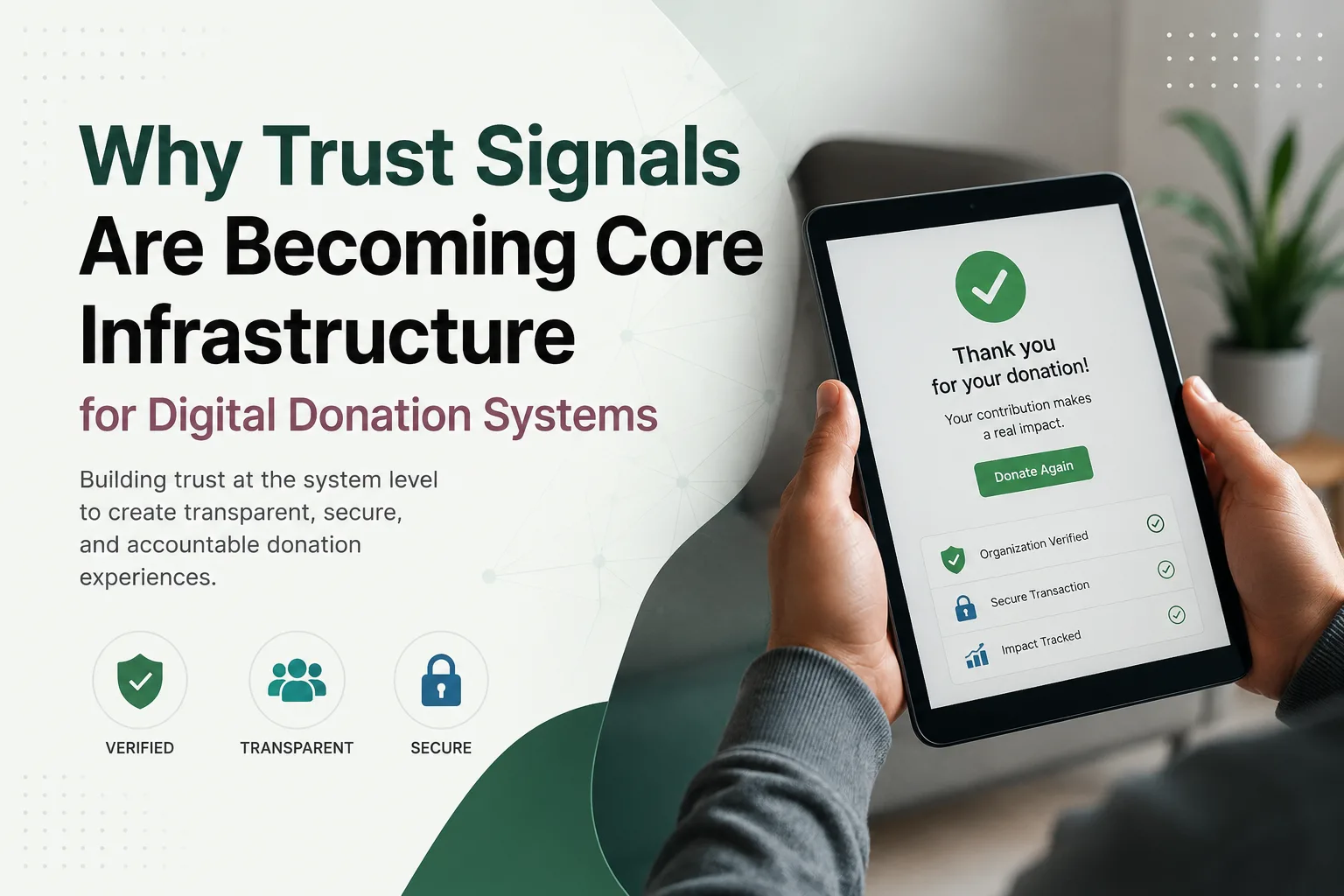
The third observation is about donor-facing presentation. Even platforms that have invested in verification infrastructure often struggle with how to present the resulting signals to donors without either overwhelming them with compliance detail or flattening meaningful distinctions into a single green checkmark. Users want signal, not noise — but the underlying status is genuinely complex. Getting this right requires product thinking as much as technical architecture.
Future Implications
The trajectory points toward verification becoming a baseline expectation rather than a differentiator. Regulatory pressure is part of this — the FTC has taken increased interest in charitable solicitation fraud, and several states have strengthened their charity registration enforcement in recent years. As scrutiny increases, platforms that cannot demonstrate they have verification infrastructure in place will face uncomfortable questions.
There’s also a likely consolidation of the underlying data layer. Right now, the ecosystem has multiple overlapping sources — IRS data, GuideStar/Candid, proprietary aggregators, state registries — with varying coverage and quality. Market pressure will probably push toward fewer, better-integrated sources with clearer freshness guarantees and standardized schema. What the financial sector did with credit data over several decades, the nonprofit data ecosystem is beginning to do now, albeit more slowly.
Machine learning will play a limited but real role. Behavioral signals — donation velocity, new organization registration spikes, mismatches between stated purpose and solicitation content — can supplement registry-based verification in ways that catch fraud that clean records don’t. Several platforms are already experimenting with anomaly detection layered on top of static verification data.
Conclusion
The charitable giving space is at a point where the technical foundations for trust infrastructure are available, the business case is becoming clear, and the regulatory environment is tilting in the direction of requiring it. The organizations building donation platforms now have the tools to do this properly — not as a one-time audit process, but as continuous, query-driven architecture integrated into the giving flow itself.
The harder work is organizational: deciding that verification deserves engineering resources, building the data pipeline discipline to maintain it, and designing user-facing experiences that make trust legible without making it friction. That’s a product and engineering challenge as much as a data one — and it’s where the meaningful differentiation in this space will be built over the next several years.