Introduction
Scroll through any list of trending ERP skills and Oracle Fusion Financials almost always appears near the top, but the reasons behind that ranking rarely get explained in much depth. Soft Online Training has spent considerable time studying what's actually driving this platform's staying power in the ERP skills conversation, and the answer isn't just marketing momentum there are concrete, structural reasons why this particular skill set has climbed so consistently rather than fading like plenty of other trending technologies eventually do.
It Solves a Real, Widespread Business Problem
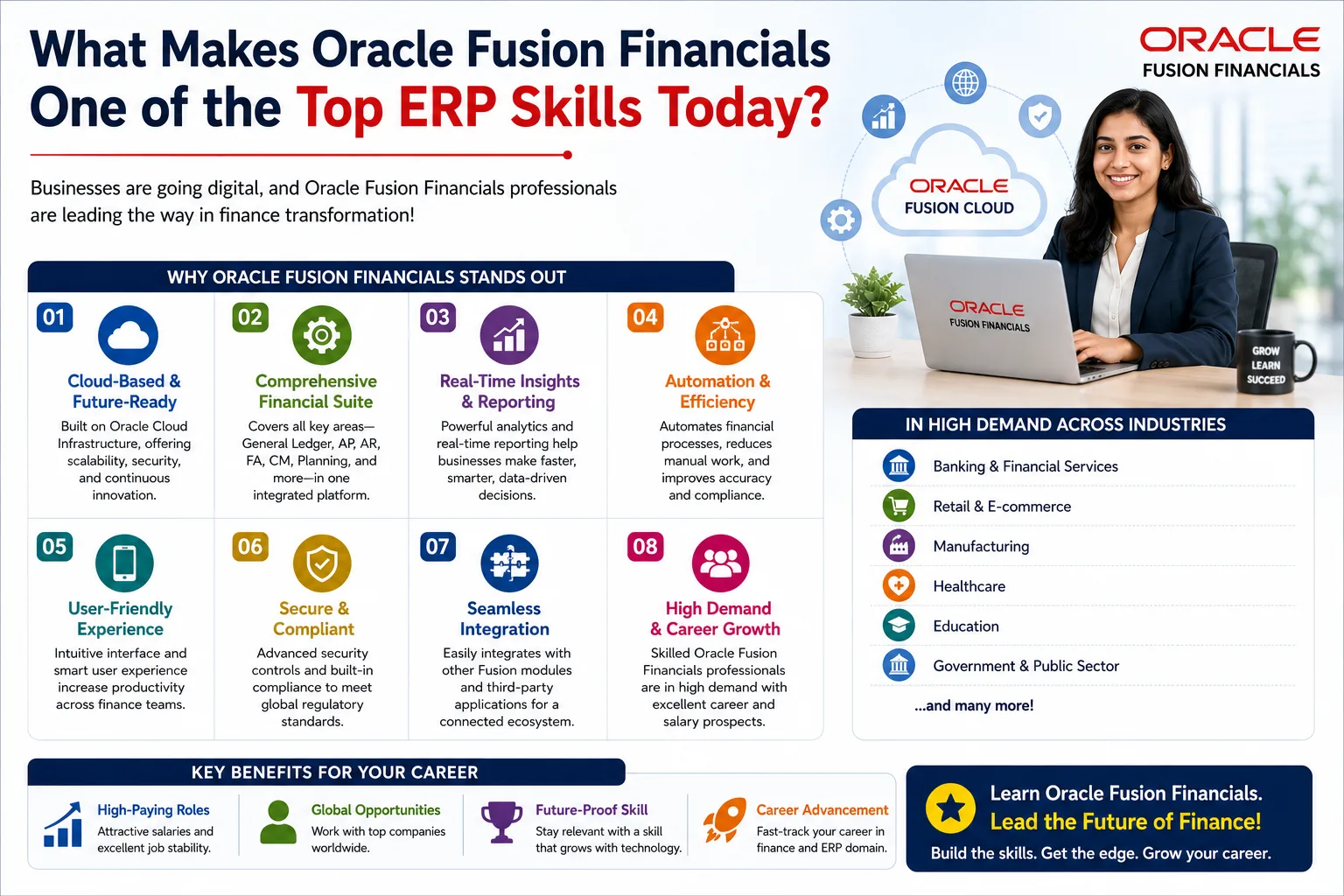
At its core, Oracle Fusion Financials Online Training addresses a problem nearly every mid-sized to large organization eventually faces: aging, disconnected financial systems that can't keep pace with modern reporting expectations. Because this is a genuinely universal business challenge rather than a niche one, the demand for people who can implement and manage the solution extends across industries, geographies, and company sizes in a way many narrower ERP skills simply don't.
Cloud-Native Architecture Gives It Real Staying Power
Unlike platforms that were retrofitted for the cloud after years of on-premise design, Fusion Financials was built cloud-native from the start. This matters for the skills conversation because it means the platform evolves through continuous updates rather than disruptive, multi-year overhauls that eventually make existing skills obsolete overnight. Professionals who build expertise here aren't learning something with a built-in expiration date tied to a major version replacement cycle.
The Talent Gap Keeps the Skill Genuinely Valuable
A skill only stays "top" if demand consistently outpaces supply, and that's precisely the situation with Fusion Financials right now. Plenty of professionals understand accounting fundamentals; plenty understand ERP systems broadly. Far fewer combine both areas with real depth, and that scarcity is exactly why a properly built Oracle Fusion Financials Course continues attracting strong enrollment the underlying skill gap hasn't closed, and there's no clear sign of it closing anytime soon.
It Sits at the Center of Digital Finance Transformation
As companies push toward automated, real-time financial operations, Fusion Financials frequently ends up as the platform actually running that transformation behind the scenes. This positions the associated skill set at the center of a much larger shift in how finance departments operate, rather than being a peripheral or optional add-on skill. Professionals with genuine expertise here aren't just learning a tool they're positioning themselves inside one of the more significant structural shifts happening in enterprise finance right now.
Automation and AI Features Keep Expanding the Skill's Depth
Oracle continues layering in more sophisticated automation and AI-driven capabilities predictive forecasting, intelligent transaction matching, anomaly detection which keeps expanding what "expertise" in this platform actually requires. Rather than plateauing into a static, fully-learned skill, Fusion Financials expertise keeps growing in scope, which naturally sustains ongoing demand for professionals willing to keep building their knowledge through continued Oracle Fusion Financials Online Training rather than stopping after an initial certification.
Consulting Demand Adds a Second Growth Track
Beyond direct enterprise hiring, consulting firms have scaled up their Fusion Financials practices considerably, since clients frequently need external expertise during implementations and ongoing system optimizations. This consulting layer adds an entirely separate growth track on top of standard enterprise hiring, which is part of why demand for this skill keeps expanding across two parallel channels rather than relying on a single hiring source.
Remote-Friendly Work Has Widened Who Can Build This Skill
Because Fusion Financials implementation and support work doesn't require being physically present in a specific office, the pool of people who can realistically pursue this specialization has widened considerably. Flexible learning formats have made this even more accessible, since professionals no longer need to relocate or attend rigid in-person sessions to build real expertise.
Why Structured Learning Matters for Staying Genuinely Competitive
Given how many overlapping areas now fall under "Fusion Financials expertise" core configuration, automation, reporting, integrations, and tax piecing this together through scattered, self-directed study has become genuinely inefficient. A properly sequenced Oracle Fusion Financials Online Training program addresses this directly, covering these areas in a logical order so foundational skills are solid before moving into more specialized, higher-value capabilities.
Is This Growth Sustainable, or Just a Temporary Wave?
All the underlying signals point toward sustainability rather than a passing trend. The migration wave toward cloud ERP isn't slowing down, the platform's continuous-update model keeps it relevant longer than legacy systems, the talent gap remains wide, and both direct enterprise hiring and consulting demand continue growing in parallel rather than competing over a shrinking pool of opportunities.
The Bottom Line
Oracle Fusion Financials holds its place among the top ERP skills today because it solves a genuinely widespread business problem, sits on cloud-native architecture built for longevity, and continues expanding in scope faster than the available talent pool can keep pace. Building real expertise through a solid Oracle Fusion Financials Online Training or Oracle Fusion Financials Course isn't chasing a passing trend it's positioning yourself inside one of the more durable, structurally-supported growth areas in enterprise technology right now.